
Overview
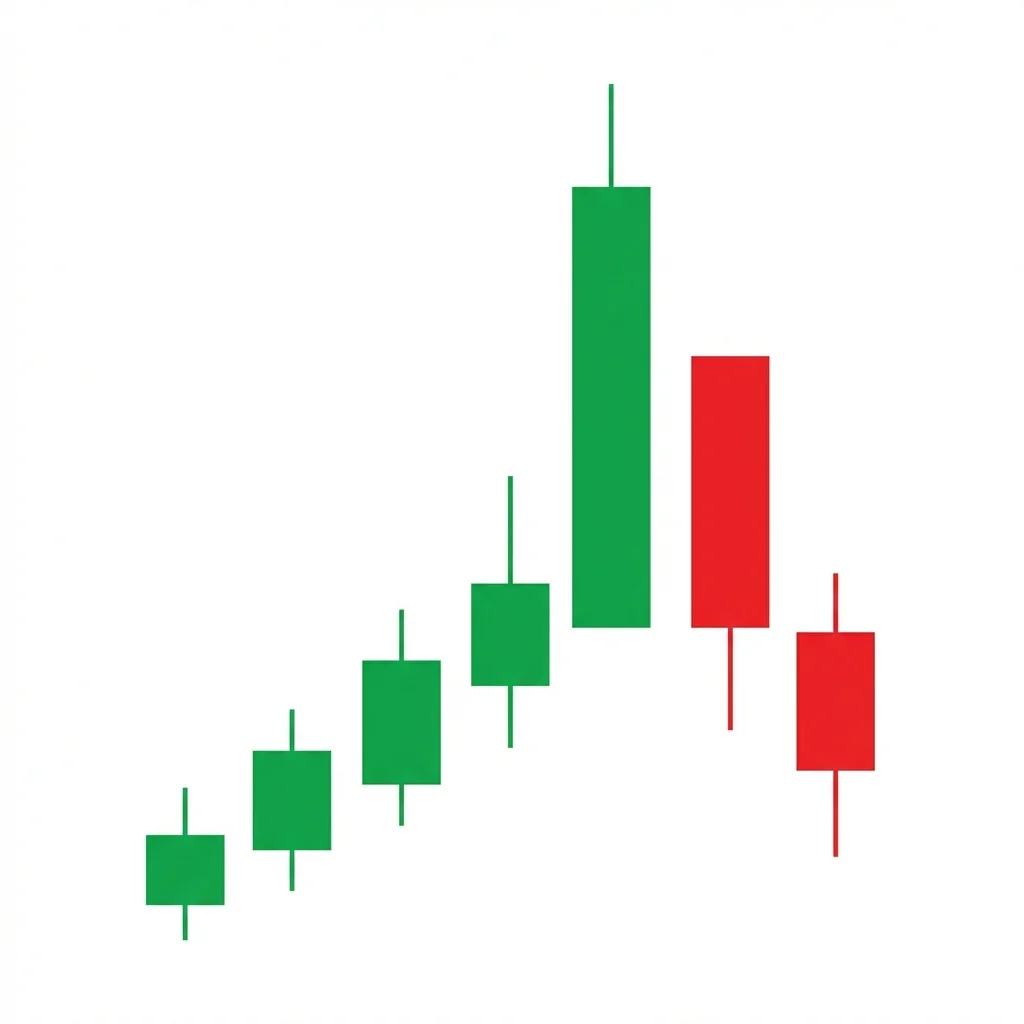
Bearish Counterattack Line
Deai Sen (Bearish)
Also known as: Counterattack Bearish, Meeting Line Bearish, Bearish Counterattack
The Bearish Counterattack Line features a bullish candle followed by a bearish candle that gaps up at the open but closes back to the same level as the first candle's close, signaling that sellers 'counterattacked' the bullish advance.
The Bearish Counterattack Line is a two-candle reversal pattern that occurs during an uptrend. The first candle is a strong bullish candle confirming the trend. The second candle opens with a gap up (even more bullish at first glance), but then sellers drive the price down throughout the session, closing at or very near the same closing price as the first candle. The matching closes are the signature feature. This pattern tells us that despite an even more bullish open, sellers were able to push price all the way back to the previous close — a 'counterattack' that neutralizes the bullish advance. While similar to the Dark Cloud Cover, the key difference is that the Counterattack Line closes at the first candle's close rather than penetrating into its body. This makes it a slightly weaker signal than the Dark Cloud Cover.
History & Etymology
The Counterattack Line is part of the classical Japanese candlestick lexicon. In Japanese, 'Deai Sen' means 'meeting line,' describing how the two candles' closes meet at the same level. The pattern was recognized by Japanese rice traders as a sign that the balance of power was shifting.
The name 'counterattack' describes the sellers' aggressive response to the gap-up open. Despite bulls opening the market higher, bears launch a counterattack that drives price all the way back to the previous close, achieving a stalemate. The Japanese name 'Deai Sen' means 'meeting line' — the two closes 'meet' at the same price.
How It Forms
Formation Steps
- 1First candle: a long bullish candle in an uptrend
- 2Second candle: a long bearish candle that opens above the first candle's close (gaps up) and closes at or very near the first candle's close
Prerequisites
- Established uptrend
- The first candle must be a strong bullish candle
- The second candle must gap up at the open and then close back to the first candle's close level
- Both candles should have long bodies
Confirmation Signals
- Third candle closes below the counterattack close level
- Volume increases on the second candle
- Bearish follow-through on the next session
- Break below the second candle's low
Invalidation Signals
- Price rallies above the second candle's open/high
- Third candle closes above the matching close level
- Low volume on the second candle
Candle Breakdown
Bullish Trend Candle
A long bullish candle that continues the uptrend, demonstrating strong buying momentum.
Bulls are confident. The strong close reinforces the uptrend narrative and encourages further buying.
Counterattack Candle
A long bearish candle that opens above the first candle's close (gap up) and closes at or very near the first candle's close.
The gap up creates euphoria, but sellers immediately take control. The entire gap and more is erased during the session. Closing at the first candle's level shows sellers exactly matched the bulls' progress, creating a battlefield stalemate.
Psychology
The Counterattack Line demonstrates that sellers can match the buying power even when given a head start (the gap up). The meeting of closes represents a psychological stalemate that often resolves bearishly.
Buyer Perspective
Buyers are initially excited by the gap up, which seems to confirm the uptrend. But as the session progresses and price falls back to the previous close, their enthusiasm turns to concern. The bulls achieved nothing despite a favorable opening.
Seller Perspective
Sellers see the gap up as an opportunity to sell at higher prices. Their selling is so aggressive that it erases the entire gap and more, driving price back to the previous close. This demonstrates significant selling power.
Smart Money Action
Institutions use the gap up to begin distribution. The gap-up open attracts retail buyers who they sell into. By the close, institutional selling has fully absorbed the retail demand.
Retail Trader Trap
Retail traders buy the gap up, expecting continuation. By the close, they are at breakeven or slightly underwater. The lack of progress despite a bullish start creates doubt.
Emotional Cycle
Trading Strategy
Aggressive Entry
Short at the close of the second candle when the matching close is confirmed.
Conservative Entry
Wait for a third candle to close below the matching close level.
Nearest support level.
The length of the second candle's body projected downward.
Previous swing low.
Best Conditions
- Timeframe: daily
- Timeframe: weekly
- Timeframe: 4h
- at resistance
- after extended uptrend
- overbought conditions
- Asset: stocks
- Asset: forex
- Asset: indices
Avoid When
- Timeframe: 1m
- Timeframe: 5m
- strong breakout momentum
- early-stage uptrend
Confluence Factors
- Pattern forms at a resistance level
- RSI bearish divergence
- The gap up was on weak catalyst
- Volume increases on the counterattack candle
- Higher timeframe shows resistance
Scale In Strategy
Enter 50% at the second candle close, add 50% on confirmation.
Scale Out Strategy
Take 50% at first support, trail the rest.
Risk Management
Volume Analysis
Volume Confirmation
Higher volume on the second candle than the first confirms the counterattack's significance.
Volume Profile
Ideal: high volume first candle, even higher on the second. This shows sellers stepping up.
Volume Divergence
Declining volume through the uptrend before the pattern strengthens the reversal case.
Technical Confluence
Support Resistance
The matching close level becomes a key pivot point. A break below it is bearish; a hold above it may negate the pattern.
Fibonacci Levels
The pattern at a Fibonacci extension level adds significance.
Moving Averages
The counterattack candle closing back below a recently broken moving average (e.g., 20 EMA) adds bearish weight.
Rsi Confirmation
RSI turning down from above 65-70 at the time of the pattern adds confirmation.
Macd Confirmation
MACD histogram declining or a bearish crossover aligns with the counterattack signal.
Bollinger Bands
The gap-up open above the upper band with the close back inside is a mean-reversion confirmation.
Vwap
On intraday charts, the second candle closing below VWAP after opening above it shows the session's counterattack.
Ichimoku Cloud
Pattern above the cloud with the second candle showing rejection adds confluence.
Elliott Wave
Can appear at the end of Wave 5 or the peak of an ABC correction.
Wyckoff Phase
Aligns with early distribution — the gap up is the Upthrust, the close back is the failure.
Market Profile
The gap-up open into a low-volume area that immediately fills back shows poor price acceptance at higher levels.
Order Flow
Delta turning negative after a positive open confirms institutional selling absorbed the gap-up buying.
Open Interest
Flat or declining OI on the gap up followed by rising OI on the decline suggests new shorts.
Multi-Timeframe Analysis
Higher Timeframe Alignment
A daily Counterattack Line at weekly resistance adds conviction.
Lower Timeframe Entry
After the daily pattern, use the 1H chart for precise entry timing.
Timeframe Confluence
The pattern is most powerful on weekly charts where the gap-up and close-back represents an entire week of activity.
Top-Down Approach
Weekly: resistance. Daily: Counterattack Line. 4H: entry refinement.
Statistics
Historical Examples
JP Morgan (JPM) Counterattack Line
successJPM gapped up after earnings but sold off throughout the session, closing right at the previous day's close. The stock fell 10% over the following two weeks.
Lesson: Earnings gap-ups that close back to the prior level are classic counterattack patterns. The market 'counterattacked' the bullish earnings reaction.
Variations
Near Counterattack Line
The closes are close but not exactly matching — within 0.5% of each other.
Confusion Matrix
Patterns commonly confused with Bearish Counterattack Line and how to distinguish them.
Bearish Dark Cloud Cover
8000% similarCheck where the second candle closes relative to the first candle. If it penetrates the body past the midpoint, it is a Dark Cloud Cover. If it closes at the first candle's close level, it is a Counterattack Line.
Key Differences
- Dark Cloud Cover closes INTO the first candle's body (below the midpoint)
- Counterattack Line closes AT the first candle's close (not into the body)
- Dark Cloud Cover is a stronger signal
The Dark Cloud Cover is a two-candle bearish reversal pattern where a bearish candle opens above the prior bullish candle's high and closes below its midpoint, signaling that the bullish 'sky' is being covered by a bearish 'dark cloud.'
The Bearish Engulfing is one of the most powerful and commonly traded two-candle reversal patterns. A large bearish candle completely engulfs the prior bullish candle, demonstrating a decisive shift from buying to selling dominance.
The shooting star is a single-candle bearish reversal pattern with a small body near the low and a long upper shadow. It shows that buyers pushed price significantly higher during the session but sellers drove it back down, signaling a potential top.
The Bullish Counterattack Line is a two-candle reversal where a gap-down bullish candle rallies to close at exactly the same level as the previous bearish candle close, showing that buyers have matched sellers point for point.
The Confirmed Shooting Star adds a bearish confirmation candle to the classic shooting star, eliminating the ambiguity of the standalone pattern and creating a higher-probability reversal signal at the top of uptrends.
The Bearish Doji Star is a two-candle reversal pattern featuring a strong bullish candle followed by a doji that gaps above it, signaling that buying momentum has stalled and indecision has replaced conviction at the top of an uptrend.
Pro Tips & Common Mistakes
Pro Tips
- The matching closes must be precise — a tolerance of 0.1-0.3% is acceptable, but a larger gap weakens the pattern.
- The second candle should ideally have a larger body than the first, showing sellers had even more energy than buyers.
- This pattern is weaker than the Dark Cloud Cover. Use it as a warning signal and combine with other factors before trading.
- The pattern is most relevant when the gap up was driven by a weak catalyst (not a major fundamental change).
Common Mistakes
- Confusing the Counterattack Line with the Dark Cloud Cover — the close position is different.
- Trading the pattern without confirmation in a strong uptrend.
- Not checking if the second candle actually opened above the first candle's close (the gap up is required).
- Ignoring the body sizes — both candles should have long bodies for the pattern to be valid.
Advanced Techniques
- Use the matching close level as a pivot for future trades — it often acts as support/resistance.
- In options, the Counterattack Line is a signal to sell covered calls if you are long the underlying.
- Combine with market breadth — a Counterattack Line on an index while breadth narrows is more significant.
Institutional Perspective
Institutions recognize the gap-up close-back pattern as a distribution signal. The gap up provides the liquidity needed to sell, and the close back shows their selling absorbed all the buying pressure.
Fun Facts
- The Counterattack Line is one of the most poetically named patterns — it evokes the image of a military counterattack, where one side initially gains ground but is pushed back to the starting position.
- The Japanese name 'Deai Sen' (meeting line) is more neutral, simply describing the meeting of the two closes — the Western name carries more drama.
Frequently Asked Questions
The Dark Cloud Cover's second candle closes INTO the first candle's body (past the midpoint). The Counterattack Line's second candle closes AT the first candle's close level — it does not penetrate the body. The Dark Cloud Cover is a stronger reversal signal.
Yes. The gap up at the open is a required element. Without the gap, the pattern is simply a bearish candle following a bullish candle, which does not have the same significance.