
Overview
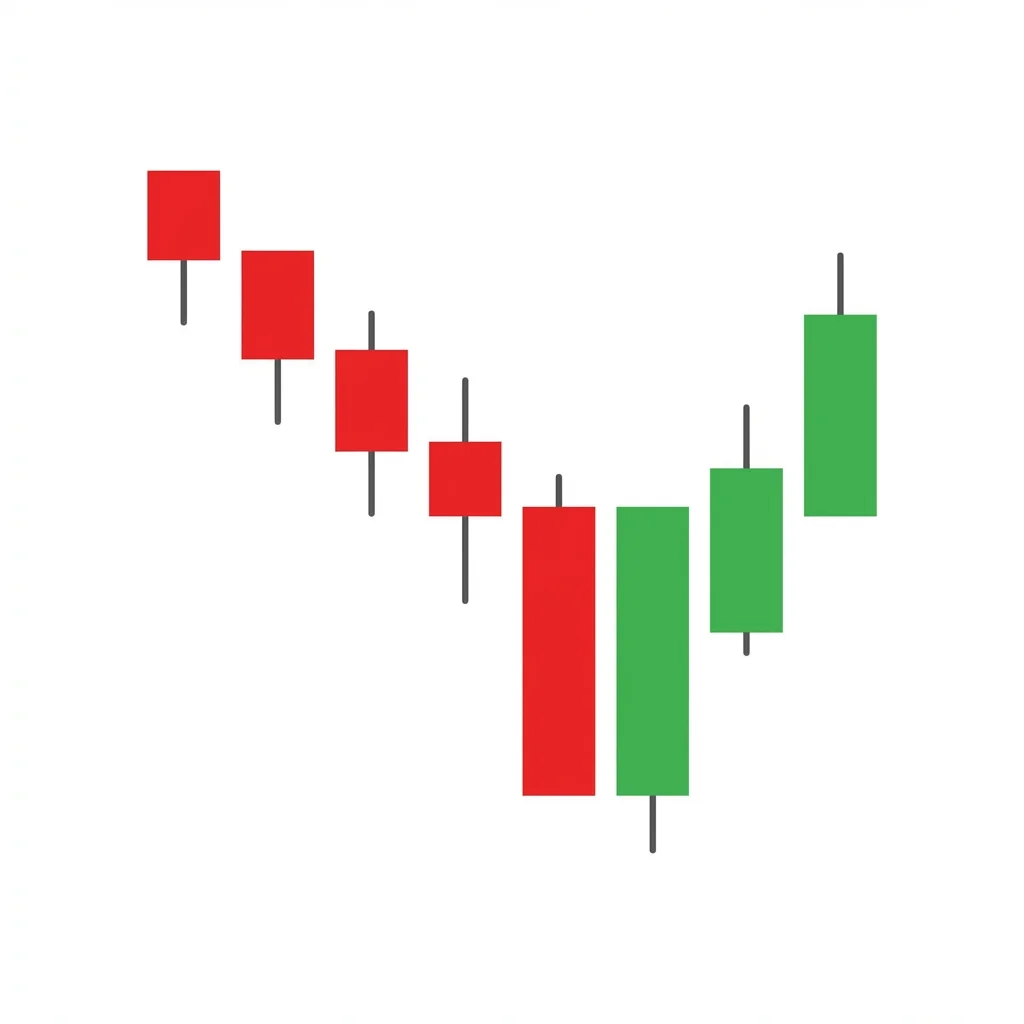
Bullish Counterattack Line
Deai Sen
Also known as: Meeting Line, Counterattack Bullish, Bullish Meeting Lines
The Bullish Counterattack Line is a two-candle reversal where a gap-down bullish candle rallies to close at exactly the same level as the previous bearish candle close, showing that buyers have matched sellers point for point.
The Bullish Counterattack Line forms when the second candle gaps down significantly at the open (continuing the bearish momentum) but then stages a powerful intraday rally to close at the same price level as the previous bearish candle close. The matching closes represent a standoff where buyers have completely counterattacked the sellers advance. Unlike the piercing line which closes above the midpoint of the first candle, the counterattack line specifically closes at the same level as the first candle close. This precise matching shows that buyers have drawn a line in the sand.
History & Etymology
Known as Deai Sen (meeting line) in Japanese, this pattern was documented in classical Japanese candlestick analysis. The meeting of the two closes was seen as a significant event where opposing forces meet head-on.
Counterattack refers to the bulls fighting back after the bears gap price lower. The line refers to the matching close level where the two opposing forces meet. The Japanese name Deai Sen means meeting line, referring to the two closes meeting at the same price.
How It Forms
Formation Steps
- 1First candle: long bearish candle continuing the downtrend
- 2Second candle: long bullish candle that opens sharply lower (gap down) but rallies to close at or very near the same level as the first candle close
Prerequisites
- Established downtrend
- The second candle must open with a significant gap down
- Both candles should be long-bodied
Confirmation Signals
- Third candle closes above the shared close level
- Volume increases on the second candle
- Follow-through buying continues
Invalidation Signals
- Price falls below the second candle low
- No follow-through on the third session
- Volume is weak on the second candle
Candle Breakdown
Bearish Advance
A long bearish candle extending the downtrend.
Bears push prices lower with conviction. The close sets the level that will become the counterattack target.
Counterattack
A long bullish candle opening lower but rallying to close at the first candle close level.
Bears appear to win with the gap down, but bulls mount a fierce counterattack throughout the session, recovering all losses to reach the exact same close.
Psychology
The counterattack line shows a dramatic power shift within a single session. Despite a bearish gap open, buyers completely reverse the session to match the prior close, demonstrating that their resolve matches or exceeds the sellers.
Buyer Perspective
Buyers see the gap down as an opportunity. Their aggressive buying throughout the session brings price back to exactly where sellers left it, proving their strength.
Seller Perspective
Sellers initially feel vindicated by the gap down but watch helplessly as all their progress is erased during the session.
Smart Money Action
Institutions execute large buy programs during the gap-down open, absorbing panic selling at depressed prices and driving the recovery.
Retail Trader Trap
Retail sellers who panicked on the gap down sold at the worst prices. Shorts who entered on the gap find themselves in immediate pain.
Emotional Cycle
Trading Strategy
Aggressive Entry
Enter long at the close of the second candle when it reaches the first candle close level.
Conservative Entry
Wait for a third candle to close above the matching close level for confirmation.
At the open of the first bearish candle.
At the prior swing high before the downtrend.
Measured move equal to the second candle range projected upward.
Best Conditions
- Timeframe: daily
- Timeframe: weekly
- After gap-down events in uptrends
- At major support levels
- During oversold conditions
- Asset: stocks
- Asset: futures
Avoid When
- Timeframe: 1m
- Timeframe: 5m
- In strong bear markets
- During fundamental deterioration
Confluence Factors
- Pattern at support
- Oversold RSI
- Volume confirmation
- Sector showing similar recovery
Scale In Strategy
Enter 50% on the counterattack close, add 50% on third candle confirmation.
Scale Out Strategy
Take 50% at the first target, trail the rest.
Risk Management
Volume Analysis
Volume Confirmation
Volume on the second candle should be above average, showing genuine buying conviction.
Volume Profile
Heavy buying volume during the latter half of the second candle session.
Volume Divergence
Low volume on the counterattack suggests a weak rally and potential failure.
Technical Confluence
Support Resistance
Most effective at established support levels where the counterattack has extra significance.
Fibonacci Levels
The matching close at a Fibonacci level adds confluence.
Moving Averages
Counterattack at a major moving average (50 or 200 SMA) is a strong signal.
Rsi Confirmation
RSI turning up from oversold territory during the counterattack candle confirms the reversal.
Macd Confirmation
A bullish MACD signal during the counterattack adds weight.
Bollinger Bands
The gap down piercing the lower band followed by recovery inside is a mean-reversion signal.
Vwap
Recovering above VWAP during the counterattack candle shows buyers reclaiming fair value.
Ichimoku Cloud
Limited significance unless at a key Ichimoku level.
Elliott Wave
May appear at the end of a corrective C wave.
Wyckoff Phase
Can serve as a spring or test event in accumulation.
Market Profile
The counterattack shows rejection of the lower value area.
Order Flow
Aggressive buying (positive delta) during the second candle confirms institutional demand.
Open Interest
New long positions being established on the counterattack candle is bullish.
Multi-Timeframe Analysis
Higher Timeframe Alignment
A daily counterattack at weekly support is the highest conviction setup.
Lower Timeframe Entry
Use 1-hour chart to watch the recovery develop during the counterattack session.
Timeframe Confluence
Daily counterattack within a weekly uptrend pullback is ideal.
Top-Down Approach
Weekly uptrend, daily identifies counterattack at support, 4-hour times entry.
Statistics
Historical Examples
Goldman Sachs Post-Earnings Counterattack
successGoldman Sachs gapped down after earnings but rallied throughout the session to close at the same level as the prior bearish close. The counterattack preceded a 15% rally over the following month.
Lesson: Earnings-driven gap-downs that are fully recovered by the close often signal that the market has already priced in the negative news.
Variations
Deep Gap Counterattack
The second candle gaps down more than 2% before recovering.
Confusion Matrix
Patterns commonly confused with Bullish Counterattack Line and how to distinguish them.
Bullish Piercing Line
7500% similarCompare the second candle close to the first candle body. Piercing line penetrates above the midpoint; counterattack matches the close exactly.
Key Differences
- Piercing line closes above the midpoint of the first candle body
- Counterattack closes at the same level as the first candle close
The Bearish Counterattack Line features a bullish candle followed by a bearish candle that gaps up at the open but closes back to the same level as the first candle's close, signaling that sellers 'counterattacked' the bullish advance.
The Bullish Engulfing is one of the most popular and reliable two-candle reversal patterns. A large bullish candle completely engulfs the prior bearish candle body, signaling a decisive shift from selling to buying control.
The Piercing Line is a two-candle bullish reversal pattern where a bearish candle is followed by a bullish candle that opens below the low and 'pierces' above the midpoint of the first candle's body, showing strong buying recovery.
The Bullish Three Inside Up is a three-candle reversal pattern that combines a bullish harami with a confirming third candle that closes above the first candle's open, providing a more reliable reversal signal than the harami alone.
The Confirmed Shooting Star adds a bearish confirmation candle to the classic shooting star, eliminating the ambiguity of the standalone pattern and creating a higher-probability reversal signal at the top of uptrends.
The Dark Cloud Cover is a two-candle bearish reversal pattern where a bearish candle opens above the prior bullish candle's high and closes below its midpoint, signaling that the bullish 'sky' is being covered by a bearish 'dark cloud.'
Pro Tips & Common Mistakes
Pro Tips
- The bigger the gap down that gets recovered, the more powerful the counterattack signal
- The closes should match within 0.1-0.3% for a valid pattern
- Volume on the counterattack candle is crucial for validation
- Best when the gap down creates initial panic that is then completely reversed
Common Mistakes
- Confusing this with the piercing line which has different close requirements
- Not requiring a significant gap down on the second candle
- Ignoring volume confirmation
- Trading on forex where gaps are uncommon
Advanced Techniques
- Use intraday charts to watch the counterattack develop and enter before the daily close
- Monitor the gap-down open volume versus the recovery volume to gauge the quality of the reversal
- Combine with options flow to see if institutional call buying accompanies the counterattack
Institutional Perspective
Counterattack lines often result from institutional buy programs triggered by gap-down events. Large funds see the gap as an opportunity to buy at a discount and their buying drives the full recovery.
Fun Facts
- The Japanese name Deai Sen literally means meeting line, poetically describing the moment two opposing forces meet at the same price.
- The counterattack line is more common in stocks than forex because it requires a gap-down open, which occurs naturally between daily stock sessions.
Frequently Asked Questions
The closes should match within a very small tolerance, typically 0.1-0.3% of the price. They do not need to be exactly identical to the penny, but they should be close enough that visually the two closes appear at the same level.
The piercing line closes above the midpoint of the first candle body, while the counterattack line closes at the same level as the first candle close. The piercing line is generally considered a stronger signal because the close penetrates further into the first candle body.