
Overview
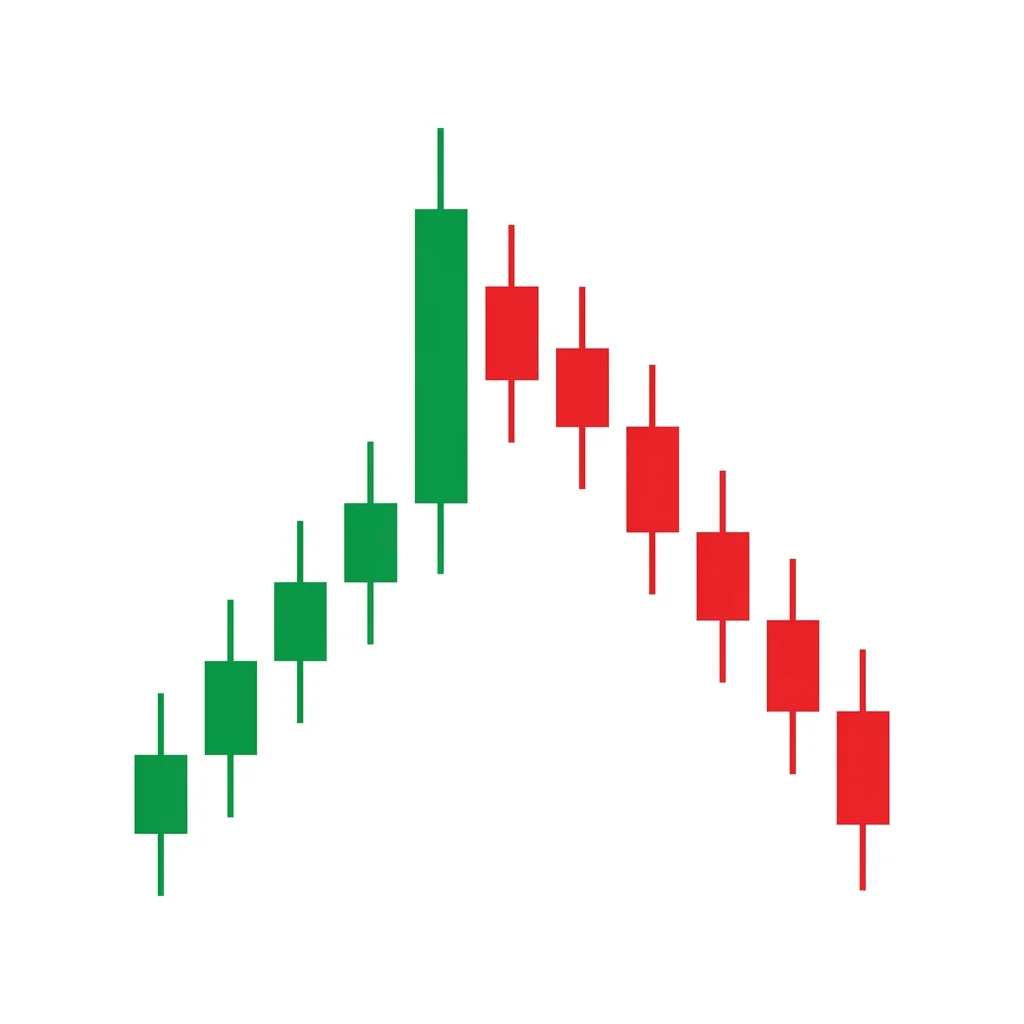
Bearish Harami
Harami
Also known as: Bearish Inside Bar, Bearish Pregnant Pattern
The bearish harami is a two-candle reversal pattern where a large bullish candle is followed by a small bearish candle entirely contained within the first candle's body. It signals waning buying momentum and potential trend reversal.
The bearish harami represents a loss of momentum in an uptrend. After a strong bullish candle, the next session opens lower and trades in a narrow range, closing below its open but still within the previous candle's body. The small second candle shows indecision and a sudden contraction in buying enthusiasm. The pattern is the mirror image of the bullish harami and is considered a moderate reversal signal that benefits significantly from confirmation. In Japanese, 'harami' means 'pregnant,' with the large first candle being the 'mother' and the small second candle being the 'baby.'
History & Etymology
The harami pattern is one of the classic Japanese candlestick formations documented in the original Sakata method. The concept of a smaller candle contained within a larger one was recognized by rice traders as a sign of market indecision and potential change in direction.
Harami (はらみ) means 'pregnant' in Japanese. The large first candle is the 'mother' and the small second candle is the 'baby' or 'fetus' contained within. The imagery suggests that something new (a reversal) is being born within the old trend.
How It Forms
Formation Steps
- 1First candle: large bullish candle in an uptrend
- 2Second candle: small bearish candle whose body is entirely within the first candle's body
- 3The second candle opens below the first candle's close and closes above the first candle's open
Prerequisites
- Established uptrend
- Large bullish candle as the first candle
Confirmation Signals
- Third candle closes below the second candle's low
- Gap down on the third candle
- Increased volume on the confirmation candle
Invalidation Signals
- Price breaks above the first candle's high
- No follow-through selling within 2-3 sessions
- Bullish candle that engulfs both harami candles
Candle Breakdown
Mother Candle
A large bullish candle representing the continuation of the uptrend. This candle has a substantial body showing strong buying pressure.
Buyers appear confident with strong participation. This candle represents the last surge of bullish conviction.
Baby Candle
A small bearish candle whose entire body fits within the body of the first candle. Opens below the prior close and closes above the prior open.
Buying momentum evaporates. The small range and bearish close show indecision and the beginning of seller participation.
Psychology
The harami pattern captures the moment when bullish momentum stalls. After a strong buying session, the next session's narrow range and bearish close signal that buyers have lost conviction and sellers are starting to test the waters.
Buyer Perspective
Buyers who drove the strong first candle expect continuation. The narrow, weak second candle creates doubt. Some early bulls begin to take profits, sensing the momentum shift.
Seller Perspective
Sellers notice the sudden loss of buying momentum and begin testing the market. The small bearish candle gives them confidence that the uptrend may be exhausting.
Smart Money Action
Institutions may begin reducing long positions after the strong first candle, creating the narrow range of the second candle. The harami signals the beginning of distribution.
Retail Trader Trap
Retail traders see the large bullish candle and buy, expecting continuation. The harami's second candle is too subtle for many to recognize as a warning sign.
Emotional Cycle
Trading Strategy
Aggressive Entry
Short on the close of the second (baby) candle or the next session's open.
Conservative Entry
Wait for a third candle to close below the low of the baby candle, confirming the reversal.
The body length of the mother candle projected downward.
Prior swing low or support level.
2x the mother candle's body length.
Best Conditions
- Timeframe: daily
- Timeframe: 4h
- Timeframe: weekly
- overbought market
- at resistance
- end of rally
- Asset: stocks
- Asset: forex
- Asset: indices
Avoid When
- Timeframe: 1m
- Timeframe: 5m
- strong bull trend
- breakout mode
- low volatility
Confluence Factors
- Forms at a resistance level
- RSI above 70 or showing bearish divergence
- MACD histogram declining
- Fibonacci retracement level alignment
- Declining volume on the baby candle
Scale In Strategy
Enter 50% on confirmation candle, add 50% on break below the mother candle's open.
Scale Out Strategy
Take 50% at TP1, trail the rest with 20 EMA.
Risk Management
Volume Analysis
Volume Confirmation
Volume should decline on the second candle compared to the first. This confirms a loss of buying interest rather than active selling.
Volume Profile
The baby candle should trade within the high-volume area of the mother candle, showing consolidation rather than breakout.
Volume Divergence
If volume increases on the baby candle, the pattern may be an inside-bar accumulation rather than a reversal signal.
Technical Confluence
Support Resistance
The mother candle's high becomes the key resistance level. A bearish harami at a pre-existing resistance zone is much more significant.
Fibonacci Levels
Bearish harami at the 61.8% or 78.6% Fibonacci retracement of a prior decline is a high-probability short setup.
Moving Averages
Harami forming at the 50 or 200 SMA from below is a strong rejection signal.
Rsi Confirmation
RSI above 65-70 when the harami forms adds conviction to the bearish signal.
Macd Confirmation
MACD declining or showing bearish crossover while the harami forms confirms weakening momentum.
Bollinger Bands
Harami at the upper Bollinger Band shows rejection of overextended prices.
Vwap
Baby candle closing below VWAP on intraday charts is a bearish confirmation.
Ichimoku Cloud
Harami at the Senkou Span B or at the top of the cloud is a strong reversal setup.
Elliott Wave
Bearish harami often appears at the end of Wave 3 or Wave 5, marking momentum shifts.
Wyckoff Phase
The harami can represent the first sign of supply appearing in a distribution phase.
Market Profile
The baby candle's range represents a contraction within the prior day's range — a balance area forming within the trend.
Order Flow
Delta neutralizing on the baby candle (balanced buying and selling) after strong positive delta on the mother confirms momentum loss.
Open Interest
Stable or declining open interest on the baby candle suggests longs closing rather than new shorts entering.
Multi-Timeframe Analysis
Higher Timeframe Alignment
A bearish harami on the weekly chart is much more significant than on the daily. Weekly harami at major resistance can signal multi-week reversals.
Lower Timeframe Entry
The baby candle on the daily will appear as a range-bound day on intraday charts. Use a lower timeframe break of range support for entry.
Timeframe Confluence
Harami visible on both daily and 4H charts at resistance increases reliability substantially.
Top-Down Approach
Weekly resistance → Daily bearish harami → 4H break of range support → 1H entry signal.
Statistics
Historical Examples
Microsoft Bearish Harami 2022
successMicrosoft formed a bearish harami at its all-time high. The large bullish candle was followed by a small inside bearish candle, leading to a 20% decline over the next two months.
Lesson: Harami patterns at all-time highs with overbought RSI are high-probability reversal setups.
USD/JPY Harami at Resistance
partialUSD/JPY formed a bearish harami at the 151.50 resistance zone. Price declined about 200 pips before finding support.
Lesson: Forex harami patterns at major resistance levels work well but tend to produce smaller moves than in stocks.
Variations
Bearish Harami Cross
The second candle is a doji (open equals close) rather than a small-bodied candle.
Three Inside Down
The bearish harami followed by a third bearish candle that closes below the mother candle's open.
Confusion Matrix
Patterns commonly confused with Bearish Harami and how to distinguish them.
Bearish Harami Cross
90% similarIf the second candle is a doji (open equals close), it is a harami cross. If the second candle has a visible small body, it is a standard harami.
Key Differences
- Harami cross has a doji as the second candle
- Standard harami has a small body (not a doji)
- Harami cross is considered slightly more reliable
Bearish Engulfing
50% similarIn a harami, the second candle is smaller and inside the first. In an engulfing, the second candle is larger and wraps around the first. They are opposite patterns.
Key Differences
- Harami: second candle is INSIDE the first
- Engulfing: second candle CONTAINS the first
- Engulfing is the inverse size relationship
The Dark Cloud Cover is a two-candle bearish reversal pattern where a bearish candle opens above the prior bullish candle's high and closes below its midpoint, signaling that the bullish 'sky' is being covered by a bearish 'dark cloud.'
The Bearish Engulfing is one of the most powerful and commonly traded two-candle reversal patterns. A large bearish candle completely engulfs the prior bullish candle, demonstrating a decisive shift from buying to selling dominance.
The bearish harami cross is a two-candle reversal pattern where a large bullish candle is followed by a doji contained within the first candle's body. The doji represents complete indecision, making this a slightly stronger reversal signal than the standard harami.
The three inside down is a confirmed bearish harami pattern. A long bullish candle is followed by a smaller bearish candle inside its body, then a third bearish candle closes below the first candle's low, providing definitive reversal confirmation.
The Bullish Harami is a two-candle reversal pattern where a small bullish candle is entirely contained within the body of the preceding large bearish candle, signaling a potential end to a downtrend.
The Confirmed Shooting Star adds a bearish confirmation candle to the classic shooting star, eliminating the ambiguity of the standalone pattern and creating a higher-probability reversal signal at the top of uptrends.
Pro Tips & Common Mistakes
Pro Tips
- The smaller the baby candle relative to the mother, the stronger the indecision signal.
- A bearish harami where the baby candle opens with a gap down from the mother's close is more powerful.
- Always seek confirmation — the harami alone has a high failure rate (~47%).
- The bearish harami is part of the 'three inside down' pattern — the third candle's confirmation makes it significantly more reliable.
Common Mistakes
- Trading harami patterns without confirmation in strong uptrends.
- Not requiring the baby candle's body to be fully within the mother's body — partial overlap is not a harami.
- Confusing harami with engulfing patterns — they are opposite size relationships.
- Expecting large moves from harami patterns alone — they indicate indecision, not aggressive reversal.
Advanced Techniques
- Analyze the baby candle's position within the mother: a baby near the top of the mother is less bearish than one near the bottom.
- Use volume analysis: decreasing volume on the baby is crucial — increasing volume suggests accumulation, not reversal.
- Combine with the three inside down pattern: if the third candle closes below the mother's open, the signal is much stronger.
- Look for the harami at options expiration levels where gamma exposure can amplify the reversal.
Institutional Perspective
Institutions often create harami patterns during distribution. The large first candle is their final buying push to attract retail participation. The small second candle begins the distribution as they scale out of long positions.
Fun Facts
- The word 'harami' means 'pregnant' in Japanese — the large mother candle 'carries' the small baby candle inside.
- The harami is the inverse of the engulfing pattern. If you flip the order of the candles in a harami, you get an engulfing pattern.
- In Western technical analysis, the same pattern is called an 'inside bar,' but the Japanese naming convention emphasizes the pregnancy metaphor.
Frequently Asked Questions
A bearish harami is a two-candle reversal pattern where a large bullish candle is followed by a small bearish candle completely contained within the first candle's body. It signals weakening buying momentum at the top of an uptrend.
As a standalone pattern, the bearish harami has a moderate win rate of about 53%. It becomes much more reliable with confirmation (a third bearish candle) and additional confluence factors like overbought RSI and resistance levels.
They are opposite patterns. In a harami, the second candle is smaller and contained within the first. In an engulfing, the second candle is larger and wraps around the first candle's body.