
Overview
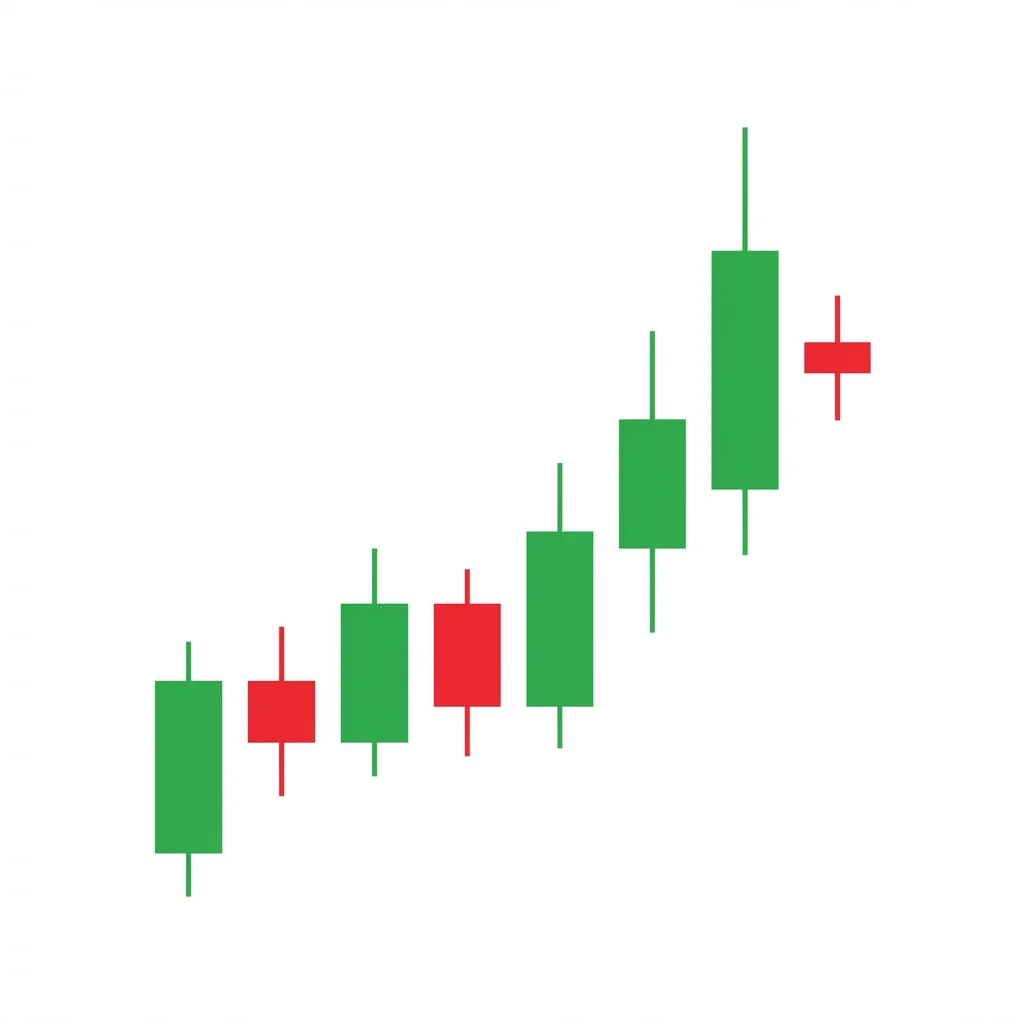
Bearish Harami Cross
Harami Yose Sen
Also known as: Bearish Inside Doji, Petrifying Pattern
The bearish harami cross is a two-candle reversal pattern where a large bullish candle is followed by a doji contained within the first candle's body. The doji represents complete indecision, making this a slightly stronger reversal signal than the standard harami.
The bearish harami cross is a variation of the bearish harami where the second candle is a doji instead of a small-bodied candle. This distinction is meaningful: the doji represents perfect equilibrium between buyers and sellers, showing that the buying momentum has completely stalled. After a strong bullish candle, this sudden shift to perfect indecision is a more powerful warning than a small bearish candle. The pattern is considered an intermediate-strength reversal signal that benefits from confirmation on the following candle.
History & Etymology
The harami cross has been part of Japanese candlestick analysis since the Sakata method. Japanese traders considered the doji version of the harami to be more significant than the standard harami because the doji represents a more definitive state of indecision — the market has literally stopped moving in the trend direction.
The name combines 'harami' (pregnant) with 'cross,' referring to the cross-like shape of the doji candle. The Japanese term 'yose sen' for the doji means 'meeting line,' where the open and close prices meet.
How It Forms
Formation Steps
- 1First candle: large bullish candle in an uptrend
- 2Second candle: a doji whose body (open = close) is within the first candle's body
- 3The doji's shadows may extend beyond the first candle's body but the open/close must be inside
Prerequisites
- Established uptrend
- Large bullish first candle
Confirmation Signals
- Bearish candle closing below the doji's low
- Gap down on the third candle
- Volume increase on the confirmation candle
Invalidation Signals
- Strong bullish candle breaking above the first candle's high
- No follow-through selling within 2-3 sessions
- Volume surges on a bullish candle
Candle Breakdown
Mother Candle
A large bullish candle continuing the uptrend with a substantial body.
Strong buying conviction. This is the last significant push by the bulls.
Doji (Cross) Candle
A doji where open equals close, positioned within the body of the first candle. Represents total indecision.
Complete equilibrium. After strong buying, the market reaches a standstill — neither side can dominate.
Psychology
The harami cross captures the exact moment when bullish momentum halts completely. The doji shows that after a vigorous rally, the market has reached a point of total indecision — an equilibrium that often precedes a reversal.
Buyer Perspective
Buyers who drove the rally are confused by the complete stall in momentum. The doji suggests their buying power has been fully absorbed by selling supply.
Seller Perspective
Sellers see the doji as a clear sign that buying pressure has exhausted itself. They prepare to press short positions, knowing the next directional move is likely downward.
Smart Money Action
Institutions complete their distribution during the doji session. The doji occurs because institutional selling perfectly offsets remaining retail buying, creating the equilibrium.
Retail Trader Trap
Retail traders still hold long positions from the rally, viewing the doji as a brief pause. They underestimate the significance of the total momentum stall.
Emotional Cycle
Trading Strategy
Aggressive Entry
Short on the open of the third candle if it opens below the doji.
Conservative Entry
Wait for a bearish candle closing below the doji's low, then enter short.
Mother candle body length projected downward.
Prior swing low or support level.
2x the mother candle body length.
Best Conditions
- Timeframe: daily
- Timeframe: 4h
- Timeframe: weekly
- overbought
- at resistance
- end of impulsive rally
- Asset: stocks
- Asset: forex
- Asset: indices
- Asset: crypto
Avoid When
- Timeframe: 1m
- Timeframe: 5m
- strong trend
- breakout mode
Confluence Factors
- Forms at resistance
- RSI overbought (>70)
- MACD bearish divergence
- Fibonacci level alignment
- Declining volume on the doji
Scale In Strategy
Enter 50% on confirmation, 50% on break below the mother candle's open.
Scale Out Strategy
Take 50% at TP1, trail rest with 20 EMA.
Risk Management
Volume Analysis
Volume Confirmation
Volume should decline significantly on the doji candle, confirming a loss of participation rather than active two-way trading.
Volume Profile
The doji should trade within the prior candle's value area, showing acceptance within that range but no expansion.
Volume Divergence
If volume is high on the doji, it suggests active two-way battles rather than indecision — less reliable.
Technical Confluence
Support Resistance
Harami cross at known resistance levels is the strongest setup. The mother candle's high becomes the key reference.
Fibonacci Levels
Harami cross at the 61.8% retracement of a prior decline is a high-probability short signal.
Moving Averages
Formation at the 50 or 200 SMA from below strengthens the reversal signal.
Rsi Confirmation
RSI above 70 with the harami cross forming confirms overbought exhaustion.
Macd Confirmation
MACD histogram declining or crossing bearish while the harami cross forms is strong confirmation.
Bollinger Bands
Harami cross at the upper Bollinger Band confirms price rejection at an extreme level.
Vwap
Doji closing near or below VWAP is bearish on intraday charts.
Ichimoku Cloud
Harami cross at the Senkou Span B is a reliable short setup.
Elliott Wave
Often marks the end of Wave 5 or Wave B, showing momentum exhaustion.
Wyckoff Phase
Consistent with the last point of supply (LPSY) in distribution.
Market Profile
The doji represents a single-print area of balance within a trending profile.
Order Flow
Delta neutralizing on the doji after strongly positive delta on the mother candle confirms momentum exhaustion.
Open Interest
Flat or declining OI on the doji suggests position unwinding rather than new positioning.
Multi-Timeframe Analysis
Higher Timeframe Alignment
Weekly harami cross at major resistance is a very powerful reversal signal.
Lower Timeframe Entry
Use 1H or 4H charts to time entries within the doji session or on the confirmation day.
Timeframe Confluence
Harami cross visible on both daily and 4H at resistance is high probability.
Top-Down Approach
Weekly resistance → Daily harami cross → 4H confirmation → 1H entry.
Statistics
Historical Examples
Tesla Harami Cross at $400
successTesla formed a bearish harami cross near its all-time high above $400 (pre-split adjusted). The doji showed complete indecision, and the stock declined over 35% in the following months.
Lesson: Harami cross patterns at all-time highs in momentum stocks can mark significant reversals.
EUR/GBP Harami Cross
partialEUR/GBP formed a harami cross at the 0.8620 resistance level, declining about 150 pips before finding support.
Lesson: Forex harami cross patterns work well at established resistance levels but produce smaller percentage moves.
Variations
High-Wave Harami Cross
The doji has very long upper and lower shadows, showing extreme indecision.
Four-Price Harami Cross
The doji has virtually no shadows — open, high, low, and close are nearly the same price.
Confusion Matrix
Patterns commonly confused with Bearish Harami Cross and how to distinguish them.
Bearish Harami
90% similarLook at the second candle: if open equals close (doji), it is a harami cross. If there is a small but visible body, it is a standard harami.
Key Differences
- Harami cross has a doji; standard harami has a small body
- The doji indicates stronger indecision than a small body
- Harami cross is considered slightly more reliable
Bearish Evening Doji Star
70% similarIf the doji gaps above the first candle (star position), it is an evening doji star. If the doji is contained within the first candle's body, it is a harami cross.
Key Differences
- Evening doji star is a 3-candle pattern; harami cross is 2 candles
- Evening doji star requires a gap up before the doji
- Evening doji star includes a confirmation candle in the pattern itself
The Bearish Doji Star is a two-candle reversal pattern featuring a strong bullish candle followed by a doji that gaps above it, signaling that buying momentum has stalled and indecision has replaced conviction at the top of an uptrend.
The Bearish Engulfing is one of the most powerful and commonly traded two-candle reversal patterns. A large bearish candle completely engulfs the prior bullish candle, demonstrating a decisive shift from buying to selling dominance.
The Evening Doji Star is a top-tier three-candle bearish reversal pattern. The doji in the star position represents the pivot point between bullish confidence (first candle) and bearish dominance (third candle), making it one of the most reliable reversal signals in candlestick analysis.
The bearish harami is a two-candle reversal pattern where a large bullish candle is followed by a small bearish candle entirely contained within the first candle's body. It signals waning buying momentum and potential trend reversal.
The three inside down is a confirmed bearish harami pattern. A long bullish candle is followed by a smaller bearish candle inside its body, then a third bearish candle closes below the first candle's low, providing definitive reversal confirmation.
The Bullish Harami Cross is a two-candle reversal pattern where a doji forms within the body of a preceding large bearish candle, indicating strong indecision and a potential bottom.
Pro Tips & Common Mistakes
Pro Tips
- The doji variant (harami cross) is considered 10-15% more reliable than the standard harami by most Japanese candlestick studies.
- The position of the doji within the mother candle matters: a doji near the top of the mother is less bearish than one near the center or bottom.
- If the doji's shadows extend well beyond the mother candle's body while the doji's body stays inside, it shows extreme indecision at a critical level.
- Combine with the three inside down pattern for built-in confirmation.
Common Mistakes
- Not distinguishing between a small body (harami) and a true doji (harami cross) — they have different implications.
- Trading without confirmation in strong uptrends.
- Confusing the harami cross with an evening doji star — the gap requirement is the key difference.
- Ignoring the volume pattern — declining volume on the doji is essential.
Advanced Techniques
- Analyze the doji's internal structure on lower timeframes to understand the intraday battle between buyers and sellers.
- Use delta analysis on the doji: perfectly balanced delta confirms the indecision signal.
- Combine with options gamma exposure: harami cross at a high-gamma strike can amplify the reversal.
- Look for multiple harami cross patterns across correlated assets for sector-wide reversal timing.
Institutional Perspective
The doji candle in the harami cross often represents the exact session where institutional distribution matches retail buying. This equilibrium is temporary — once retail buying dries up, the distribution creates the reversal.
Fun Facts
- The harami cross is sometimes called the 'petrifying pattern' in Japanese texts because it 'freezes' the market in place.
- Gregory Morris, a candlestick researcher, found that the harami cross had a slightly higher predictive accuracy than the standard harami in his studies of Japanese markets.
- The harami cross is the only common candlestick pattern that explicitly requires a doji as one of its components.
Frequently Asked Questions
A bearish harami cross is a two-candle reversal pattern where a large bullish candle is followed by a doji (open equals close) that is contained within the first candle's body. It signals that buying momentum has completely stalled.
Yes, the harami cross is generally considered slightly more reliable because the doji represents complete indecision (open equals close), which is a stronger momentum exhaustion signal than a small-bodied candle.
The harami cross has the doji inside the first candle's body. The evening doji star has the doji gapping above the first candle. The gap requirement makes the evening doji star a stronger signal.