
Overview
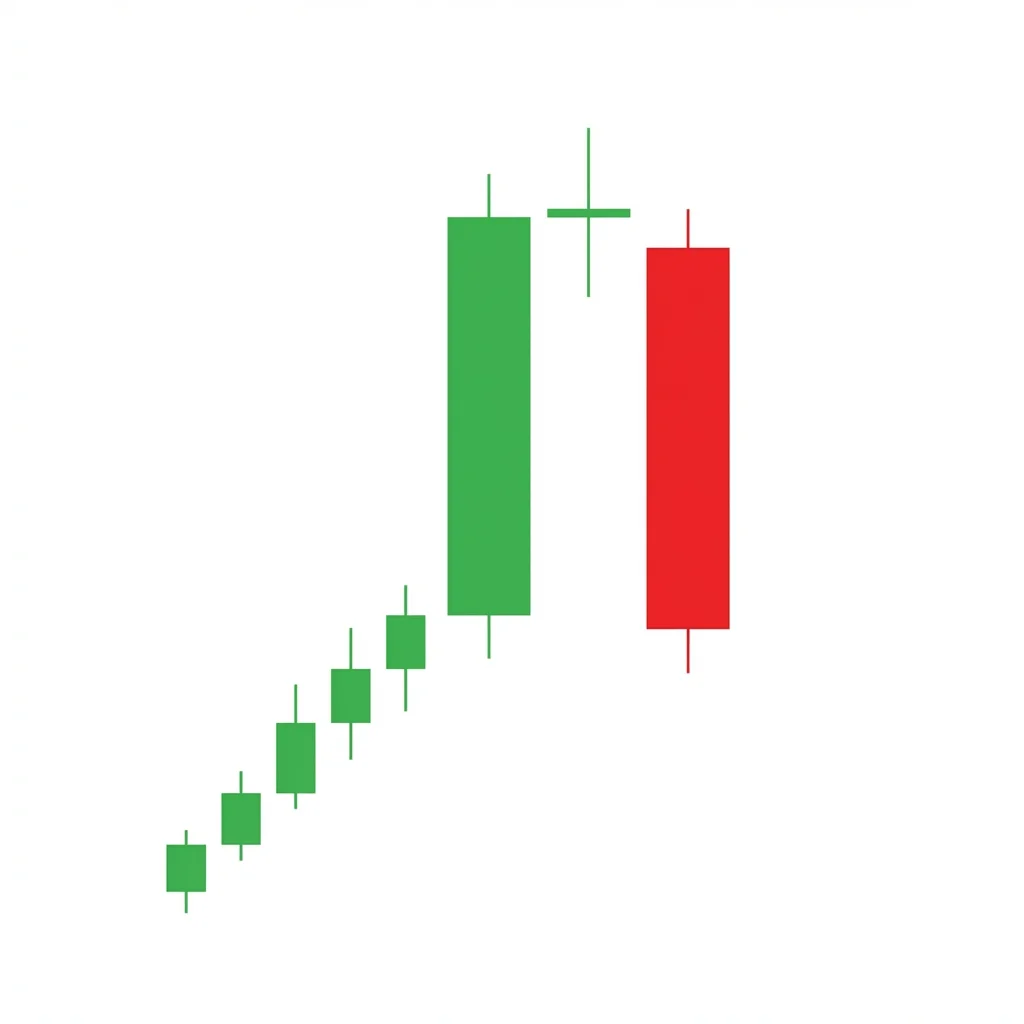
Bearish Evening Doji Star
Yoi No Doji Boshi
Also known as: Evening Doji Star, Doji Evening Star
The Evening Doji Star is a top-tier three-candle bearish reversal pattern. The doji in the star position represents the pivot point between bullish confidence (first candle) and bearish dominance (third candle), making it one of the most reliable reversal signals in candlestick analysis.
The Evening Doji Star is the definitive three-candle bearish reversal pattern. It tells a complete story in three acts: Act 1 — a strong bullish candle confirms the uptrend; Act 2 — a doji gaps above it, showing that all buying momentum has evaporated into indecision at elevated prices; Act 3 — a strong bearish candle gaps down from the doji and closes deep into the first candle's body, confirming the reversal. The doji is what distinguishes this from the regular Evening Star (which uses a small-bodied candle). The doji's equal open and close makes the indecision even more pronounced, increasing the pattern's reliability. This pattern is considered one step below the Abandoned Baby in power (which requires clean gaps with no shadow overlap) but significantly more common.
History & Etymology
The Evening Star family has been part of Japanese candlestick analysis for centuries. The 'star' reference comes from the small candle appearing separately from the large candles on either side, like a star in the sky. The doji variant was identified as a more powerful version because the doji's perfect indecision amplifies the reversal signal.
'Evening' refers to the end of the day (end of the uptrend), contrasting with 'Morning' (beginning of a new uptrend). The 'Doji Star' is a doji in the star position (gapped away from the adjacent candle). Together, the Evening Doji Star signals the twilight of the uptrend.
How It Forms
Formation Steps
- 1First candle: long bullish candle continuing the uptrend
- 2Second candle: doji that gaps above the first candle's close
- 3Third candle: long bearish candle that closes well into the first candle's body (ideally below its midpoint)
Prerequisites
- Established uptrend
- The doji must gap above the first candle (star position)
- The third candle must close into the first candle's body
Confirmation Signals
- Third candle closes below the first candle's midpoint
- Volume increases on the third candle
- Gap down from the doji to the third candle
- Follow-through selling on the fourth candle
Invalidation Signals
- Third candle fails to close into the first candle's body
- Price rallies above the doji's high
- Low volume on the third candle
Candle Breakdown
Bullish Body
A strong bullish candle with a large body, confirming the uptrend.
Bulls are confident and driving the trend. This candle attracts new buyers.
Doji Star
A doji that gaps above the first candle. The open and close are at or near the same level.
Complete indecision at elevated prices. The gap up initially seems bullish, but the doji shows the market could not decide on a direction. Smart money is distributing into the retail buying.
Bearish Confirmation
A strong bearish candle that ideally gaps down from the doji and closes below the midpoint of the first candle.
Sellers take control decisively. The close deep into the first candle shows that not just the doji's gains but the first candle's gains are being reversed. Panic selling begins.
Psychology
The Evening Doji Star is one of the clearest reversal narratives in technical analysis: strength, indecision, weakness — in three candles.
Buyer Perspective
Buyers are confident after the first candle and the gap up. The doji creates doubt. The third candle confirms their worst fears — the uptrend is over and they are losing money.
Seller Perspective
Sellers identify the doji as the turning point. The third candle's decisive action gives them confidence to press their advantage.
Smart Money Action
Smart money distributes during the doji session (selling into the gap-up demand) and adds short positions on the third candle.
Retail Trader Trap
Retail traders buy the gap up, hold through the doji hoping for continuation, and are trapped by the third candle.
Emotional Cycle
Trading Strategy
Aggressive Entry
Short at the open of the third candle if it gaps down from the doji.
Conservative Entry
Short at the close of the third candle once the pattern is complete.
The first candle's open.
The previous swing low.
2:1 or 3:1 R:R.
Best Conditions
- Timeframe: daily
- Timeframe: weekly
- Timeframe: 4h
- at resistance
- overbought
- after extended uptrend
- Asset: stocks
- Asset: indices
- Asset: forex
- Asset: crypto
Avoid When
- Timeframe: 1m
- Timeframe: 5m
- strong momentum breakout
Confluence Factors
- Pattern at resistance
- RSI above 70 with divergence
- Low volume on doji
- Gap on both sides of doji
- Higher timeframe bearish context
Scale In Strategy
Enter 50% at third candle open (if gap down), add 50% at close.
Scale Out Strategy
Take 33% at first candle's open, 33% at swing low, trail 34%.
Risk Management
Volume Analysis
Volume Confirmation
Ideally: high volume first candle, low volume doji, high volume third candle.
Volume Profile
The H-L-H volume pattern mirrors the candle pattern perfectly.
Volume Divergence
Declining volume into the pattern followed by a spike on the third candle.
Technical Confluence
Support Resistance
The doji's high becomes the key resistance. The first candle's midpoint is the confirmation level.
Fibonacci Levels
Pattern at Fibonacci extension levels is very significant.
Moving Averages
Pattern above the upper Bollinger Band or at MA resistance adds confluence.
Rsi Confirmation
RSI above 70 at the doji, declining below 70 on the third candle.
Macd Confirmation
MACD bearish crossover at the third candle confirms momentum shift.
Bollinger Bands
Doji at or above the upper band with close back inside is classic.
Vwap
Third candle closing below VWAP confirms the session was seller-dominated.
Ichimoku Cloud
Pattern above the cloud targeting the Kijun-sen.
Elliott Wave
Classic Wave 5 terminal pattern.
Wyckoff Phase
Can appear as the BC/ST transition in distribution.
Market Profile
The doji creates a poor high in the profile.
Order Flow
Delta shifts from positive (first candle) to neutral (doji) to negative (third candle).
Open Interest
Rising OI on the third candle confirms new shorts.
Multi-Timeframe Analysis
Higher Timeframe Alignment
A daily Evening Doji Star at weekly resistance is one of the highest-conviction setups in technical analysis.
Lower Timeframe Entry
After the daily pattern, use the 4H chart to find early entry on the third candle.
Timeframe Confluence
A weekly Evening Doji Star signals a major multi-week to multi-month reversal.
Top-Down Approach
Weekly: resistance. Daily: Evening Doji Star. 4H: entry refinement.
Statistics
Historical Examples
S&P 500 Evening Doji Star January 2022
successThe S&P 500 formed an Evening Doji Star at 4,818 — its all-time high. The doji appeared after a strong New Year rally, and the bearish third candle confirmed the top. The index fell 27% over the following 9 months.
Lesson: The Evening Doji Star at an all-time high is among the most powerful reversal signals. The timing at the January 2022 peak made this one of the most significant Evening Doji Stars in recent market history.
Variations
Evening Gravestone Doji Star
The middle candle is a gravestone doji (long upper shadow, no lower shadow).
Evening Doji Star with Double Gap
Gaps exist on both sides of the doji (up to doji, down from doji).
Confusion Matrix
Patterns commonly confused with Bearish Evening Doji Star and how to distinguish them.
Bearish Evening Star
8500% similarCheck the middle candle. If it is a doji (open = close), it is an Evening Doji Star. If it has a small body, it is an Evening Star.
Key Differences
- Evening Star uses a small-bodied candle, not a doji
- Evening Doji Star uses a doji — more precise indecision
- The doji version is more reliable
Bearish Abandoned Baby
8000% similarCheck if the doji's shadows overlap with the adjacent candles. Overlap = Evening Doji Star. No overlap = Abandoned Baby.
Key Differences
- Abandoned Baby requires NO shadow overlap on either side of the doji
- Evening Doji Star allows shadow overlap
- Abandoned Baby is rarer and more reliable
The Bearish Abandoned Baby is one of the rarest and most reliable top reversal patterns in candlestick analysis. It features a doji that is completely isolated by gaps on both sides, signaling an abrupt and dramatic shift from buying to selling pressure.
The Dark Cloud Cover is a two-candle bearish reversal pattern where a bearish candle opens above the prior bullish candle's high and closes below its midpoint, signaling that the bullish 'sky' is being covered by a bearish 'dark cloud.'
The Bearish Doji Star is a two-candle reversal pattern featuring a strong bullish candle followed by a doji that gaps above it, signaling that buying momentum has stalled and indecision has replaced conviction at the top of an uptrend.
The Bearish Engulfing is one of the most powerful and commonly traded two-candle reversal patterns. A large bearish candle completely engulfs the prior bullish candle, demonstrating a decisive shift from buying to selling dominance.
The Morning Doji Star is a three-candle bullish reversal pattern where a bearish candle, a gapped-down doji, and a strong bullish candle combine to signal a decisive bottom — more powerful than the standard Morning Star due to the doji's complete indecision signal.
The Bearish Advance Block shows three consecutive bullish candles with progressively smaller bodies and longer upper shadows, signaling that buying momentum is weakening and a reversal or consolidation is likely.
Pro Tips & Common Mistakes
Pro Tips
- The deeper the third candle penetrates into the first candle's body, the more bearish. A close below the first candle's open approaches Abandoned Baby strength.
- Gaps on both sides of the doji significantly increase reliability. One gap is required; two gaps make it much stronger.
- The Evening Doji Star is one of the few patterns reliable enough to trade without additional confluence, though confluence always improves results.
- Monitor the doji's shadow type: a gravestone doji in the star position is the most bearish variant.
Common Mistakes
- Confusing the Evening Doji Star with the regular Evening Star — check for the doji specifically.
- Not requiring the gap between the first candle and the doji — the star position (gap) is mandatory.
- Trading before the third candle completes — the pattern is not confirmed until the third candle closes.
- Setting stops below the doji rather than above it.
Advanced Techniques
- Use the Evening Doji Star to time options entries. Buy puts at the doji's close strike with 30-45 DTE.
- Combine with Wyckoff analysis: if the Evening Doji Star forms at the Secondary Test (ST) in distribution, the conviction is extremely high.
- Track the ratio of successful Evening Doji Stars to failed ones across a sector. A high success rate indicates the sector is topping.
Institutional Perspective
The Evening Doji Star is considered one of the most reliable candlestick reversal patterns by institutional quant teams. Its three-candle structure provides enough data points to model statistically, and its clear formation rules make it ideal for algorithmic detection.
Fun Facts
- The Evening Doji Star at the S&P 500's all-time high in January 2022 was one of the most significant candlestick patterns in recent market history, preceding a 27% decline.
- In Japanese tradition, the Evening Star represents the planet Venus appearing in the evening sky — a harbinger that night (decline) is coming.
- The Evening Doji Star consistently ranks in the top 3 most reliable bearish candlestick patterns across all major studies.
Frequently Asked Questions
Very reliable — approximately 70% win rate, making it one of the top-performing candlestick patterns. With additional confluence (resistance level, volume, RSI divergence), reliability increases further.
The Abandoned Baby requires that the doji's shadows do not overlap with the adjacent candles (complete gap isolation). The Evening Doji Star allows shadow overlap. The Abandoned Baby is rarer and slightly more reliable.