
Overview
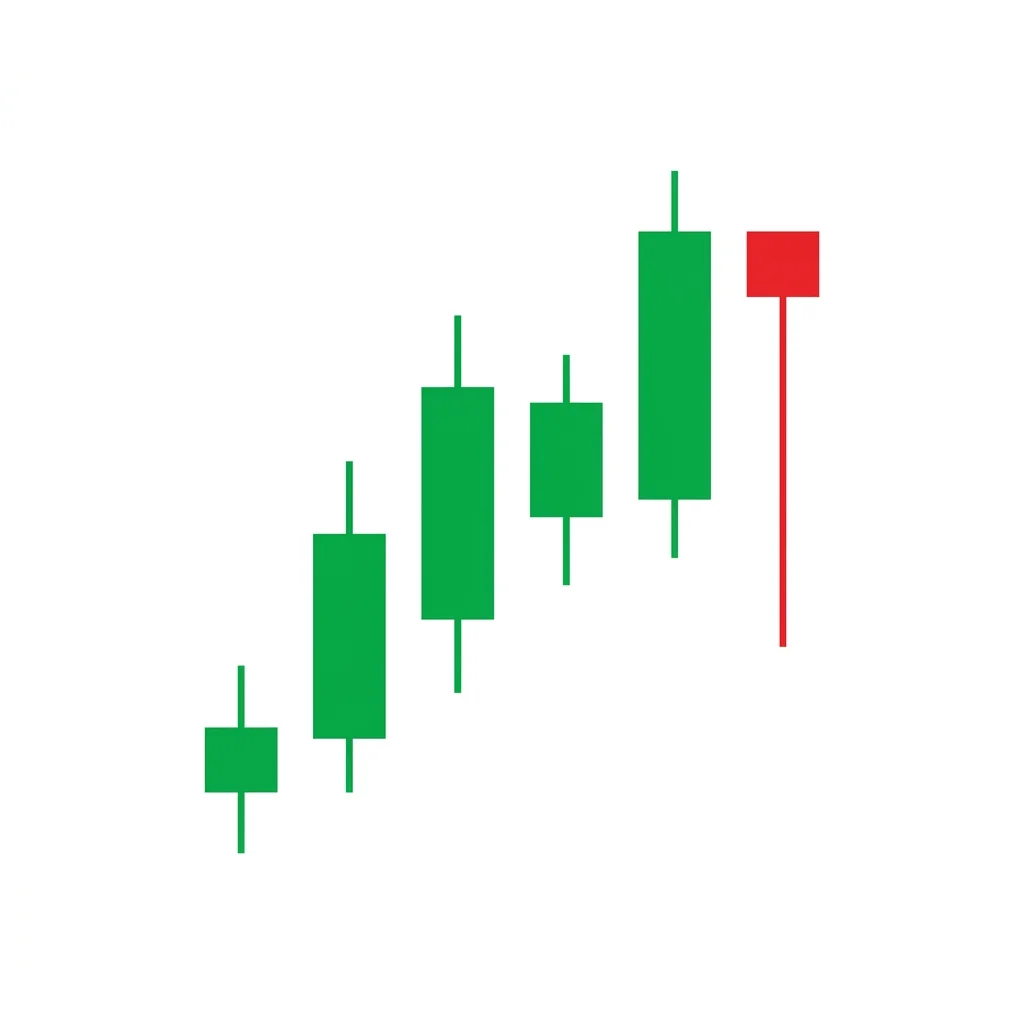
Bearish Hanging Man
Kubitsuri
Also known as: Hanging Man, Hangman
The hanging man is a single-candle bearish reversal pattern with a small body at the top and a long lower shadow, appearing at the top of an uptrend. It warns that selling pressure is emerging despite the continued uptrend.
The hanging man looks identical to a bullish hammer, but its location at the top of an uptrend gives it the opposite implication. The long lower shadow shows that sellers pushed price significantly lower during the session, though buyers managed to pull it back near the open. This tug-of-war, occurring at elevated prices, suggests that the balance of power is shifting. The pattern requires confirmation — a bearish candle on the next session validates the reversal signal. Without confirmation, the hanging man may simply represent a temporary shakeout before the uptrend continues.
History & Etymology
The hanging man is one of the oldest Japanese candlestick patterns, originating from the Dojima Rice Exchange in Osaka during the 18th century. Japanese traders gave it the morbid name because the candle's shape — small body at the top with a long lower shadow — resembles a man hanging from a gallows.
The Japanese name 'kubitsuri' literally translates to 'hanging by the neck.' The candle's visual appearance, with a small body dangling above a long lower shadow, evokes the image of a hanged figure.
How It Forms
Formation Steps
- 1Small real body at the upper end of the trading range
- 2Long lower shadow at least 2x the body length
- 3Little to no upper shadow
- 4Appears at the top of an uptrend
Prerequisites
- Established uptrend
- Preferably at a resistance level
Confirmation Signals
- Bearish candle the next session that closes below the hanging man's body
- Gap down on the following session
- Increased volume on the hanging man
Invalidation Signals
- Strong bullish candle breaking above the hanging man's high
- No follow-through selling within 2-3 sessions
- Volume is extremely low on the hanging man
Candle Breakdown
Hanging Man
Small body near the session high with a lower shadow at least twice the body's length. The color of the body can be either bullish or bearish, but bearish is slightly more reliable.
During the session, sellers drove price sharply lower but buyers rallied it back. The fact that such selling pressure appeared at these heights is a warning sign.
Psychology
The hanging man represents the first significant crack in an uptrend. For the first time, sellers were able to push price substantially lower during the session. Although buyers recovered, the emergence of selling pressure at the top of a rally is an early warning.
Buyer Perspective
Buyers manage to pull price back up by the close, which may create false confidence. However, the depth of the intraday selloff suggests that significant supply is entering the market at current levels.
Seller Perspective
Sellers tested the conviction of buyers by pushing price sharply lower. Although the recovery occurred, sellers take note that their effort was substantial and may press harder in the next session.
Smart Money Action
Institutions begin distributing (selling) their positions during the session, causing the sharp drop. They allow the recovery to occur so they can sell more at higher prices in subsequent sessions.
Retail Trader Trap
Retail traders see the recovery and view it as bullish — 'the dip was bought.' They fail to recognize that the selling pressure itself is the warning sign.
Emotional Cycle
Trading Strategy
Aggressive Entry
Short on the next candle's open if it opens below the hanging man's body, without waiting for a full bearish close.
Conservative Entry
Wait for a bearish confirmation candle that closes below the hanging man's low, then enter short.
Length of the lower shadow projected downward from the hanging man's low.
Prior swing low or support level.
Start of the uptrend rally.
Best Conditions
- Timeframe: daily
- Timeframe: 4h
- Timeframe: weekly
- end of uptrend
- at resistance
- overbought market
- Asset: stocks
- Asset: forex
- Asset: indices
- Asset: crypto
Avoid When
- Timeframe: 1m
- Timeframe: 5m
- strong bull trend
- breakout rally
- low volatility
Confluence Factors
- Forms at a known resistance level
- RSI above 70 (overbought)
- Bearish divergence on MACD or RSI
- At a Fibonacci retracement or extension level
- Volume is above average
Scale In Strategy
Enter 50% on confirmation candle, add 50% on break of the hanging man's low.
Scale Out Strategy
Take 50% at TP1, trail remainder with 10 EMA.
Risk Management
Volume Analysis
Volume Confirmation
High volume on the hanging man strengthens the signal significantly, as it shows heavy participation in the selling.
Volume Profile
If the lower shadow's volume is concentrated at the low, it shows aggressive selling that was absorbed but may return.
Volume Divergence
Declining volume on the hanging man compared to recent candles weakens the signal.
Technical Confluence
Support Resistance
A hanging man at a key resistance level is significantly more reliable. The high of the hanging man becomes the new resistance reference.
Fibonacci Levels
Hanging man at the 127.2% or 161.8% Fibonacci extension of a prior correction is a high-probability reversal signal.
Moving Averages
Hanging man forming after a rally to the 200 SMA from below, or at the 20 EMA acting as dynamic resistance in a broader downtrend.
Rsi Confirmation
RSI above 70 when the hanging man forms confirms overbought conditions. Bearish RSI divergence adds conviction.
Macd Confirmation
MACD histogram declining or showing bearish divergence while the hanging man forms strengthens the signal.
Bollinger Bands
Hanging man at or beyond the upper Bollinger Band is a strong reversal signal.
Vwap
Hanging man forming above VWAP at the end of a session, with the close settling back near VWAP, is bearish.
Ichimoku Cloud
Hanging man at the Senkou Span B or at the top of the cloud is an excellent setup.
Elliott Wave
Hanging man often marks the end of Wave 5 or the peak of a corrective Wave B rally.
Wyckoff Phase
The hanging man is consistent with upthrust action in the distribution phase.
Market Profile
The lower shadow represents a price excursion below value that was rejected, but the selling interest is noted for future reference.
Order Flow
Aggressive selling during the formation of the lower shadow, followed by passive buying to recover, shows institutional distribution in progress.
Open Interest
Large call open interest at the hanging man's price level may cap further upside.
Multi-Timeframe Analysis
Higher Timeframe Alignment
A hanging man on the weekly chart is much more significant than on the daily. Weekly hanging man at resistance can mark major turning points.
Lower Timeframe Entry
The lower shadow of the daily hanging man will appear as a decline and recovery on intraday charts. Use this to time entries.
Timeframe Confluence
Hanging man on both the daily and 4H charts at the same resistance level is a strong setup.
Top-Down Approach
Monthly resistance → Weekly hanging man → Daily confirmation candle → 4H entry signal.
Statistics
Historical Examples
S&P 500 Hanging Man 2020
successThe S&P 500 formed a hanging man at its all-time high on February 19, 2020. The next day began the COVID-19 crash that wiped out 34% of the market's value in weeks.
Lesson: Hanging man patterns at all-time highs during periods of elevated uncertainty can precede catastrophic declines.
Gold Hanging Man at $2000
successGold formed a hanging man near the psychological $2000 level, followed by a multi-month correction of over 15%.
Lesson: Hanging man at major psychological levels (round numbers) with high volume is a powerful combination.
Variations
Bearish Hanging Man
Hanging man with a bearish (red/black) body.
Bullish Hanging Man
Hanging man with a bullish (green/white) body.
High-Volume Hanging Man
Hanging man with volume at least 2x the 20-day average.
Confusion Matrix
Patterns commonly confused with Bearish Hanging Man and how to distinguish them.
Bullish Hammer
100% similarLocation is everything. If the candle with a long lower shadow appears at the TOP of an uptrend, it is a hanging man (bearish). At the BOTTOM of a downtrend, it is a hammer (bullish).
Key Differences
- Identical shape but OPPOSITE location
- Hanging man appears at top of uptrend; hammer at bottom of downtrend
- Hanging man is bearish; hammer is bullish
Bearish Shooting Star
60% similarLook at which shadow is long. Long lower shadow = hanging man. Long upper shadow = shooting star.
Key Differences
- Hanging man has a long LOWER shadow; shooting star has a long UPPER shadow
- Both are single-candle bearish reversal patterns at the top of uptrends
- Shooting star is generally considered more reliable
The Dark Cloud Cover is a two-candle bearish reversal pattern where a bearish candle opens above the prior bullish candle's high and closes below its midpoint, signaling that the bullish 'sky' is being covered by a bearish 'dark cloud.'
The Bearish Doji Star is a two-candle reversal pattern featuring a strong bullish candle followed by a doji that gaps above it, signaling that buying momentum has stalled and indecision has replaced conviction at the top of an uptrend.
The Bearish Engulfing is one of the most powerful and commonly traded two-candle reversal patterns. A large bearish candle completely engulfs the prior bullish candle, demonstrating a decisive shift from buying to selling dominance.
The gravestone doji is a single-candle reversal pattern with the open, close, and low at the same level and a long upper shadow, resembling a gravestone. It signals that buyers pushed price higher but sellers reclaimed all gains by the close.
The shooting star is a single-candle bearish reversal pattern with a small body near the low and a long upper shadow. It shows that buyers pushed price significantly higher during the session but sellers drove it back down, signaling a potential top.
The Bearish Belt Hold is a single bearish candle that opens at its high and closes near its low with a long body, indicating that sellers dominated from the opening bell and controlled price action throughout the session.
Pro Tips & Common Mistakes
Pro Tips
- A bearish-colored hanging man (red/black body) is slightly more powerful than a bullish-colored one.
- The hanging man's lower shadow should be at least 2x the body — the longer, the more significant.
- Always require confirmation — the hanging man fails frequently without a follow-through bearish candle.
- Combine with volume: a high-volume hanging man is much more reliable than a low-volume one.
Common Mistakes
- Trading the hanging man without confirmation — its failure rate is high as a standalone signal.
- Confusing the hanging man with a bullish hammer due to identical appearance — context matters.
- Not considering the broader trend — a hanging man in a strong bull market may just be a pause.
- Placing stops too tight — below the hanging man rather than above it.
Advanced Techniques
- Analyze the internal structure of the hanging man on lower timeframes — look for distribution patterns within the candle.
- Use cumulative delta analysis: if the delta is strongly negative despite the close near the open, distribution is occurring.
- Combine hanging man with options flow: large put buying or call selling at the level confirms institutional bearish intent.
- Look for hanging man patterns simultaneously across correlated assets for sector-wide reversal signals.
Institutional Perspective
The hanging man is often the visible result of institutional distribution. During the session, large sellers push price lower to test demand. The recovery allows them to sell more at higher prices. The pattern marks the transition from accumulation to distribution.
Fun Facts
- The hanging man is the most commonly confused candlestick pattern because it looks exactly like the bullish hammer — proving that context is everything in technical analysis.
- Japanese traders considered the hanging man to be a warning that the market was 'dangling' at unsustainable heights, about to drop.
- Steve Nison, who introduced Japanese candlesticks to the West, noted that the hanging man was one of the patterns that most surprised Western analysts.
Frequently Asked Questions
A hanging man is a single-candle bearish reversal pattern that appears at the top of an uptrend. It has a small body near the top, a long lower shadow at least 2x the body length, and little to no upper shadow.
They look identical but appear in opposite contexts. A hammer forms at the bottom of a downtrend (bullish). A hanging man forms at the top of an uptrend (bearish). The location determines the meaning.
Yes, confirmation is strongly recommended. A bearish candle closing below the hanging man's body on the next session validates the reversal. Without confirmation, the failure rate is about 45%.