
Overview
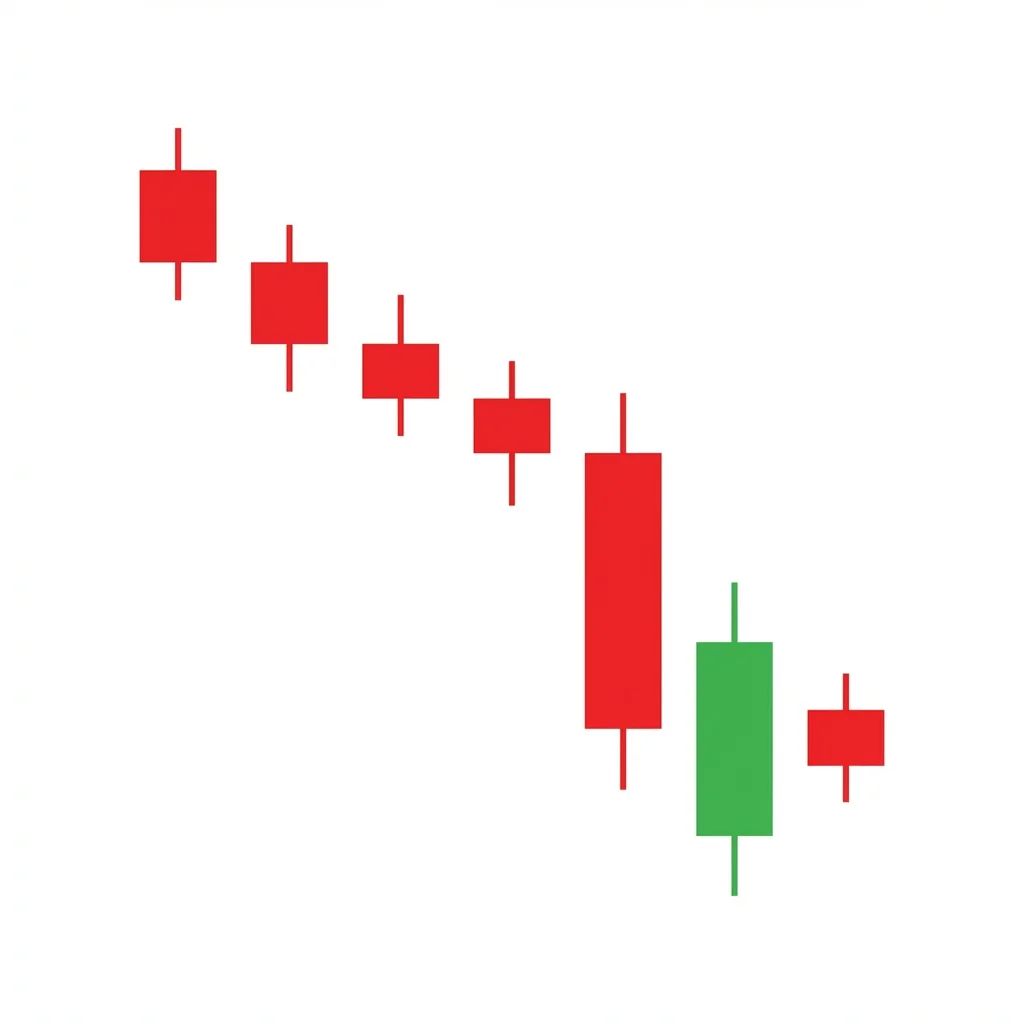
Bearish Thrusting
Sashikomi
Also known as: Thrusting Line, Thrusting Pattern Down
The bearish thrusting pattern is a two-candle continuation signal in a downtrend. A long bearish candle is followed by a bullish candle that opens below the first candle's low but closes below its midpoint, showing insufficient buying strength to reverse the trend.
The thrusting pattern is a weaker version of the bullish piercing line. While both feature a bearish candle followed by a bullish candle that opens below and closes within the bearish candle's body, the key difference is where the bullish candle closes relative to the midpoint. In the thrusting pattern, the bullish candle fails to close above the midpoint of the first candle, indicating that buying pressure is too weak to mount a reversal. This failure to penetrate the midpoint signals that the downtrend will likely continue. The pattern is particularly relevant because it explicitly signals the absence of a reversal—traders can use it to confirm that the downtrend remains intact and that the brief bullish candle was merely a pause.
History & Etymology
The thrusting pattern comes from Japanese candlestick analysis, where the distinction between thrusting (closing below the midpoint) and piercing (closing above the midpoint) was considered crucial for determining whether a counter-trend move signaled continuation or reversal.
'Thrusting' refers to the bullish candle thrusting into the prior bearish candle's body, but without sufficient force to reach the midpoint. The Japanese name 'sashikomi' means 'inserting' or 'pushing in.'
How It Forms
Formation Steps
- 1First candle is a long bearish candle in a downtrend
- 2Second candle opens below the first candle's low (gaps down)
- 3Second candle closes within the first candle's body but below its midpoint
- 4The bullish second candle fails to reach the midpoint of the first
Prerequisites
- Established downtrend
- The first candle should be a strong bearish candle
Confirmation Signals
- Third candle is bearish, continuing the downtrend
- Volume decreases on the bullish candle
- The midpoint of the first candle acts as resistance
Invalidation Signals
- The second candle closes above the first candle's midpoint (becomes piercing line instead)
- Strong bullish follow-through
- Volume increases on the bullish candle
Candle Breakdown
Bearish Candle
A long bearish candle continuing the downtrend with conviction.
Strong selling confirms the downtrend is in force.
Thrusting Candle
A bullish candle that opens below the first candle's low and closes within the first candle's body but below its midpoint.
Buyers attempt a recovery but cannot push price past the midpoint of the prior decline. The weakness of this rally confirms seller dominance.
Psychology
The thrusting pattern reveals that buying interest is present but insufficient to reverse the downtrend. The failure to reach the midpoint is a clear signal of bearish dominance.
Buyer Perspective
Buyers attempt to bottom-fish after the gap down but cannot generate enough momentum to push past the midpoint—a sign that the decline is not yet over.
Seller Perspective
Sellers view the weak bullish candle as confirmation that their thesis is intact. The failure at the midpoint gives them confidence to maintain or add to short positions.
Smart Money Action
Smart money uses the weak bounce to add to short positions at better prices.
Retail Trader Trap
Retail traders who buy the bounce are trapped when the downtrend resumes.
Emotional Cycle
Trading Strategy
Aggressive Entry
Enter short at the close of the thrusting candle.
Conservative Entry
Wait for the third candle to close below the thrusting candle's low.
Previous swing low
Measured move equal to the first candle's range
Next major support
Best Conditions
- Timeframe: 1D
- Timeframe: 4h
- Established downtrends
- Bear markets
- Asset: Stocks
- Asset: Forex
- Asset: Indices
Avoid When
- Timeframe: 1m
- Timeframe: 5m
- Sideways markets
- Near strong support
Confluence Factors
- Downtrend context
- Thrusting candle fails at a moving average
- Volume declining
- RSI below 50
Scale In Strategy
Enter on confirmation, add on pullbacks.
Scale Out Strategy
Take 50% at previous low, trail rest.
Risk Management
Volume Analysis
Volume Confirmation
Volume should be lower on the thrusting candle than the bearish candle.
Volume Profile
Declining volume on the bullish candle confirms weak buying.
Volume Divergence
High volume on the thrusting candle suggests potential piercing line instead.
Technical Confluence
Support Resistance
The first candle's midpoint becomes the key resistance level that the thrusting candle fails to reach.
Fibonacci Levels
The thrusting candle typically closes at the 38.2% retracement of the first candle, below the 50% (midpoint).
Moving Averages
The thrusting candle may rally to a declining 10 or 20 EMA before failing.
Rsi Confirmation
RSI remaining below 50 during the thrusting candle confirms bearish momentum.
Macd Confirmation
MACD remaining negative during the pattern confirms the downtrend.
Bollinger Bands
Price near the lower band with the thrusting candle failing to reach the middle band.
Vwap
The thrusting candle failing to reclaim VWAP confirms institutional selling.
Ichimoku Cloud
Pattern below the Kumo cloud confirms bearish context.
Elliott Wave
May appear during brief corrections within a bearish impulse.
Wyckoff Phase
Can appear during minor rallies in the markdown phase.
Market Profile
The thrusting candle fails to reach the point of control, confirming seller dominance.
Order Flow
Positive delta on the thrusting candle is insufficient to shift the cumulative delta trend.
Open Interest
Stable or increasing open interest during the pattern suggests new shorts are being established.
Multi-Timeframe Analysis
Higher Timeframe Alignment
Daily thrusting in a weekly downtrend.
Lower Timeframe Entry
4H confirmation of continuation.
Timeframe Confluence
Daily pattern within weekly downtrend.
Top-Down Approach
Weekly downtrend > Daily thrusting > 4H entry.
Statistics
Historical Examples
EUR/USD Thrusting Pattern
successEUR/USD formed a thrusting pattern during a downtrend, with the bullish candle closing below the prior candle's midpoint. The downtrend resumed with a 100-pip decline.
Lesson: The midpoint test is the key differentiator between continuation and reversal signals.
Variations
Deep Thrusting
The bullish candle closes very close to (but below) the midpoint.
Confusion Matrix
Patterns commonly confused with Bearish Thrusting and how to distinguish them.
Bullish Piercing Line
8500% similarCalculate the midpoint of the first candle. If the second candle closes above it, it is a piercing line (bullish). If below, it is a thrusting line (bearish continuation).
Key Differences
- Piercing line closes ABOVE the midpoint; thrusting closes BELOW
- Piercing line is bullish reversal; thrusting is bearish continuation
- The midpoint is the critical dividing line
The bearish in neck pattern is a two-candle continuation pattern where a bullish second candle closes at or barely above the first bearish candle's close, showing insufficient buying power to reverse the downtrend.
The bearish on neck is a two-candle continuation pattern where a bullish second candle closes at the first bearish candle's low, showing that buyers could only push price to the weakest resistance level — the prior candle's low.
Bearish separating lines consist of a bullish candle followed by a bearish candle that opens at the same price as the first candle's open. The matching opens 'separate' or 'divide' the two candles, and the bearish second candle confirms the downtrend will continue.
The Piercing Line is a two-candle bullish reversal pattern where a bearish candle is followed by a bullish candle that opens below the low and 'pierces' above the midpoint of the first candle's body, showing strong buying recovery.
The Confirmed Shooting Star adds a bearish confirmation candle to the classic shooting star, eliminating the ambiguity of the standalone pattern and creating a higher-probability reversal signal at the top of uptrends.
The Bearish Counterattack Line features a bullish candle followed by a bearish candle that gaps up at the open but closes back to the same level as the first candle's close, signaling that sellers 'counterattacked' the bullish advance.
Pro Tips & Common Mistakes
Pro Tips
- The midpoint of the first candle is THE critical level—measure it precisely.
- If the bullish candle closes very close to the midpoint, treat the signal with caution.
- Always require confirmation from the third candle.
- The pattern is a useful 'anti-signal'—it tells you that a piercing line reversal has NOT occurred.
Common Mistakes
- Confusing thrusting with piercing line—check the midpoint carefully
- Trading without downtrend context
- Over-relying on a moderate-reliability pattern
Advanced Techniques
- Use the exact midpoint calculation to determine whether the pattern is thrusting or piercing—this precision matters.
- Track how close the close is to the midpoint—closer to the midpoint suggests a more contested and less reliable signal.
Institutional Perspective
The failure of the bullish candle to reach the midpoint shows that institutional selling absorbed all buying pressure before it could challenge the key level.
Fun Facts
- The thrusting pattern highlights how a single price level (the midpoint) can determine whether a pattern is bullish or bearish.
- Japanese traders considered the midpoint of a candle to be a psychologically significant level, representing the balance point between buyers and sellers.
Frequently Asked Questions
Both patterns have a bearish candle followed by a bullish candle that closes within the first candle's body. The difference is where the second candle closes: above the midpoint = piercing line (bullish reversal), below the midpoint = thrusting (bearish continuation).