
Overview
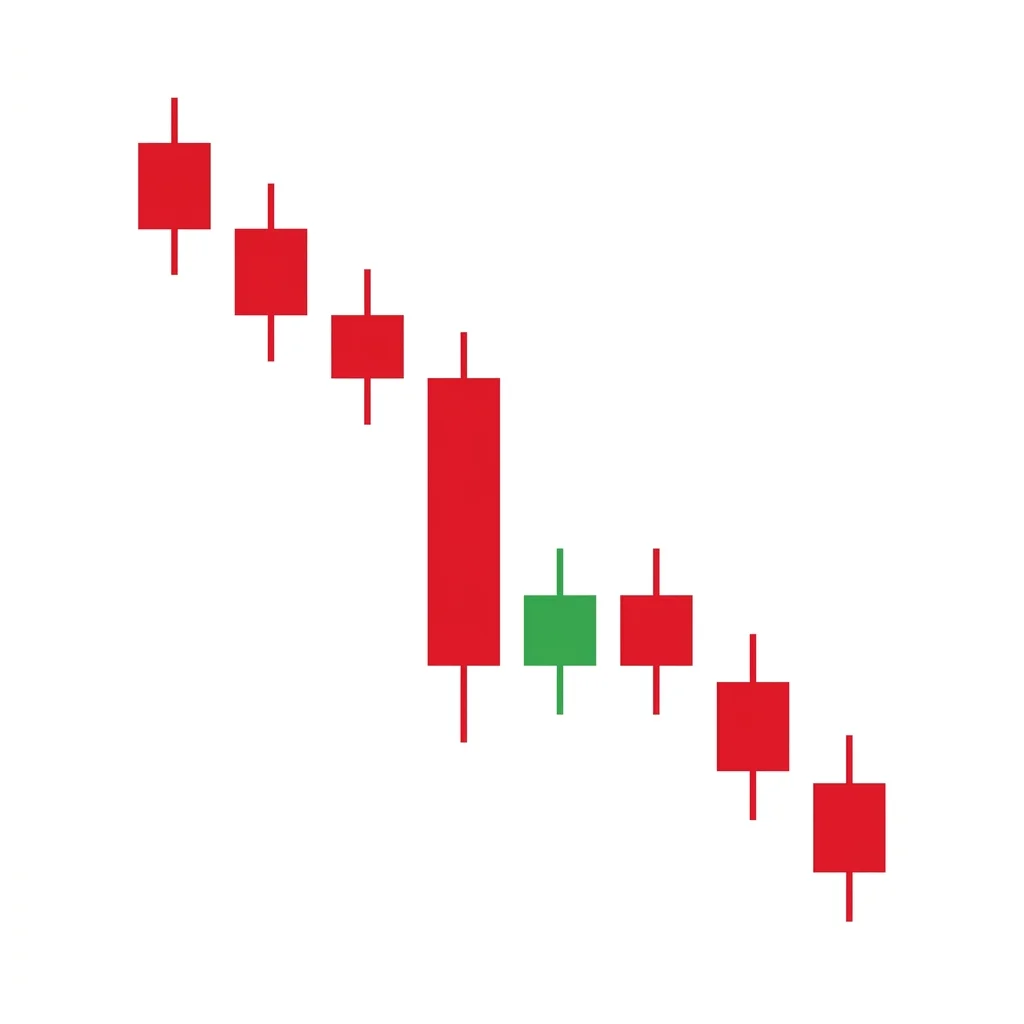
Bearish In Neck
Iri Kubi
Also known as: In Neck Line, In-Neck Pattern
The bearish in neck pattern is a two-candle continuation pattern where a bullish second candle closes at or barely above the first bearish candle's close, showing insufficient buying power to reverse the downtrend.
The in neck pattern occurs during a downtrend when a small bullish candle fails to penetrate meaningfully into the prior bearish candle's body. The second candle opens below the first candle's low (gap down), rallies intraday, but only manages to close at or slightly above the first candle's close — the 'neck' level. This minimal rally shows that buyers attempted a reversal but lacked the strength to push price higher. The pattern confirms that the downtrend remains intact and is likely to continue. It is similar to the on-neck pattern but with the close slightly higher.
History & Etymology
The in neck pattern is part of the Japanese candlestick lexicon, classified alongside the on-neck and thrusting patterns as a family of continuation patterns that test the selling resolve. Japanese traders used these patterns to gauge the strength of counter-trend rallies within established downtrends.
The name 'in neck' (iri kubi) refers to the second candle's close being 'in' the neck area — slightly above the first candle's close. The 'neck' metaphor refers to the close of the first candle, which acts as a resistance level.
How It Forms
Formation Steps
- 1First candle: a long bearish candle in a downtrend
- 2Second candle: opens below the first candle's low (gap down)
- 3Second candle rallies and closes at or slightly above the first candle's close (near the 'neck')
- 4The close of the second candle does NOT penetrate significantly into the first candle's body
Prerequisites
- Established downtrend
- Long bearish first candle
Confirmation Signals
- Third candle closes below the second candle's low
- Volume remains strong on the bearish continuation
- No further upside follow-through
Invalidation Signals
- Price continues higher, penetrating deep into the first candle's body
- Strong bullish volume on the second candle
- Third candle is strongly bullish
Candle Breakdown
Bearish Candle
A long bearish candle continuing the downtrend with a substantial body.
Strong selling pressure continues. Bears are in firm control.
In Neck Candle
A small bullish candle that opens below the first candle's low and closes at or slightly above the first candle's close.
Buyers attempt a rally but can only push price to the prior close level. This failure to penetrate the body shows weak buying.
Psychology
The in neck pattern demonstrates that buyers attempted a counter-trend move but failed to make any meaningful progress. Closing at the prior candle's close level shows that buying pressure merely returned price to where selling left off — no ground was gained.
Buyer Perspective
Buyers see the gap down as a buying opportunity and push price higher. However, they can only reach the prior close level, revealing their lack of conviction and strength.
Seller Perspective
Sellers note that the counter-trend rally failed to penetrate their territory. The inability to close above the prior candle's close confirms their dominance.
Smart Money Action
Institutions use the small rally as an opportunity to add to short positions at better prices. The failure to penetrate the prior body confirms their selling thesis.
Retail Trader Trap
Retail traders may buy the gap down, seeing the rally as a potential reversal. The failure at the neck level traps them.
Emotional Cycle
Trading Strategy
Aggressive Entry
Short on the close of the second candle, recognizing the failed rally.
Conservative Entry
Wait for a third bearish candle closing below the second candle's low.
First candle's body length projected downward.
Next support level.
2x the first candle's body.
Best Conditions
- Timeframe: daily
- Timeframe: 4h
- established downtrend
- bear market
- Asset: stocks
- Asset: forex
- Asset: indices
Avoid When
- Timeframe: 1m
- Timeframe: 5m
- Timeframe: 15m
- oversold bounce
- reversal conditions
Confluence Factors
- Pattern occurs within a strong downtrend
- RSI below 50 throughout
- Moving averages sloping down
- Volume declining on the second candle
- No bullish divergence present
Scale In Strategy
Enter 50% on the second candle's close, add 50% on confirmation.
Scale Out Strategy
Take 50% at TP1, trail the rest.
Risk Management
Volume Analysis
Volume Confirmation
Volume should be lower on the second candle than the first. Low volume confirms weak buying.
Volume Profile
The second candle should trade within the low-volume zone of the first candle's lower range.
Volume Divergence
High volume on the second candle suggests genuine buying — the pattern may fail.
Technical Confluence
Support Resistance
The first candle's close (neck level) acts as resistance. The pattern confirms this resistance is holding.
Fibonacci Levels
The second candle's rally represents less than a 38.2% retracement of the first candle — insufficient for reversal.
Moving Averages
The pattern forming below declining moving averages confirms the bearish context.
Rsi Confirmation
RSI staying below 50 during the pattern confirms bearish momentum.
Macd Confirmation
MACD negative with no bullish crossover confirms continuation.
Bollinger Bands
Price staying near or below the lower Bollinger Band during the pattern is bearish.
Vwap
Both candles trading below VWAP on intraday charts confirms selling dominance.
Ichimoku Cloud
Pattern forming below the Kumo cloud confirms bearish context.
Elliott Wave
The in neck pattern often appears during Wave 3 corrective pullbacks.
Wyckoff Phase
Consistent with brief automatic rallies during the markdown phase.
Market Profile
The second candle fails to expand the value area upward, confirming sellers' control.
Order Flow
Passive selling at the neck level absorbs the buying pressure.
Open Interest
Stable or rising open interest confirms the trend remains intact.
Multi-Timeframe Analysis
Higher Timeframe Alignment
In neck on the daily within a weekly downtrend is the ideal setup.
Lower Timeframe Entry
Use the 1H chart to confirm the rally failure at the neck level for precise entry.
Timeframe Confluence
Pattern visible on both daily and 4H charts confirms the continuation signal.
Top-Down Approach
Weekly downtrend → Daily in neck → 4H confirmation → 1H entry.
Statistics
Historical Examples
Cisco In Neck During Tech Bust
successCisco formed multiple in neck patterns during its decline from $80 to $11. Each pattern confirmed that brief rallies were insufficient to reverse the trend.
Lesson: In neck patterns are most reliable during strong, fundamental-driven downtrends where brief rallies are consistently sold.
EUR/USD In Neck Pattern
successEUR/USD formed an in neck pattern during its decline toward parity. The small bullish candle closed at the prior candle's close, and the downtrend continued.
Lesson: Forex in neck patterns work well during strong trend environments driven by divergent monetary policies.
Variations
Perfect In Neck
Second candle closes exactly at the first candle's close.
Slight In Neck
Second candle closes just barely above the first candle's close.
Confusion Matrix
Patterns commonly confused with Bearish In Neck and how to distinguish them.
Bearish On Neck
90% similarCheck the second candle's close relative to the first: if it closes at the LOW, it is on neck. If it closes at or just above the CLOSE, it is in neck.
Key Differences
- On neck closes AT the prior candle's low; in neck closes AT or slightly above the prior close
- In neck shows slightly more buying power than on neck
- On neck is considered slightly more bearish
Bearish Thrusting
80% similarMeasure how far the second candle closes into the first candle's body. At or near the close = in neck. Penetrating into the lower half of the body = thrusting.
Key Differences
- Thrusting penetrates deeper into the first candle's body (up to 50%)
- In neck only reaches the close level
- Thrusting shows more buying strength
The Dark Cloud Cover is a two-candle bearish reversal pattern where a bearish candle opens above the prior bullish candle's high and closes below its midpoint, signaling that the bullish 'sky' is being covered by a bearish 'dark cloud.'
The bearish marubozu is a single candle with no shadows — price opened at the high and closed at the low, showing complete seller domination throughout the entire session with no buying resistance.
The bearish on neck is a two-candle continuation pattern where a bullish second candle closes at the first bearish candle's low, showing that buyers could only push price to the weakest resistance level — the prior candle's low.
Three black crows is a powerful bearish reversal pattern consisting of three consecutive long bearish candles, each opening within the prior candle's body and closing near its low. It signals strong, persistent selling pressure and a likely trend reversal.
The bearish thrusting pattern is a two-candle continuation signal in a downtrend. A long bearish candle is followed by a bullish candle that opens below the first candle's low but closes below its midpoint, showing insufficient buying strength to reverse the trend.
The Confirmed Shooting Star adds a bearish confirmation candle to the classic shooting star, eliminating the ambiguity of the standalone pattern and creating a higher-probability reversal signal at the top of uptrends.
Pro Tips & Common Mistakes
Pro Tips
- The in neck pattern is most reliable when it occurs in a strong, established downtrend — not at the beginning of a potential reversal.
- Compare with the on neck and thrusting patterns: the less the second candle penetrates the first body, the more bearish the signal.
- Volume declining on the second candle is critical — it confirms weak buying rather than genuine demand.
- Use the in neck as a continuation signal, not a standalone trade — combine with trend analysis and other indicators.
Common Mistakes
- Confusing the in neck with the piercing line — the piercing line closes above the midpoint of the first candle's body.
- Trading in neck patterns in ranging or oversold markets where reversals are more likely.
- Not distinguishing between in neck and on neck — the reference point (close vs low) matters.
- Expecting large moves from this moderate-strength pattern.
Advanced Techniques
- Combine the in neck with the broader trend structure — it is most effective as a continuation signal within a clear markdown phase.
- Use the family of neck patterns (on neck, in neck, thrusting) as a spectrum of bearish continuation strength.
- Monitor the gap between candles: a larger opening gap with failure to fill confirms stronger selling.
- Use order flow to see if the rally in the second candle was driven by short-covering (less bearish) or genuine buying (more cautionary).
Institutional Perspective
The in neck pattern shows that institutional selling is so persistent that even counter-trend rallies fail to gain traction. Institutions use these weak rallies to add to short positions.
Fun Facts
- The in neck, on neck, and thrusting patterns form a family of continuation signals that measure the depth of buying penetration — the deeper the penetration, the less bearish the signal.
- The neck patterns are among the least-known candlestick patterns in Western trading but are well-documented in Japanese candlestick literature.
- Gregory Morris's research found that neck patterns had higher continuation accuracy in Japanese equity markets than in Western markets.
Frequently Asked Questions
The in neck pattern is a two-candle bearish continuation pattern where a bullish second candle fails to close above the first bearish candle's close level. It shows that buying pressure is too weak to reverse the downtrend.
The on neck pattern has the second candle closing at the first candle's LOW. The in neck has the second candle closing at or slightly above the first candle's CLOSE. In neck shows slightly more buying power but both are bearish continuation patterns.
The in neck has a moderate win rate of about 56%. It works best in established downtrends and with confirmation from a third bearish candle. It is not a high-confidence standalone signal.