
Overview
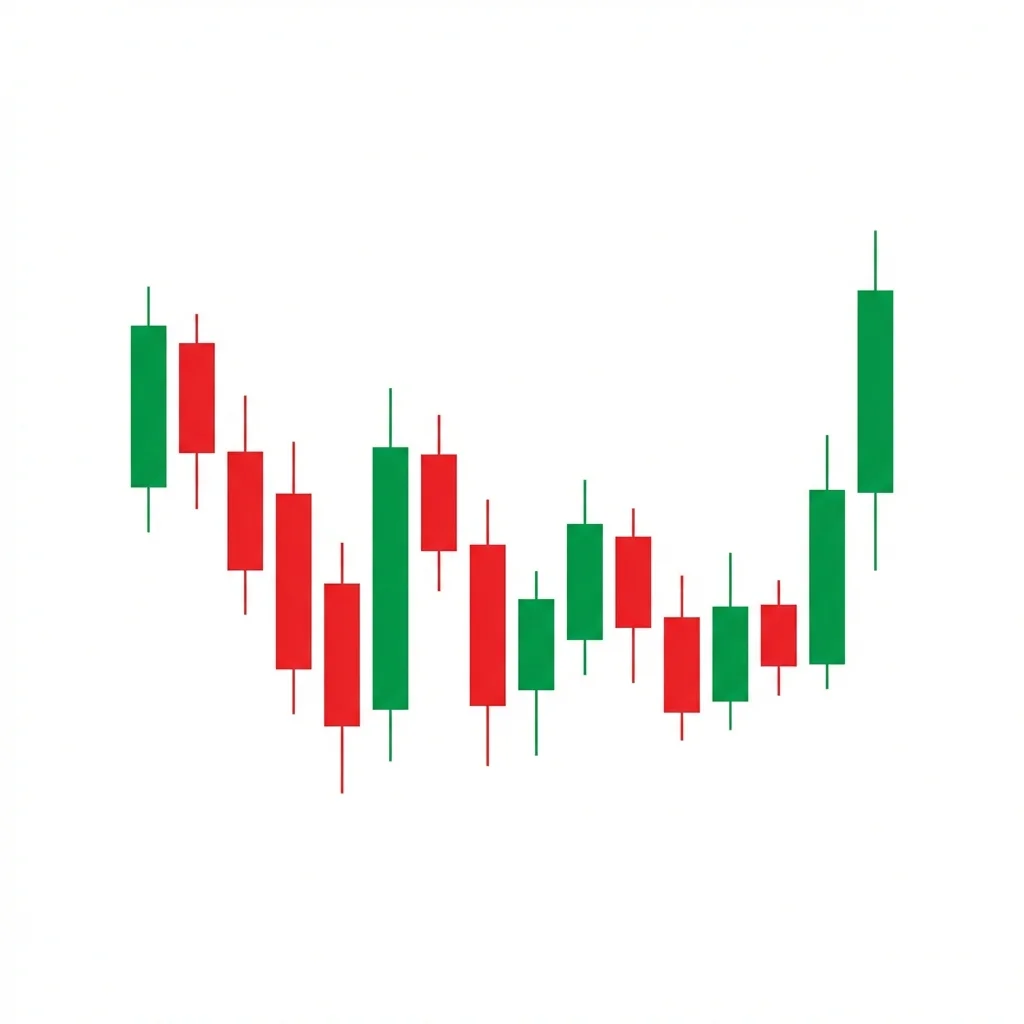
Bullish Falling Wedge
Also known as: Descending Wedge, Falling Wedge Reversal, Contracting Downward Wedge
The Falling Wedge is a bullish pattern with two converging downward-sloping trendlines. The narrowing range compresses energy that is released on an upside breakout, making it both a reversal pattern (after downtrends) and a continuation pattern (during uptrend corrections).
The Falling Wedge forms when price makes lower highs and lower lows within two converging, downward-sloping trendlines. The key distinction from a falling channel is that the trendlines converge rather than run parallel. This convergence shows that while sellers are pushing price lower, their momentum is decreasing (the range between each high and low narrows). The pattern resolves bullishly approximately 68% of the time, with the breakout occurring above the upper trendline. As a reversal pattern, it forms after a downtrend and signals a new uptrend. As a continuation pattern, it forms as a correction within an uptrend (a flag-like pullback) before the uptrend resumes.
History & Etymology
The falling wedge was classified by Edwards and Magee as one of the most reliable chart patterns. Thomas Bulkowski's extensive research confirmed its bullish bias, finding a 68% upward breakout rate. The pattern is widely taught in technical analysis education.
Wedge refers to the converging trendlines creating a wedge or funnel shape. Falling indicates both trendlines slope downward. Despite the downward appearance, the pattern is bullish because the convergence signals weakening bearish momentum.
How It Forms
Formation Steps
- 1Two downward-sloping trendlines that converge toward each other
- 2Upper trendline connects lower highs
- 3Lower trendline connects lower lows, but at a steeper angle
- 4Price oscillates between the converging lines with decreasing range
- 5Breakout occurs above the upper trendline
Prerequisites
- Converging trendlines both sloping downward
- At least two touches on each trendline
- The lower trendline should be steeper than the upper
Confirmation Signals
- Close above the upper trendline on volume
- Follow-through buying
- Volume increases on the breakout
Invalidation Signals
- Price breaks below the lower trendline with volume
- Pattern takes too long to resolve
- Volume expands on declines
Candle Breakdown
Wedge Interior
Price making progressively lower highs and lower lows with decreasing range.
Sellers push price lower but with diminishing force. Each swing is smaller than the last, showing momentum is fading.
Breakout Candle
A strong bullish candle breaking above the upper trendline.
The compressed energy releases upward. Buyers break through the weakened resistance of the upper trendline with conviction.
Psychology
The falling wedge compresses bearish energy until it dissipates. The progressively smaller swings show sellers losing conviction, and the breakout is the moment buyers take over.
Buyer Perspective
Buyers see the converging wedge as a coiled spring. They accumulate within the narrowing range and add aggressively on the breakout.
Seller Perspective
Sellers gradually lose steam. Each push lower produces less downside, frustrating their efforts until they capitulate on the breakout.
Smart Money Action
Institutions buy at the lower trendline of the wedge throughout its formation, building positions in the narrowing range. The breakout is where they add their final positions.
Retail Trader Trap
Retail shorts within the wedge are squeezed on the breakout. Those who sold at the lower trendline expecting continuation are trapped.
Emotional Cycle
Trading Strategy
Aggressive Entry
Enter long within the wedge when price bounces from the lower trendline near the apex.
Conservative Entry
Wait for a close above the upper trendline with volume.
The widest part of the wedge projected above the breakout point.
The origin of the wedge (where the downtrend began).
1.618x the wedge height.
Best Conditions
- Timeframe: 4h
- Timeframe: daily
- Timeframe: weekly
- After downtrends
- During uptrend corrections
- In any market environment where wedges form clearly
- Asset: stocks
- Asset: forex
- Asset: crypto
- Asset: futures
- Asset: ETFs
Avoid When
- Timeframe: 1m
- Timeframe: 5m
- In accelerating bear markets
Confluence Factors
- Declining volume within the wedge
- RSI divergence
- Wedge at a major support level
- 50 or 200 SMA acting as support at wedge low
- MACD divergence
Scale In Strategy
Enter 50% at the lower trendline near the apex, add 50% on the breakout.
Scale Out Strategy
Take 50% at the wedge height target, trail the rest.
Risk Management
Volume Analysis
Volume Confirmation
Volume should decrease as the wedge narrows and spike on the breakout.
Volume Profile
Declining volume pattern within the wedge is one of the most important confirmation signals.
Volume Divergence
Increasing volume on decline within the wedge suggests genuine selling, not just wedge compression.
Technical Confluence
Support Resistance
The upper trendline becomes support after the breakout. The lower trendline marks the historical demand zone.
Fibonacci Levels
Falling wedges often retrace 50-78.6% of the prior move, with the breakout resuming the prior trend.
Moving Averages
The 50 SMA often tracks near the upper trendline, and reclaiming it confirms the breakout.
Rsi Confirmation
RSI making higher lows while price makes lower lows (bullish divergence) is very common in falling wedges.
Macd Confirmation
MACD showing less negative momentum throughout the wedge confirms the weakening bearish trend.
Bollinger Bands
Bands contract during the wedge and expand on the breakout, confirming the volatility transition.
Vwap
Breaking above VWAP on the breakout day confirms institutional buying.
Ichimoku Cloud
Price often enters the cloud during the wedge and breaks above it on the breakout.
Elliott Wave
Falling wedges often form as Wave 2 or Wave 4 corrections (zigzag or complex corrections).
Wyckoff Phase
Can represent the final phase of accumulation before the markup begins.
Market Profile
The narrowing value area during the wedge gives way to range extension on the breakout.
Order Flow
Positive delta increasing despite lower prices within the wedge shows buyer absorption.
Open Interest
Rising open interest within the wedge confirms position building.
Multi-Timeframe Analysis
Higher Timeframe Alignment
A daily falling wedge within a weekly uptrend (correction) has the highest win rate.
Lower Timeframe Entry
Use the 4-hour chart to time the breakout entry within the wedge.
Timeframe Confluence
A weekly falling wedge is a major signal for multi-month trend changes.
Top-Down Approach
Weekly uptrend, daily falling wedge, 4-hour breakout entry.
Statistics
Historical Examples
Bitcoin Falling Wedge 2022
successBitcoin formed a falling wedge from $25,000 to $15,500 during late 2022. The breakout above the upper trendline near $17,500 in January 2023 launched a rally to $30,000+.
Lesson: Falling wedges in major assets, even during bear markets, can signal powerful reversals when the convergence is clear and volume confirms the breakout.
Variations
Steep Falling Wedge
A wedge with a steep downward angle.
Confusion Matrix
Patterns commonly confused with Bullish Falling Wedge and how to distinguish them.
Bullish Falling Channel Break
7000% similarMeasure the distance between the trendlines at the start and end. If it narrows, it is a wedge. If constant, it is a channel.
Key Differences
- Channels have parallel trendlines
- Wedges have converging trendlines
A rising wedge is a bearish pattern formed by two converging upward-sloping trendlines. As price makes higher highs and higher lows within the narrowing range, momentum diminishes. The breakdown below the lower trendline typically leads to a sharp decline targeting the base of the wedge.
The Bullish Engulfing is one of the most popular and reliable two-candle reversal patterns. A large bullish candle completely engulfs the prior bearish candle body, signaling a decisive shift from selling to buying control.
The Falling Channel Break occurs when price breaks above the upper boundary of a descending parallel channel, signaling the end of the downtrend and the beginning of a new bullish phase.
The Bullish Flag is the quintessential continuation pattern: a sharp rally (pole) followed by a brief, tight consolidation (flag) before the next leg up. It represents a healthy pause in a strong uptrend.
The Bullish Pennant is a continuation pattern featuring a sharp advance (flagpole) followed by a brief triangular consolidation (pennant), before price breaks out and continues higher with a measured move equal to the flagpole.
Three White Soldiers is one of the strongest bullish reversal patterns: three consecutive long bullish candles with progressively higher closes, each opening within the prior candle's body, signaling a powerful shift from bearish to bullish sentiment.
Pro Tips & Common Mistakes
Pro Tips
- The convergence of the trendlines is what distinguishes a wedge from a channel and is critical for the pattern
- Volume should noticeably decrease as the wedge narrows, like a coiled spring losing energy before release
- Falling wedges as continuation patterns within uptrends have higher win rates than reversal wedges
- The breakout in the final third of the wedge (near the apex) tends to be more powerful
- RSI divergence within the wedge is one of the most reliable leading indicators of the breakout
Common Mistakes
- Confusing falling wedges with falling channels (convergence vs. parallel lines)
- Not verifying that the trendlines actually converge
- Trading before the breakout confirms (buying within the wedge based on hope)
- Ignoring volume patterns
- Setting targets too small for a pattern that often produces large moves
Advanced Techniques
- Use the convergence rate to estimate the time of the breakout (where the lines meet)
- Combine with momentum divergence for early entry within the wedge
- Calculate the average swing-to-swing decline rate to confirm the deceleration
Institutional Perspective
Falling wedges are among the most programmed patterns in institutional algorithms. The convergence creates a mathematically identifiable structure that quant systems can detect and trade automatically.
Fun Facts
- Thomas Bulkowski found the falling wedge to be one of the top 5 most reliable chart patterns across all categories.
- The falling wedge is often called the opposite of the rising wedge, and their combined study reveals the fundamental principle that wedges tend to break opposite to their slope direction.
Frequently Asked Questions
Yes, the falling wedge breaks upward approximately 68% of the time, making it a bullish pattern regardless of whether it appears as a reversal (after a downtrend) or continuation (during an uptrend correction). The convergence of the trendlines inherently shows weakening bearish momentum.