
Overview
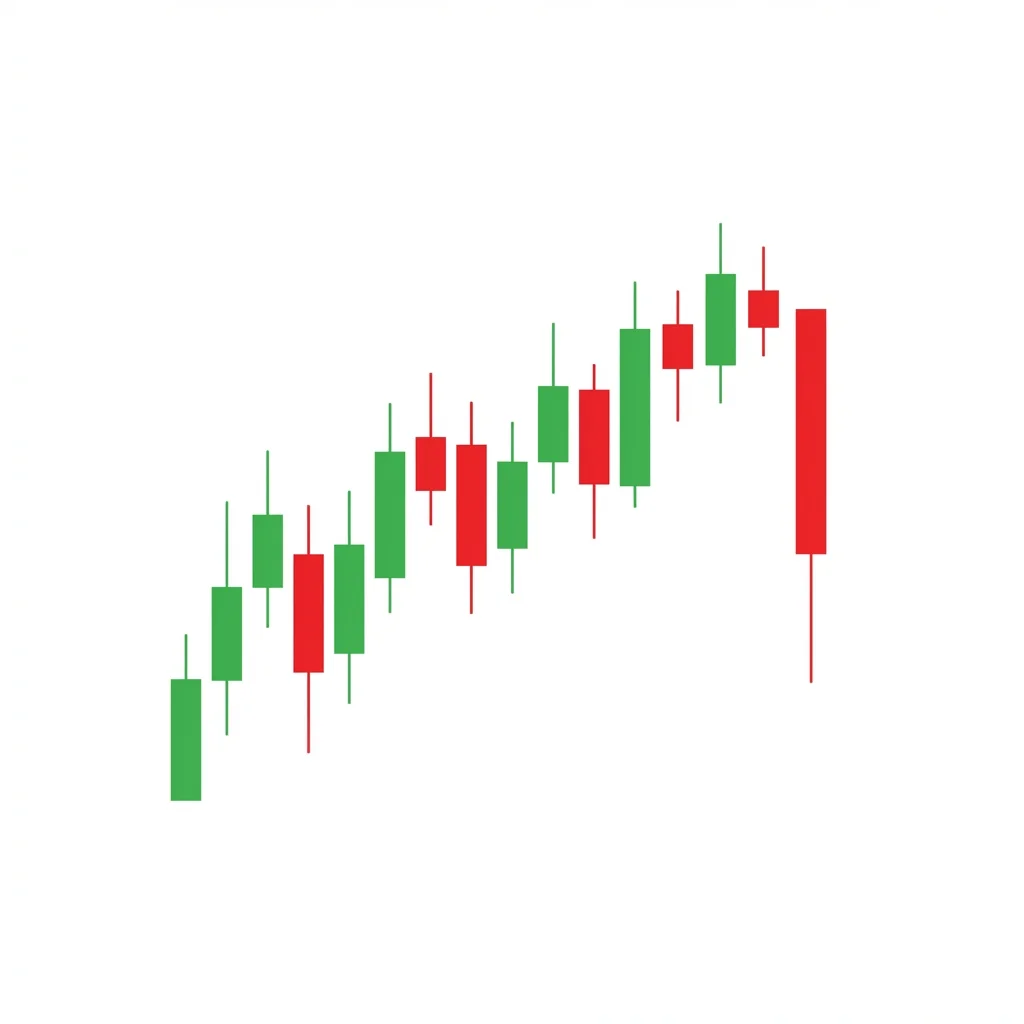
Bearish Rising Wedge
Also known as: Ascending Wedge, Rising Wedge Reversal, Bearish Wedge
A rising wedge is a bearish pattern formed by two converging upward-sloping trendlines. As price makes higher highs and higher lows within the narrowing range, momentum diminishes. The breakdown below the lower trendline typically leads to a sharp decline targeting the base of the wedge.
The rising wedge is one of the most reliable bearish chart patterns. It forms as price makes higher highs and higher lows, but the range between the highs and lows narrows progressively because the lower trendline rises at a steeper angle than the upper trendline. This convergence signals that buying pressure is weakening—each new high is harder to achieve, and support rises faster than resistance. The pattern can appear as a reversal signal in uptrends or as a continuation signal in downtrends (a corrective rally within a bear trend). Volume typically diminishes as the wedge forms and expands sharply on the breakdown. The minimum target is the base (widest point) of the wedge, but moves often exceed this target.
History & Etymology
Wedge patterns have been recognized in technical analysis since at least the 1930s, with Schabacker providing early descriptions. Edwards and Magee codified the rising wedge as an inherently bearish pattern in their 1948 classic, noting its high reliability. The pattern remains one of the most-studied formations in modern technical analysis.
'Rising' describes the upward slope of both trendlines. 'Wedge' refers to the converging shape, resembling a physical wedge being driven upward. The convergence implies diminishing momentum.
How It Forms
Formation Steps
- 1Price makes higher highs and higher lows within converging upward-sloping trendlines
- 2The upper trendline has a shallower slope than the lower trendline
- 3The range narrows as the wedge progresses toward the apex
- 4Price breaks below the lower trendline with increasing volume
Prerequisites
- Converging trendlines both sloping upward
- At least two touches on each trendline
- The pattern can appear in uptrends (reversal) or downtrends (continuation)
Confirmation Signals
- Close below the lower trendline of the wedge
- Volume spike on the breakdown
- Failed retest of the broken lower trendline
Invalidation Signals
- Price breaks above the upper trendline with strong volume
- The wedge resolves to the upside with momentum
- Volume pattern supports bullish continuation
Candle Breakdown
Wedge Formation Candles
A series of candles creating higher highs and higher lows within the converging trendlines. Bodies tend to get smaller as the wedge progresses.
Buying momentum is fading. Each new high is achieved with less conviction, and the narrowing range reflects increasing indecision.
Breakdown Candle
A large bearish candle that closes below the lower trendline of the rising wedge, confirming the bearish resolution.
The compressed energy of the wedge releases to the downside. Stop losses below the lower trendline trigger, creating a cascade of selling.
Psychology
The rising wedge represents a market where buyers are progressively losing their advantage. Each rally is weaker, and the narrowing range creates a pressure cooker that almost always resolves to the downside.
Buyer Perspective
Buyers keep pushing price higher but with diminishing returns. Each new high requires more effort, and the tightening range signals that the rally is running out of steam.
Seller Perspective
Sellers gradually gain confidence as the rallies weaken. The rising wedge shape tells them that gravity is taking hold, and the breakdown provides the trigger for aggressive short entries.
Smart Money Action
Smart money uses the rising wedge to distribute positions gradually, selling into each successively weaker rally. The breakdown marks the completion of their distribution.
Retail Trader Trap
Retail traders see higher highs and assume the uptrend will continue. They buy near the end of the wedge and are trapped when the breakdown occurs.
Emotional Cycle
Trading Strategy
Aggressive Entry
Enter short when price fails to reach the upper trendline within the wedge (lower high inside the wedge).
Conservative Entry
Wait for a close below the lower trendline with volume, then enter on a pullback to the broken trendline.
Base of the wedge (widest point) projected from the breakdown
61.8% Fibonacci retracement of the entire wedge move
Full retracement to the starting point of the wedge
Best Conditions
- Timeframe: 1D
- Timeframe: 4h
- Timeframe: 1W
- Late-stage rallies
- Corrective bounces in downtrends
- Overbought markets
- Asset: Stocks
- Asset: Indices
- Asset: Crypto
- Asset: Forex
Avoid When
- Timeframe: 1m
- Timeframe: 5m
- Strong momentum rallies
- Early-stage uptrends
Confluence Factors
- Volume declining throughout the wedge
- RSI bearish divergence
- Wedge forms near a resistance level
- Moving averages flattening or turning down
- The wedge is a corrective rally within a larger downtrend (continuation setup)
Scale In Strategy
Enter initial position on the breakdown, add on the pullback retest if the trendline holds as resistance.
Scale Out Strategy
Take 50% at the wedge base target, trail the rest to the full retracement level.
Risk Management
Volume Analysis
Volume Confirmation
Volume should decline throughout the wedge formation and surge 50%+ on the breakdown candle.
Volume Profile
Decreasing volume within the wedge is one of the most reliable confirming characteristics of the pattern.
Volume Divergence
Increasing volume on the rallies within the wedge may suggest the pattern will fail—monitor closely.
Technical Confluence
Support Resistance
The broken lower trendline becomes resistance. The base of the wedge often aligns with a key support level.
Fibonacci Levels
Rising wedges frequently end at the 61.8% or 78.6% Fibonacci retracement of a prior decline, making them ideal continuation setups in downtrends.
Moving Averages
Price typically crosses below the 50 SMA on or shortly after the wedge breakdown.
Rsi Confirmation
RSI showing lower highs while price makes higher highs within the wedge is classic bearish divergence.
Macd Confirmation
MACD histogram declining within the wedge confirms fading momentum despite higher prices.
Bollinger Bands
The Bollinger Bands contract during the wedge and expand on the breakdown, signaling a volatility breakout.
Vwap
Price falling below VWAP on the breakdown confirms the intraday shift to bearish.
Ichimoku Cloud
A wedge breakdown through the Kumo cloud provides strong Ichimoku bearish confirmation.
Elliott Wave
Rising wedges are the classic shape of corrective waves (Wave 2 or Wave B) in Elliott Wave theory—their breakdown starts the next impulse.
Wyckoff Phase
A rising wedge within a trading range may represent the upthrust before the sign of weakness in Wyckoff distribution.
Market Profile
The wedge apex often coincides with the value area high, and the breakdown rotates price back toward fair value.
Order Flow
Cumulative delta divergence (declining delta vs. rising price) within the wedge is a powerful leading indicator of the breakdown.
Open Interest
Monitor open interest changes for additional confirmation of institutional participation in the move.
Multi-Timeframe Analysis
Higher Timeframe Alignment
A daily rising wedge is most reliable when the weekly chart shows resistance or overbought conditions.
Lower Timeframe Entry
Use the 1H chart to time the exact breakdown from a daily wedge—look for a lower-timeframe break of structure at the lower trendline.
Timeframe Confluence
A 4H wedge within a daily downtrend is the ideal continuation setup.
Top-Down Approach
Weekly resistance > Daily rising wedge > 4H breakdown signal > 1H precise entry.
Statistics
Historical Examples
Bitcoin Rising Wedge 2021
successBitcoin formed a rising wedge between $55,000 and $64,000 with clearly declining volume. The breakdown led to a crash to $30,000 within two weeks.
Lesson: Rising wedges in crypto can produce exceptionally sharp breakdowns due to the highly leveraged nature of the market.
S&P 500 Rising Wedge Before COVID
successThe S&P 500 formed a rising wedge throughout January-February 2020. The breakdown coincided with COVID fears and led to a 35% crash.
Lesson: While the fundamental catalyst was unexpected, the technical pattern had been warning of vulnerability for weeks.
Variations
Terminal Wedge
A rising wedge that appears at the end of a 5-wave Elliott impulse, marking the terminal thrust before reversal.
Corrective Wedge
A rising wedge that forms as a counter-trend rally within a larger downtrend.
Confusion Matrix
Patterns commonly confused with Bearish Rising Wedge and how to distinguish them.
Bearish Rising Channel Break
7500% similarIf the trendlines converge toward an apex, it is a wedge. If they remain roughly parallel, it is a channel.
Key Differences
- Rising wedge has converging trendlines; rising channel has parallel trendlines
- Wedges have an inherent bearish bias due to narrowing range
- Channels are directionally neutral until they break
Bearish Ascending Triangle
5500% similarCheck the upper boundary. If it is flat, it is an ascending triangle. If it slopes upward, it is a rising wedge.
Key Differences
- Ascending triangles have a flat top and rising bottom; wedges have both lines sloping up
- Ascending triangles typically break upward; rising wedges break downward
- The patterns have opposite inherent biases
The Bearish Engulfing is one of the most powerful and commonly traded two-candle reversal patterns. A large bearish candle completely engulfs the prior bullish candle, demonstrating a decisive shift from buying to selling dominance.
A bearish reversal is the comprehensive transition from an uptrend to a downtrend, marked by a failure to make a new higher high, the formation of a lower high, and a break below the last higher low. It represents a fundamental shift in market sentiment from bullish to bearish.
A bearish rising channel break occurs when price has been trading within an ascending channel and breaks below the lower trendline, signaling the end of the uptrend. The measured target equals the channel's width projected downward from the breakout point.
The Falling Wedge is a bullish pattern with two converging downward-sloping trendlines. The narrowing range compresses energy that is released on an upside breakout, making it both a reversal pattern (after downtrends) and a continuation pattern (during uptrend corrections).
The Broadening Top (Megaphone) is a chart formation characterized by expanding price swings that create higher highs and lower lows, reflecting increasing volatility and instability at market tops before a bearish breakdown.
The Descending Channel is a chart formation where price trends lower within two parallel downward-sloping trendlines, making consistent lower highs and lower lows in an orderly bearish progression.
Pro Tips & Common Mistakes
Pro Tips
- Rising wedges that form on declining volume are the most reliable—this is the single most important confirmation factor.
- The pattern is even more powerful when it appears as a corrective rally within a larger downtrend (continuation setup).
- The breakdown typically occurs at 60-75% of the way from the base to the apex—don't wait for the apex to be reached.
- Count the number of internal oscillations: 4-6 swings within the wedge is ideal for a reliable breakdown.
- After the breakdown, the initial target is the base of the wedge, but moves often retrace the entire wedge.
Common Mistakes
- Confusing a rising wedge with a rising channel—check if the lines converge
- Entering short before the breakdown is confirmed—the wedge can continue longer than expected
- Not using volume as a filter—rising wedges without declining volume are less reliable
- Setting targets too conservatively—rising wedges often exceed their measured move
- Trading tiny wedges on low timeframes where the pattern loses significance
Advanced Techniques
- Use the convergence point (apex) of the wedge as a time target—if the breakdown hasn't occurred by 75% of the way to the apex, the pattern is weakening.
- Combine the wedge with Elliott Wave analysis: rising wedges as Wave B corrections within zigzags are among the most reliable bearish setups.
- Use implied volatility analysis: the declining volatility within the wedge creates cheap options, making put purchases particularly attractive.
- Apply Wyckoff effort vs. result analysis within the wedge to confirm that rallies are becoming increasingly effortful.
Institutional Perspective
Institutional traders recognize rising wedges as distribution patterns where smart money sells into increasingly weak rallies. The narrowing range tells them that demand is drying up, and the breakdown is a matter of when, not if.
Fun Facts
- Thomas Bulkowski's statistical research found the rising wedge to be one of the top-5 most reliable bearish chart patterns.
- In Elliott Wave theory, rising wedges often appear as 'ending diagonals'—the final exhaustion thrust before a major reversal.
- The Nifty 50 stocks of the 1970s collectively formed rising wedges before their spectacular collapse.
Frequently Asked Questions
Yes, a rising wedge is inherently bearish regardless of whether it appears in an uptrend (reversal) or downtrend (continuation). The converging trendlines with both sloping upward indicate fading momentum, and the pattern breaks to the downside approximately 68% of the time.
The minimum target is the base (widest point) of the wedge projected from the breakdown point. However, rising wedges frequently exceed this target, often retracing the entire wedge move.
Connect at least two higher highs for the upper trendline and at least two higher lows for the lower trendline. Both should slope upward, and they should converge toward a point (the apex). The lower trendline should have a steeper slope than the upper trendline.