
Overview
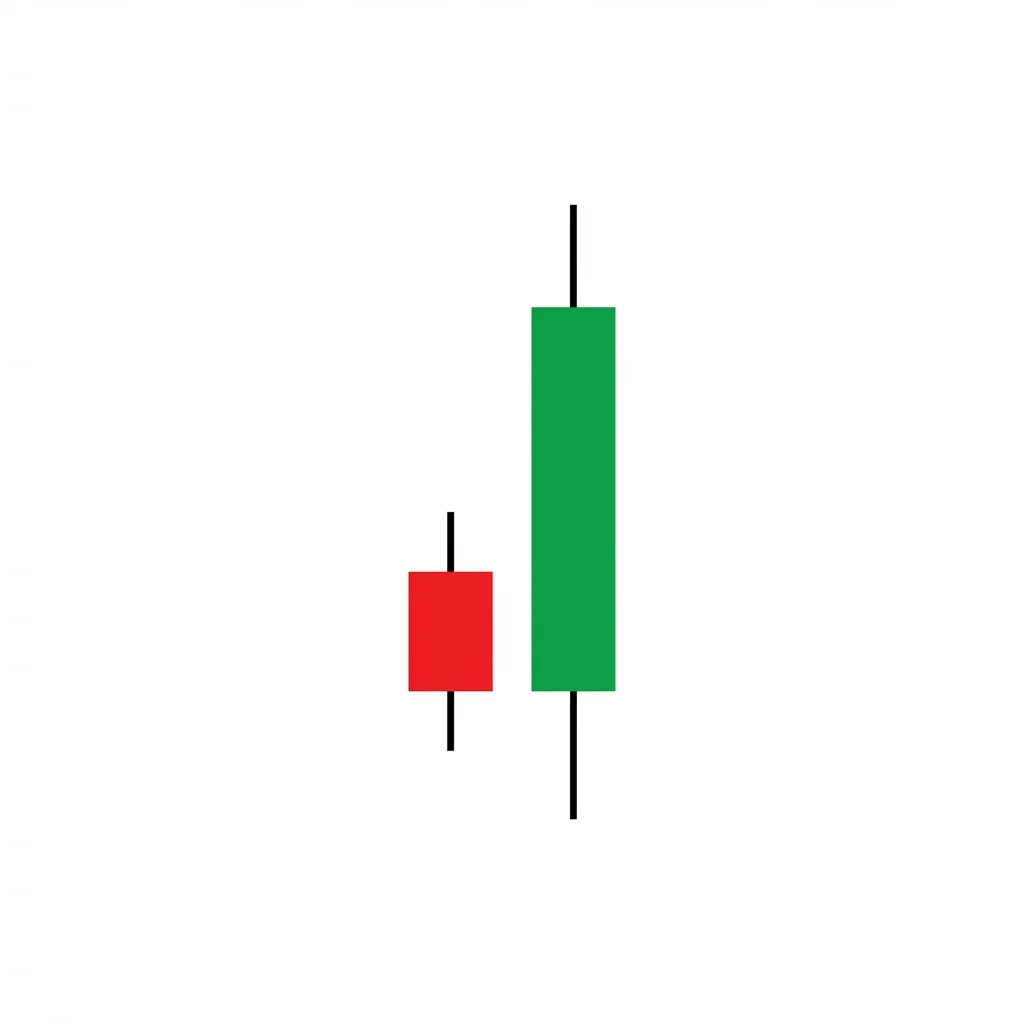
Bullish Engulfing
Tsutsumi
Also known as: Engulfing Bull, Outside Day Bullish, Bullish Wrap
The Bullish Engulfing is one of the most popular and reliable two-candle reversal patterns. A large bullish candle completely engulfs the prior bearish candle body, signaling a decisive shift from selling to buying control.
The Bullish Engulfing pattern forms when a bearish candle is followed by a larger bullish candle whose body completely contains the previous body. The second candle opens below the prior close (suggesting continued selling) but then rallies powerfully to close above the prior open. This complete engulfment visually demonstrates that buyers have overwhelmed sellers and seized control. The pattern is one of the most traded reversal signals due to its clarity, frequency, and reliability. It is particularly powerful when it appears after an extended downtrend at a key support level with above-average volume.
History & Etymology
The engulfing pattern is one of the fundamental patterns in Japanese candlestick analysis, called Tsutsumi (wrapping). It was used by Japanese rice traders for centuries before being introduced to Western markets by Steve Nison.
Engulfing means to swallow up or surround completely. The bullish candle engulfs (wraps around, swallows) the prior bearish candle body. The Japanese name Tsutsumi also means wrapping.
How It Forms
Formation Steps
- 1First candle: small bearish candle (any size body)
- 2Second candle: large bullish candle whose body completely engulfs (wraps around) the first candle body
- 3The second candle opens below the first candle close and closes above the first candle open
Prerequisites
- Established downtrend
- The second candle body must fully contain the first candle body
- The larger the second candle relative to the first, the stronger the signal
Confirmation Signals
- Third candle closes above the engulfing candle high
- Volume increases on the engulfing candle
- Subsequent sessions maintain above the engulfing low
Invalidation Signals
- Price drops below the engulfing candle low
- Next candle is strongly bearish
- Volume is low on the engulfing candle
Candle Breakdown
Bearish Setup
A small bearish candle that continues the downtrend.
The small bearish body suggests selling momentum is already weakening. The decline is losing steam.
Engulfing Candle
A large bullish candle that completely engulfs the first candle body.
Buyers overwhelm sellers decisively. Opening below the prior close suggests continued weakness, but the powerful rally and close above the prior open shows a complete reversal of control.
Psychology
The Bullish Engulfing captures the moment when buyer conviction overwhelms seller conviction. The visual engulfment represents a power takeover that is easy to see and understand.
Buyer Perspective
Buyers enter aggressively, driving price from below the prior close to above the prior open. This wide-ranging buying shows strong conviction and commitment.
Seller Perspective
Sellers see their prior session gains completely erased and then some. The psychological impact of being fully engulfed is significant and triggers covering.
Smart Money Action
Institutional buyers often create engulfing patterns by executing large buy programs that start at the open and continue through the session. The wide-ranging candle reflects their commitment.
Retail Trader Trap
Retail shorts who were comfortable with the bearish candle are shocked by the engulfing reversal. Their stops above the prior open are triggered.
Emotional Cycle
Trading Strategy
Aggressive Entry
Enter long at the close of the engulfing candle.
Conservative Entry
Wait for the third candle to close above the engulfing high, or enter on a pullback to the engulfing midpoint.
Engulfing candle body height projected above the close.
Next major resistance level.
Prior swing high before the downtrend.
Best Conditions
- Timeframe: 1h
- Timeframe: 4h
- Timeframe: daily
- Timeframe: weekly
- At support levels in downtrends
- Oversold conditions
- After panic selloffs
- Asset: stocks
- Asset: forex
- Asset: crypto
- Asset: futures
- Asset: ETFs
Avoid When
- Timeframe: 1m
- In strong bear markets with no support nearby
- In choppy ranges where engulfing patterns lose significance
Confluence Factors
- At a key support level
- RSI oversold
- At a moving average
- High volume
- Bullish divergence on oscillators
Scale In Strategy
Enter 60% on the engulfing close, add 40% on confirmation or pullback.
Scale Out Strategy
Take 50% at the body projection target, trail the remainder.
Risk Management
Volume Analysis
Volume Confirmation
Volume on the engulfing candle should be above average, ideally 1.5x the 20-day average.
Volume Profile
Heavy volume throughout the engulfing session, especially in the latter half as the engulfment completes.
Volume Divergence
A low-volume engulfing pattern is suspect and may not follow through.
Technical Confluence
Support Resistance
A bullish engulfing at a major support level is one of the most reliable setups in all of candlestick analysis.
Fibonacci Levels
An engulfing at a 50% or 61.8% Fibonacci retracement is a textbook setup.
Moving Averages
Engulfing patterns at the 200 or 50 SMA are high-probability trades.
Rsi Confirmation
RSI below 30 or showing bullish divergence during the engulfing confirms the reversal.
Macd Confirmation
MACD bullish crossover on the engulfing day adds conviction.
Bollinger Bands
An engulfing at the lower Bollinger Band is a strong mean-reversion signal.
Vwap
The engulfing candle reclaiming VWAP from below confirms institutional buying.
Ichimoku Cloud
An engulfing at the Kijun-sen or cloud boundary adds Ichimoku confirmation.
Elliott Wave
Often marks the beginning of Wave 1 or Wave 3 after a completed correction.
Wyckoff Phase
Can serve as the Sign of Strength after a spring in accumulation.
Market Profile
The engulfing candle creates a wide range that often becomes a reference point for future value areas.
Order Flow
Strong positive delta on the engulfing candle confirms aggressive institutional buying.
Open Interest
Rising open interest during the engulfing confirms new long positions.
Multi-Timeframe Analysis
Higher Timeframe Alignment
A daily engulfing within a weekly uptrend pullback is the ideal setup.
Lower Timeframe Entry
Use the 1-hour chart to time entry during the engulfing session.
Timeframe Confluence
A weekly engulfing is a very powerful signal for multi-week trends.
Top-Down Approach
Weekly trend, daily identifies engulfing at support, 4-hour times entry.
Statistics
Historical Examples
Apple Bullish Engulfing at $125 Support
successApple formed a textbook bullish engulfing at the $125 support level, with the large white candle on above-average volume completely engulfing the prior red candle. The stock rallied to $175 over the following months.
Lesson: Bullish engulfing patterns at major support in quality stocks provide some of the most reliable reversal entries available.
Variations
High-Volume Engulfing
Volume on the engulfing candle is more than 2x the 20-day average.
Gap-Down Engulfing
The engulfing candle opens with a gap below the first candle low.
Confusion Matrix
Patterns commonly confused with Bullish Engulfing and how to distinguish them.
Bullish Piercing Line
7000% similarCheck where the second candle closes relative to the first candle body. If it closes above the entire body, it is engulfing. If it only pierces above the midpoint, it is a piercing line.
Key Differences
- Piercing line closes above the midpoint but not above the first candle open
- Engulfing closes above the entire first candle body
Bullish Outside Reversal
9000% similarTechnically the engulfing pattern requires body engulfment, while an outside day refers to the entire range. In practice, many traders use the terms interchangeably.
Key Differences
- Outside reversal considers the entire range (including shadows)
- Engulfing specifically requires body engulfment
The Bearish Engulfing is one of the most powerful and commonly traded two-candle reversal patterns. A large bearish candle completely engulfs the prior bullish candle, demonstrating a decisive shift from buying to selling dominance.
The Bullish Confirmed Hammer adds a confirmation candle to the classic hammer pattern, significantly improving reliability by proving that buyers who defended the lows maintained control into the next session.
The Bullish Outside Reversal is a two-bar pattern where the second bar has a wider range than the first, trading both below its low and above its high before closing bullish. This dramatic range expansion signals a powerful shift from bearish to bullish control.
The Piercing Line is a two-candle bullish reversal pattern where a bearish candle is followed by a bullish candle that opens below the low and 'pierces' above the midpoint of the first candle's body, showing strong buying recovery.
The Bullish Three Inside Up is a three-candle reversal pattern that combines a bullish harami with a confirming third candle that closes above the first candle's open, providing a more reliable reversal signal than the harami alone.
The Bullish Three Outside Up is a three-candle reversal pattern combining a bullish engulfing with a confirming third candle that closes higher, providing one of the strongest reversal signals in candlestick analysis.
Pro Tips & Common Mistakes
Pro Tips
- The larger the second candle relative to the first, the stronger the signal
- The best engulfing patterns have the second candle opening below the first candle low (not just the close)
- Volume is crucial. A high-volume engulfing is far more reliable than a low-volume one
- Engulfing patterns that also engulf the shadows (not just the bodies) of the first candle are called outside days and are even stronger
- Look for the engulfing at key support levels for the highest win rates
Common Mistakes
- Calling a pattern engulfing when the second body does not fully contain the first body
- Trading engulfing patterns in the middle of a range where they have less directional meaning
- Ignoring volume on the engulfing candle
- Not recognizing that the pattern needs a downtrend context to be a bullish reversal
Advanced Techniques
- Measure the engulfing candle body as a percentage of ATR. Engulfing candles larger than 2x ATR are the most powerful
- Use the engulfing as a component in a multi-signal confirmation system (engulfing + oversold RSI + support = triple confirmation)
- Monitor the first 30 minutes of the engulfing session to decide if the reversal is institutional
Institutional Perspective
The bullish engulfing is widely used in institutional quantitative strategies as a reversal signal. Many systematic funds include it as one of their core candlestick pattern filters, especially when combined with volume and support/resistance context.
Fun Facts
- The Bullish Engulfing is the most searched candlestick pattern on the internet, according to search engine data.
- Thomas Bulkowski ranked the Bullish Engulfing as one of the top 10 most reliable candlestick patterns in his Encyclopedia of Candlestick Charts.
- Some algorithmic trading firms use the bullish engulfing as their sole candlestick entry signal, relying on context filters for confirmation.
Frequently Asked Questions
The traditional definition requires the second candle BODY to engulf the first candle BODY. It does not need to engulf the shadows. However, when the second candle engulfs both body and shadows (an outside day), the signal is even stronger.
Technically yes, but the smaller the first candle, the less impressive the engulfment. The pattern is most powerful when the first candle has a meaningful body that the second candle clearly overwhelms.