
Overview
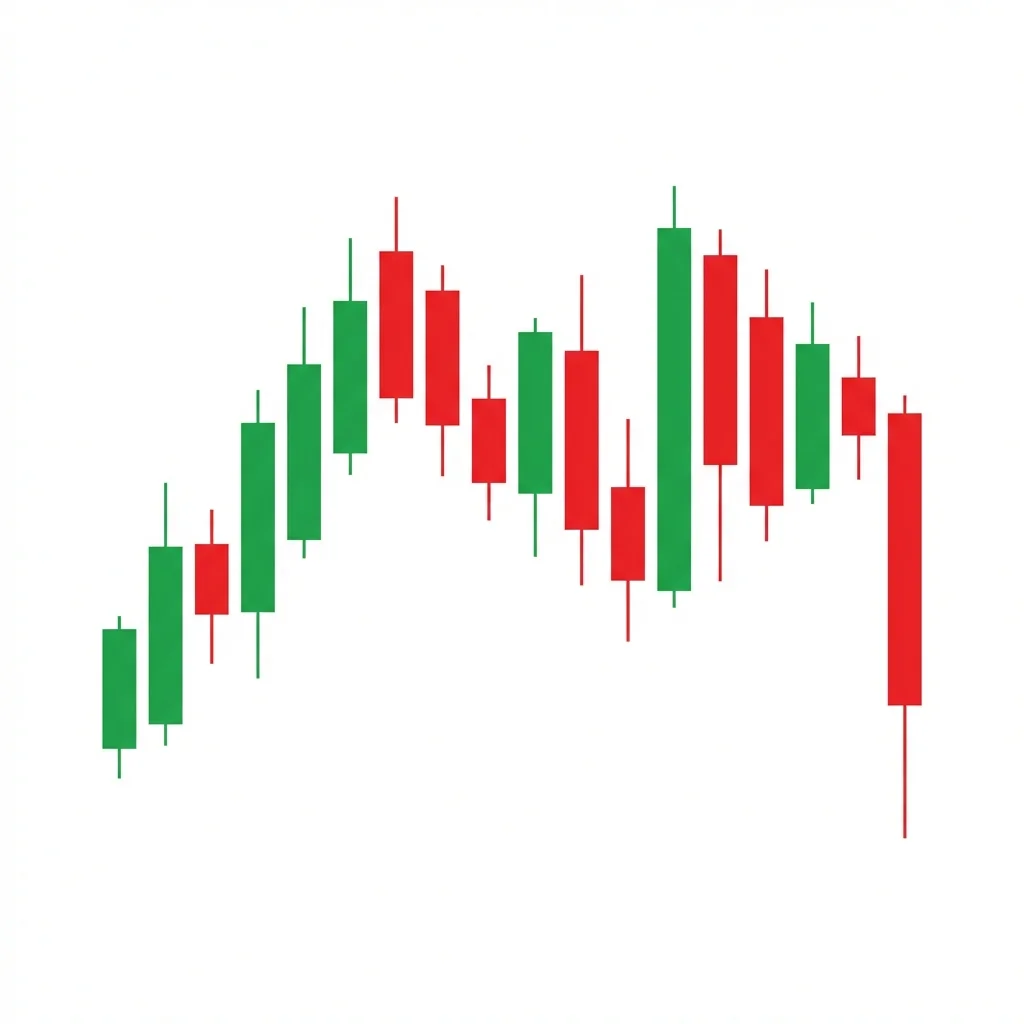
Bearish Diamond Top
Also known as: Diamond Top Reversal, Diamond Formation, Diamond Pattern
The Diamond Top is a rare reversal pattern that forms at market peaks, consisting of a broadening formation followed by a contracting formation, creating a diamond shape that signals a shift from expansion to contraction and ultimately a bearish breakdown.
The Diamond Top is one of the rarest and most complex chart patterns. It forms at market tops and consists of two phases: first, a broadening formation (expanding swings making higher highs and lower lows), followed by a contracting formation (narrowing swings making lower highs and higher lows). When trendlines are drawn connecting these swing points, the shape resembles a diamond. The pattern essentially combines a Broadening Top with a Symmetrical Triangle, reflecting a market that first becomes increasingly unstable and then settles into compression before breaking down. The Diamond Top is notoriously difficult to identify in real-time because the broadening phase can look like random volatility, and the contracting phase may not be apparent until it is well underway. However, when correctly identified, it is a powerful reversal signal. The measured move target is typically the height of the diamond projected downward from the breakdown point.
History & Etymology
The Diamond formation was documented by early 20th-century technical analysts. Edwards and Magee included it in their 1948 classic, noting its rarity and reliability. The pattern gained renewed attention in the 2000s when automated pattern recognition software made it easier to identify the complex formation.
The name 'diamond' refers to the shape created by the four trendlines connecting the highs and lows. When drawn, the pattern looks like a diamond or rhombus tilted on its side. The 'top' designation indicates it forms at market peaks.
How It Forms
Formation Steps
- 1First half: broadening formation — higher highs and lower lows (expanding volatility)
- 2Second half: contracting formation — lower highs and higher lows (decreasing volatility)
- 3The pattern resembles a diamond when trendlines are drawn connecting the highs and lows
- 4Breakdown occurs when price breaks below the lower-right trendline
Prerequisites
- Prior uptrend leading into the formation
- At least two swing points on each side (upper-left, upper-right, lower-left, lower-right) to form the diamond shape
- The pattern should form at a clear market top or resistance area
Confirmation Signals
- Break below the lower-right trendline on above-average volume
- Follow-through selling after the breakdown
- Volume expansion on the breakdown
- Failure to re-enter the diamond after breaking down
Invalidation Signals
- Breakout above the upper-right trendline on high volume
- Price consolidates within the diamond without breaking in either direction for an extended period
- Volume increases on upswings within the diamond
Candle Breakdown
Broadening Phase
Price swings become progressively wider, with higher highs and lower lows, forming the left half of the diamond.
Market instability increases. Bulls and bears become more aggressive, pushing price to wider extremes. Uncertainty peaks.
Widest Point (Diamond Center)
The widest swing in the pattern marks the transition from broadening to contracting.
Peak uncertainty. This is the most volatile part of the pattern. After this point, conviction on both sides begins to wane.
Contracting Phase
Price swings narrow progressively, with lower highs and higher lows, forming the right half of the diamond.
Energy coils. The decreasing volatility indicates that the market is building up for a decisive move. Traders await resolution.
Breakdown
Price breaks below the lower-right trendline, resolving the diamond bearishly.
The coiled energy releases bearishly. The accumulated selling pressure from the broadening phase and the compression of the contracting phase combine to fuel a powerful breakdown.
Psychology
The Diamond Top captures a two-phase psychological shift: first, increasing disagreement (broadening) as bulls and bears fight for control, then decreasing conviction (contracting) as both sides exhaust themselves, followed by a bearish resolution.
Buyer Perspective
Buyers are initially confident but become whipsawed by the broadening swings. During the contraction phase, their rallies get weaker. By the breakdown, buying enthusiasm is exhausted.
Seller Perspective
Sellers gain confidence as the pattern develops. The contracting phase shows them gaining the upper hand. The breakdown confirms their thesis and triggers aggressive short selling.
Smart Money Action
Institutions use the broadening phase to accumulate shorts, buying back on lows and selling on highs. During the contraction, they position for the breakdown. The diamond gives them time and liquidity to build large positions.
Retail Trader Trap
Retail traders get whipsawed during the broadening phase, buying highs and selling lows. During contraction, they hesitate, paralyzed by previous losses. The breakdown catches them flat-footed.
Emotional Cycle
Trading Strategy
Aggressive Entry
Short when the contracting phase is clear and price fails to make a new high.
Conservative Entry
Short on a confirmed close below the lower-right trendline with volume.
The diamond height (widest vertical measurement) projected below the breakdown.
1.5x the diamond height.
Major support level below the pattern.
Best Conditions
- Timeframe: daily
- Timeframe: weekly
- major market tops
- after extended rallies
- speculative peaks
- Asset: indices
- Asset: large-cap stocks
- Asset: commodities
Avoid When
- Timeframe: 1m
- Timeframe: 5m
- Timeframe: 15m
- trending markets with clear direction
Confluence Factors
- Pattern forms at or near all-time highs
- RSI divergence during the contracting phase
- Volume follows the expected pattern (expand, contract, spike)
- Market breadth deteriorating during the diamond formation
- Higher timeframe shows resistance at the diamond level
Scale In Strategy
Short 33% on lower high confirmation, add 33% on breakdown, add 34% on retest of the diamond.
Scale Out Strategy
Take 33% at 1x diamond height, 33% at 1.5x, trail 34%.
Risk Management
Volume Analysis
Volume Confirmation
Volume should increase during the broadening phase, decline during contraction, and spike on the breakdown.
Volume Profile
The ideal volume signature mirrors the diamond shape — high in the center, lower on the sides, spike on breakdown.
Volume Divergence
Declining volume during the contraction phase is essential — it confirms energy is being stored for the breakout.
Technical Confluence
Support Resistance
The diamond's boundaries create a complex support/resistance zone. After the breakdown, the entire diamond becomes an overhead supply zone.
Fibonacci Levels
The breakdown target often aligns with Fibonacci retracements of the uptrend that preceded the diamond.
Moving Averages
The diamond often forms around the 50-day MA. A break of the 200-day MA after the diamond breakdown is very bearish.
Rsi Confirmation
RSI making lower highs during the contracting phase while price is roughly flat provides strong confirmation.
Macd Confirmation
MACD declining during the diamond and making a bearish crossover at the breakdown adds conviction.
Bollinger Bands
Bollinger Bands expand during the broadening phase and contract during the compression — the Squeeze indicator fires at the breakdown.
Vwap
Anchored VWAP from the diamond's start often provides resistance after the breakdown.
Ichimoku Cloud
The diamond forming above the cloud with a breakdown through the Kijun-sen signals the start of a major reversal.
Elliott Wave
The Diamond Top often marks the end of an Expanded Flat (3-3-5) correction or the terminal pattern of a Wave 5.
Wyckoff Phase
The broadening phase aligns with the Buying Climax and early distribution. The contraction aligns with the Secondary Test and LPSY phases.
Market Profile
The diamond creates a broad value area. The breakdown below the value area low (VAL) confirms distribution completion.
Order Flow
The contraction phase shows decreasing delta and volume, while the breakdown shows explosive negative delta.
Open Interest
Rising OI during the contraction and breakdown confirms new short positions.
Multi-Timeframe Analysis
Higher Timeframe Alignment
A daily Diamond Top with weekly overbought conditions is extremely powerful.
Lower Timeframe Entry
After identifying the daily diamond, use the 4H chart to time the breakdown entry.
Timeframe Confluence
A weekly Diamond Top is one of the rarest and most powerful patterns in all of technical analysis.
Top-Down Approach
Monthly: cyclical peak. Weekly: Diamond Top forming. Daily: trade the breakdown.
Statistics
Historical Examples
Dow Jones Diamond Top 2007
successThe Dow formed a Diamond Top pattern on the weekly chart throughout 2007. The broadening phase reflected growing uncertainty about the subprime crisis, and the contraction preceded the breakdown that ultimately led to the 2008 financial crisis. The decline from the diamond was over 50%.
Lesson: Diamond Tops on weekly index charts are extremely rare and signal major market turning points. The 2007 Diamond was one of the most significant chart patterns in recent market history.
Variations
Asymmetric Diamond Top
The broadening phase is longer/wider than the contracting phase.
Diamond Top with False Upside Breakout
Price briefly breaks above the upper-right trendline before reversing and breaking down.
Confusion Matrix
Patterns commonly confused with Bearish Diamond Top and how to distinguish them.
Bearish Head Shoulders
5000% similarLook for the diamond's characteristic broadening-then-contracting phases. H&S has a more symmetrical three-peak structure.
Key Differences
- H&S has three defined peaks with a neckline
- Diamond has four boundaries forming a rhombus shape
- H&S does not require a broadening-then-contracting dynamic
Bearish Broadening Top
6500% similarIf the swings start narrowing after the broadest point, it is a Diamond. If they continue expanding or the pattern breaks down from the wide end, it is a Broadening Top.
Key Differences
- Broadening Top only has the expanding phase — no contraction follows
- Diamond Top transitions from broadening to contracting
- Diamond is essentially a Broadening Top + Symmetric Triangle
The Broadening Top (Megaphone) is a chart formation characterized by expanding price swings that create higher highs and lower lows, reflecting increasing volatility and instability at market tops before a bearish breakdown.
The Distribution phase is a Wyckoff concept where institutional investors systematically sell (distribute) their holdings to the public within a trading range at a market top, before the subsequent markdown (decline) begins.
The Double Top is an M-shaped reversal pattern where price tests a resistance level twice and fails, creating two peaks at similar levels. The breakdown below the neckline (trough between peaks) confirms the reversal with a measured move target equal to the pattern height.
The head and shoulders is the most well-known reversal pattern in technical analysis. It consists of three peaks — a higher middle peak (head) flanked by two lower peaks (shoulders) — and signals a major bearish reversal when the neckline breaks.
The Bullish Diamond Bottom is a complex reversal formation that transitions from expanding volatility to contracting volatility in a diamond shape, resolving with a bullish breakout as uncertainty transforms into directional conviction.
The Descending Channel is a chart formation where price trends lower within two parallel downward-sloping trendlines, making consistent lower highs and lower lows in an orderly bearish progression.
Pro Tips & Common Mistakes
Pro Tips
- The Diamond Top is one of the hardest patterns to identify in real-time. Use automated pattern recognition tools to assist with identification.
- The broadening-to-contracting transition is the key diagnostic feature. If you see expanding volatility followed by contracting volatility at a market top, consider a Diamond.
- The measured move target (diamond height projected from the breakdown) is typically achieved in 65-70% of cases.
- Diamond Tops on weekly or monthly charts signal major, multi-month reversals. These are rare opportunities for large-scale position trades.
- Volume analysis is essential — the expand-contract-spike volume pattern confirms the diamond structure.
Common Mistakes
- Seeing diamonds everywhere — the pattern is rare. Do not force it onto chart patterns that do not clearly show the broadening-to-contracting transition.
- Trading within the diamond — the whipsaw risk is extreme during both the broadening and contracting phases.
- Using tight stops after the breakdown. The diamond is a complex pattern and retests are common.
- Ignoring the broadening phase. If the pattern only shows contracting (no prior broadening), it is a triangle, not a diamond.
Advanced Techniques
- Use the Bollinger Band Width indicator to identify the broadening-to-contracting transition quantitatively.
- Calculate the diamond's symmetry. The more symmetrical the four sides, the more reliable the pattern.
- Use options straddles during the diamond formation and convert to directional on the breakdown.
Institutional Perspective
Diamond Tops are often the footprint of institutional distribution. The broadening phase reflects conflicting institutional views, and the contraction shows consensus forming around the bearish thesis. The breakdown is the final confirmation that institutions are positioned short.
Fun Facts
- The Diamond Top is so rare that many professional traders never see a textbook example on a major index in their entire career.
- The 2007 Dow Jones Diamond Top is often cited as one of the most significant chart patterns of the 21st century, preceding the 2008 financial crisis.
- Some automated pattern recognition algorithms struggle with Diamond Tops because the broadening-to-contracting transition is difficult to quantify algorithmically.
Frequently Asked Questions
Very rare. On daily charts, you might see one every few years on a major index. On weekly charts, they mark generational market tops. The pattern requires a specific broadening-then-contracting sequence that occurs infrequently.
Measure the diamond's height (the widest vertical distance within the pattern) and project that distance below the breakdown point. This measured move target is achieved approximately 65-70% of the time.
Yes, approximately 30-35% of Diamond Tops resolve with an upside breakout. Always wait for directional confirmation and maintain stops.