
Overview
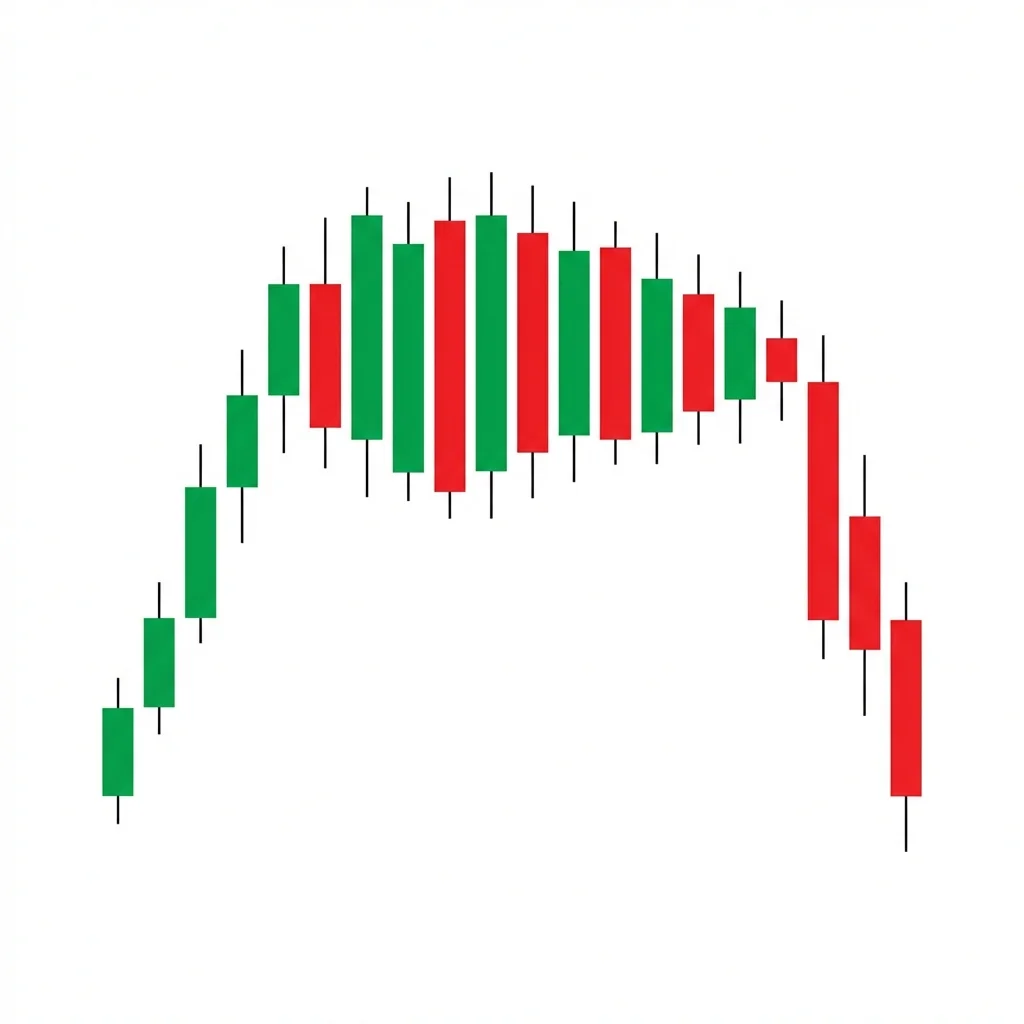
Bearish Distribution
Also known as: Distribution Phase, Wyckoff Distribution, Distribution Zone, Smart Money Distribution
The Distribution phase is a Wyckoff concept where institutional investors systematically sell (distribute) their holdings to the public within a trading range at a market top, before the subsequent markdown (decline) begins.
Distribution is the process by which institutional investors transfer large positions from strong hands (smart money) to weak hands (retail traders). It occurs within a trading range at the top of an uptrend. The range is not random — it follows a predictable schematic first described by Richard Wyckoff. The process begins with the Buying Climax (BC) where extreme volume signals peak demand. The Automatic Reaction (AR) follows, establishing the range's boundaries. Smart money then uses rallies within the range (Secondary Tests, Upthrusts) to sell remaining positions into retail demand. The Sign of Weakness (SOW) is the first break below the range, confirming distribution. The Last Point of Supply (LPSY) is the final rally before the markdown phase begins. Distribution can take weeks or months as institutions need time to offload massive positions without crashing the price. Understanding distribution is considered by many professional traders to be the single most valuable concept in technical analysis.
History & Etymology
Richard Wyckoff developed the distribution schematic in the 1930s based on his observation that markets are driven by a 'composite operator' (the aggregation of institutional activity). His method was based on reading the 'tape' (price and volume) to detect institutional intentions. Wyckoff's distribution concept has been validated repeatedly at every major market top over the past century.
The term 'distribution' comes from the financial concept of distributing shares from one group (institutional holders) to another (the public). Like distributing goods from a warehouse, institutions 'distribute' their stock holdings to retail buyers, emptying their inventory before prices decline.
How It Forms
Formation Steps
- 1Preliminary Supply (PSY): early signs of selling on increased volume
- 2Buying Climax (BC): extreme volume spike at the high — smart money distributes
- 3Automatic Reaction (AR): sharp sell-off after the BC, establishing the lower boundary
- 4Secondary Test (ST): rally back toward the BC level to test supply/demand balance
- 5Upthrust (UT): false breakout above the BC level — the bull trap
- 6Sign of Weakness (SOW): break below the AR level on increasing volume
- 7Last Point of Supply (LPSY): final weak rally before the markdown begins
Prerequisites
- Established uptrend preceding the distribution range
- Trading range forms at the top of the uptrend
- Volume characteristics follow the Wyckoff distribution schematic
- Time spent in the range is typically weeks to months
Confirmation Signals
- Sign of Weakness (SOW) — break below the support of the range on increased volume
- Last Point of Supply (LPSY) — weak rally that fails to reach the range midpoint
- Volume decreases on rallies and increases on declines within the range
- Multiple bearish candle patterns appear within the distribution range
Invalidation Signals
- Price breaks above the BC on high volume and sustains
- Volume increases on rallies within the range
- Higher lows start forming (re-accumulation instead of distribution)
Candle Breakdown
Buying Climax (BC)
Extreme volume spike with wide price range at the top. The climactic buying exhausts remaining demand.
Maximum euphoria. All remaining buyers pour in. Smart money uses this as the primary exit opportunity.
Automatic Reaction (AR)
Sharp decline from the BC area. This establishes the lower boundary of the distribution range.
The first shock. Buyers from the BC are immediately underwater. Panic selling begins but is absorbed by some buying.
Secondary Test (ST)
A rally back toward the BC level, typically on lower volume, testing whether supply has truly overcome demand.
Hope returns. Buyers think the AR was just a shakeout. But the lower volume on the rally reveals that demand is waning.
Sign of Weakness (SOW)
A decline that breaks below the AR low, confirming that supply is overwhelming demand.
Reality hits. The break below the range confirms distribution. Remaining holders begin to panic.
Psychology
Distribution is fundamentally about the transfer of risk from informed investors to uninformed investors. Smart money uses every tool available — media narratives, false breakouts, volatile swings — to maintain demand while they sell.
Buyer Perspective
Retail buyers during distribution believe they are buying during a 'healthy consolidation' or 'pause before the next leg up.' Each rally within the range reinforces this belief. The eventual breakdown shatters this narrative.
Seller Perspective
Institutional sellers have a clear plan: exit their positions within the trading range without causing panic. They sell in measured amounts, using rallies to offload, and may even buy briefly to support price and create buying opportunities for retail traders.
Smart Money Action
Institutions orchestrate the distribution process. They sell on strength (BC, ST, UT areas), support on weakness (to prevent premature panic), and gradually shift from net sellers to flat or short. The entire process is a masterclass in position management.
Retail Trader Trap
Retail traders are the 'bag holders' of distribution. They buy at the BC (FOMO), buy on the AR (bargain hunting), buy the ST (confirmation bias), buy the UT (breakout), and finally capitulate during the SOW and markdown. Every rally in the range is a trap.
Emotional Cycle
Trading Strategy
Aggressive Entry
Short on the Upthrust (UT) — the false breakout above the trading range.
Conservative Entry
Short after the Sign of Weakness (SOW) — the break below the range support.
The height of the distribution range projected below the SOW level.
The start of the uptrend that preceded the distribution.
Major support levels from the prior accumulation zone.
Best Conditions
- Timeframe: daily
- Timeframe: weekly
- end of bull market
- after extended uptrend
- at all-time highs
- Asset: stocks
- Asset: indices
- Asset: crypto
Avoid When
- Timeframe: 1m
- Timeframe: 5m
- Timeframe: 15m
- early-stage bull market
- post-accumulation breakout
Confluence Factors
- Declining OBV while price is flat (stealth distribution)
- Bearish divergence on RSI and MACD
- Narrowing market breadth during the distribution range
- Increasing put/call ratio
- Smart money flow indicators turning negative
Scale In Strategy
Short 25% on UT, add 25% on SOW, add 25% on LPSY failure, add 25% on markdown confirmation.
Scale Out Strategy
Take 25% at the range height target, 25% at the trend origin, trail 50%.
Risk Management
Volume Analysis
Volume Confirmation
Volume declining on rallies and increasing on declines within the range is the hallmark of distribution.
Volume Profile
High volume at the top of the range (distribution), low volume on rallies (lack of demand), high volume on declines (supply).
Volume Divergence
The most critical divergence: price staying flat or rising while On Balance Volume (OBV) declines — confirming silent distribution.
Technical Confluence
Support Resistance
The BC high and AR low define the range boundaries. The SOW breaks below the AR low. The LPSY fails to reach the BC high.
Fibonacci Levels
The AR typically retraces 38.2-50% of the BC rally. The markdown targets the 61.8-100% retracement of the entire prior uptrend.
Moving Averages
The 50 and 200 MAs often flatten during distribution. A Death Cross (50 below 200) during or after distribution confirms the bearish shift.
Rsi Confirmation
RSI failing to reach 70 on Secondary Tests and LPSYs shows weakening momentum — classic bearish divergence.
Macd Confirmation
MACD making lower highs during the distribution range while price makes roughly equal highs confirms distribution.
Bollinger Bands
Bollinger Bands narrow during the distribution range. The bandwidth squeeze before the SOW breakdown signals the impending volatility expansion.
Vwap
Anchored VWAP from the BC high drifts lower during distribution, acting as overhead resistance for rallies.
Ichimoku Cloud
The Kumo cloud flattens during distribution. Price falling below the cloud after the SOW confirms the trend change.
Elliott Wave
Distribution ranges often form between Wave 5 and the beginning of the corrective A wave.
Wyckoff Phase
This IS the Wyckoff Distribution phase — all Wyckoff events (PSY, BC, AR, ST, UT, SOW, LPSY) occur within this pattern.
Market Profile
The distribution range creates a broad value area at the top. The SOW is the migration of value below this area.
Order Flow
Cumulative delta declining during the range (more selling than buying) is the clearest order flow confirmation of distribution.
Open Interest
In futures, declining OI during rallies and rising OI during declines confirms distribution dynamics.
Multi-Timeframe Analysis
Higher Timeframe Alignment
A daily distribution range within a weekly overbought context is the highest-conviction bearish setup in technical analysis.
Lower Timeframe Entry
After identifying the daily distribution range, use the 4H chart to trade the individual events (UT, SOW, LPSY).
Timeframe Confluence
A weekly distribution range is a major structural pattern that can impact months to years of price action.
Top-Down Approach
Monthly: cyclical top. Weekly: distribution range forming. Daily: trade the Wyckoff events. 4H: manage positions.
Statistics
Historical Examples
S&P 500 Distribution Before 2008 Crisis
successThe S&P 500 underwent a classic Wyckoff distribution from mid-2007 to early 2008. The Buying Climax was the October 2007 all-time high. Multiple Secondary Tests and an Upthrust followed. The Sign of Weakness in January 2008 and LPSY in May 2008 preceded the crash. The total decline was 57%.
Lesson: The 2007-2008 distribution is a textbook Wyckoff example. Recognizing the BC, AR, ST, UT, and SOW events would have given months of warning before the crash.
Bitcoin Distribution 2021
successBitcoin formed a distribution range between $30,000 and $65,000 from April to November 2021. The April high was the BC, the May crash to $30,000 was the AR, the November retest of $69,000 was the UT/UTAD, and the subsequent decline to $15,500 was the markdown.
Lesson: Crypto distribution can take months with extreme volatility. The Upthrust (new all-time high in November) was the most devastating bull trap, trapping maximum retail buyers before the 77% markdown.
Variations
Simple Distribution
A distribution range without an Upthrust — just BC, AR, ST, SOW, LPSY.
Distribution with UTAD
Distribution with an Upthrust After Distribution (UTAD) — a strong false breakout above the BC level.
Confusion Matrix
Patterns commonly confused with Bearish Distribution and how to distinguish them.
Bullish Accumulation
6000% similarCheck the trend context and volume behavior. In distribution, volume rises on declines and falls on rallies — the opposite of accumulation.
Key Differences
- Accumulation occurs at bottoms; Distribution occurs at tops
- Accumulation: volume increases on rallies; Distribution: volume increases on declines
- Accumulation: institutional buying; Distribution: institutional selling
Bearish Head Shoulders
5500% similarIf you see the full Wyckoff schematic (BC, AR, ST, UT, SOW, LPSY), it is Distribution. If there are three clear peaks with a neckline, it may be an H&S within a distribution.
Key Differences
- H&S is a specific three-peak formation; Distribution is a broader process
- Distribution can contain an H&S as part of its structure
- H&S has a defined neckline; Distribution has a trading range
The Broadening Top (Megaphone) is a chart formation characterized by expanding price swings that create higher highs and lower lows, reflecting increasing volatility and instability at market tops before a bearish breakdown.
A Bull Trap is a false breakout above resistance that lures buyers in before immediately reversing, trapping them at elevated prices and triggering a sharp sell-off as trapped longs are forced to exit.
The Buying Climax is a Wyckoff concept describing the final blow-off top where extreme volume and wide price spreads signal that all remaining demand has been absorbed, leaving the market vulnerable to a sharp reversal and the beginning of distribution.
The Double Top is an M-shaped reversal pattern where price tests a resistance level twice and fails, creating two peaks at similar levels. The breakdown below the neckline (trough between peaks) confirms the reversal with a measured move target equal to the pattern height.
The head and shoulders is the most well-known reversal pattern in technical analysis. It consists of three peaks — a higher middle peak (head) flanked by two lower peaks (shoulders) — and signals a major bearish reversal when the neckline breaks.
Bullish Accumulation is a Wyckoff-based pattern where institutional investors quietly build large positions over an extended period, creating a trading range before a powerful markup phase begins.
Pro Tips & Common Mistakes
Pro Tips
- Distribution is a PROCESS, not an event. It takes weeks to months. Do not expect instant breakdowns.
- The Upthrust (UT or UTAD) is the best short entry in the entire Wyckoff method. It is a false breakout above the range that traps maximum buyers.
- On Balance Volume (OBV) is the single best indicator for detecting distribution. If OBV declines while price is flat, distribution is occurring.
- The Sign of Weakness (SOW) is the confirmation event. Before the SOW, you are anticipating distribution. After the SOW, you are trading the confirmed breakdown.
- Learn to distinguish distribution from re-accumulation. In re-accumulation, volume increases on rallies and the Spring (break below range) is quickly recovered.
Common Mistakes
- Confusing distribution with re-accumulation (a pause before another leg up). Volume behavior is the differentiator.
- Shorting too early in the distribution process — before the SOW confirms the breakdown.
- Ignoring the distribution because 'the trend is still up.' Distribution occurs AT the top, before the trend changes.
- Not recognizing the Upthrust as a false breakout. Many traders buy the UT thinking it is a genuine breakout.
- Expecting the markdown to begin immediately after the BC. Distribution requires patience.
Advanced Techniques
- Map each event of the Wyckoff distribution schematic in real-time: PSY, BC, AR, ST, UT/UTAD, SOW, LPSY. Each event provides a trading opportunity.
- Use the Effort vs. Result analysis: compare volume (effort) to price change (result). Large volume with small price gains = distribution.
- Monitor the Composite Man's intentions through cumulative delta and OBV. Negative cumulative delta during flat price = distribution.
- Use market profile to identify where institutional selling is concentrated within the distribution range.
Institutional Perspective
Distribution is the core strategy of institutional portfolio management at market tops. Fund managers cannot sell all at once — they must distribute over time. The trading range provides the time and liquidity needed. Every rally within the range is an opportunity to sell. The Wyckoff framework provides a roadmap for understanding this institutional process.
Fun Facts
- Richard Wyckoff was one of the most successful traders of the early 20th century. He developed his distribution methodology from direct observation of how large operators (like J.P. Morgan) manipulated stock prices.
- The Wyckoff method has been used continuously since the 1930s and has predicted every major market top, including 1929, 1987, 2000, 2007, and 2021.
- The 'Composite Man' concept — the idea that all institutional activity can be analyzed as if it were one entity — revolutionized how traders think about market structure.
Frequently Asked Questions
Distribution can last weeks to months. On daily charts, expect 20-100+ bars. The larger the institution's position, the longer they need to distribute. Major index distribution can take 6-12 months.
The key differentiator is volume behavior. In distribution, volume increases on declines and decreases on rallies. In re-accumulation, volume increases on rallies and decreases on declines. OBV trending down = distribution. OBV trending up = re-accumulation.
The Upthrust (UT/UTAD) is the best entry — it is a false breakout above the range that provides an entry near the high with a tight stop. The SOW is the safest entry — it confirms the distribution. The LPSY is the last entry — the final weak rally before the markdown.