
Overview
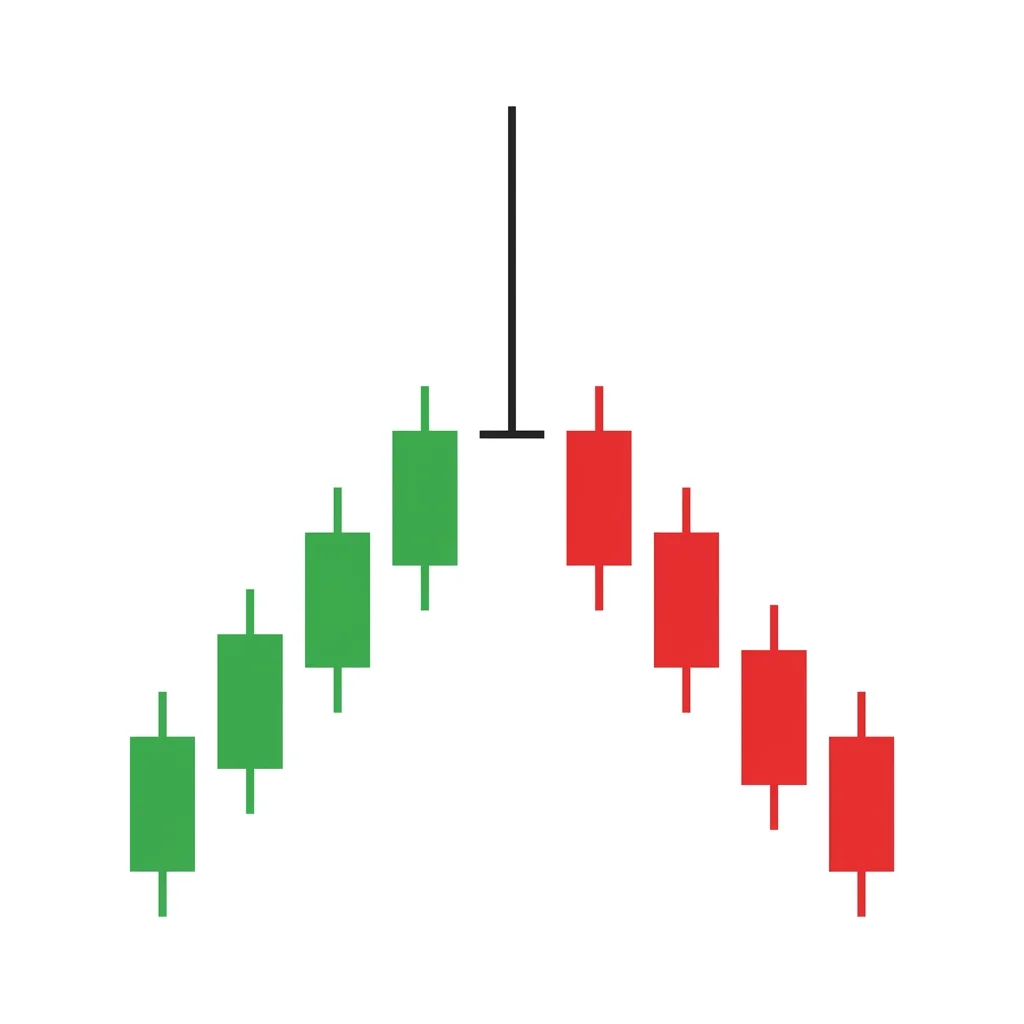
Bearish Gravestone Doji
Hakaishi
Also known as: Gravestone Doji, Tohba
The gravestone doji is a single-candle reversal pattern with the open, close, and low at the same level and a long upper shadow, resembling a gravestone. It signals that buyers pushed price higher but sellers reclaimed all gains by the close.
The gravestone doji is one of the most visually distinctive candlestick patterns. It forms when price rallies significantly during the session but closes at its opening price, erasing all gains. The resulting candle has a long upper shadow and virtually no body or lower shadow. When it appears at the top of an uptrend or at resistance, it signals that buying momentum is exhausted and sellers have taken control. The pattern is named for its resemblance to a gravestone — marking the 'death' of the uptrend.
History & Etymology
The gravestone doji is one of the original Japanese candlestick patterns documented in the Sakata method. Japanese rice traders viewed it as an ominous signal, believing it marked the resting place of fallen bulls. The pattern was introduced to Western traders through Steve Nison's pioneering work on Japanese candlesticks in the 1990s.
The Japanese name 'hakaishi' literally translates to 'gravestone.' The candle's shape — a vertical line rising from a flat base — visually resembles a gravestone or tombstone standing upright.
How It Forms
Formation Steps
- 1Open, close, and low are at or very near the same price (bottom of the candle)
- 2Long upper shadow extends significantly above the body
- 3Little to no lower shadow
Prerequisites
- Prior uptrend or rally
- Candle forms at or near a resistance level
Confirmation Signals
- Bearish candle following the gravestone doji
- Volume spike on the doji
- Gap down on the next candle
Invalidation Signals
- Strong bullish candle breaking above the doji's high next session
- No follow-through selling after the doji
- Doji forms in the middle of a range with no trend context
Candle Breakdown
Gravestone Doji
A candle where the open and close are at the low, with a long upper shadow. The body is a thin line (doji) at the bottom of the candle's range.
Bulls rallied hard but could not sustain any gains. Sellers overwhelmed buyers by the close, a stark sign of rejection at higher prices.
Psychology
The gravestone doji tells a complete story in one candle: buyers tried aggressively, reached for new highs, but were completely repelled. Every penny of gains was erased, signaling total seller domination by the close.
Buyer Perspective
Buyers who pushed price higher during the session are completely defeated. Those who bought during the rally are now trapped at higher prices with unrealized losses by the close.
Seller Perspective
Sellers demonstrate overwhelming strength by erasing the entire rally. This emboldens bears and signals that aggressive selling will continue in subsequent sessions.
Smart Money Action
Institutional sellers use the intraday rally to distribute shares at higher prices, then aggressively sell into the close. The gravestone doji is often the footprint of distribution.
Retail Trader Trap
Retail traders buy the breakout during the session's rally, only to see all gains vanish by the close. They hold hoping for recovery but face further losses.
Emotional Cycle
Trading Strategy
Aggressive Entry
Short on the next candle's open if it opens below the gravestone doji's close.
Conservative Entry
Wait for a bearish confirmation candle that closes below the gravestone doji's low, then enter short.
Length of the upper shadow projected downward from the doji's close.
Next significant support level.
Start of the prior uptrend (swing low).
Best Conditions
- Timeframe: daily
- Timeframe: 4h
- Timeframe: 1h
- Timeframe: weekly
- end of uptrend
- at resistance
- overbought conditions
- Asset: stocks
- Asset: forex
- Asset: indices
- Asset: crypto
Avoid When
- Timeframe: 1m
- Timeframe: 5m
- strong bull market
- breakout rally
- low volatility
Confluence Factors
- Forms at a known resistance level
- RSI shows overbought conditions (>70)
- Occurs at a round psychological number
- MACD showing bearish divergence
- Forms at a Fibonacci retracement level
Scale In Strategy
Enter full position on confirmation. Do not scale into gravestone doji trades as the stop is already tight.
Scale Out Strategy
Take 50% at TP1, trail the rest.
Risk Management
Volume Analysis
Volume Confirmation
High volume on the gravestone doji confirms institutional selling at the high. Above-average volume is ideal.
Volume Profile
The upper shadow area should show a spike in volume that was rejected — indicating failed absorption of supply.
Volume Divergence
If volume is low on the gravestone doji, it may be a pause rather than a reversal — wait for confirmation.
Technical Confluence
Support Resistance
The gravestone doji is most powerful at known resistance levels. The upper shadow high marks a rejection point that may become resistance on future tests.
Fibonacci Levels
A gravestone doji at the 61.8% or 78.6% Fibonacci retracement of a prior decline is an extremely strong short signal.
Moving Averages
Gravestone doji forming at the 50 or 200 SMA from below is a high-probability reversal signal.
Rsi Confirmation
RSI above 70 when the gravestone doji forms confirms overbought exhaustion.
Macd Confirmation
MACD bearish divergence (price making higher high but MACD making lower high) combined with a gravestone doji is a powerful sell signal.
Bollinger Bands
A gravestone doji that pierces the upper Bollinger Band and closes back inside is classic reversal confirmation.
Vwap
Gravestone doji forming above VWAP with a close back at or below VWAP is bearish.
Ichimoku Cloud
A gravestone doji at the top of the Kumo cloud or at the Senkou Span B line is an excellent short setup.
Elliott Wave
Gravestone dojis often mark the end of Wave 5 or the end of a corrective Wave C rally.
Wyckoff Phase
The gravestone doji is a classic upthrust pattern in Wyckoff, occurring during distribution phases.
Market Profile
The long upper shadow represents price exploration that was rejected — a failed auction above value area.
Order Flow
Large sell imbalance visible at the upper shadow's high. Passive selling absorbed all aggressive buying.
Open Interest
In options, large call open interest at the doji's high can act as a ceiling where market makers sell to hedge.
Multi-Timeframe Analysis
Higher Timeframe Alignment
A gravestone doji on the weekly chart is far more powerful than on the daily. Weekly gravestone dojis at major resistance can signal multi-week reversals.
Lower Timeframe Entry
Use the lower timeframe to see the internal structure — the intraday chart will show a rally followed by a complete reversal, allowing precise entry timing.
Timeframe Confluence
A gravestone doji visible on both the 4H and daily charts at the same resistance level is a very high-probability setup.
Top-Down Approach
Weekly resistance → Daily gravestone doji → 4H confirmation candle → Enter on 1H bearish pattern.
Statistics
Historical Examples
Apple Gravestone Doji at ATH
successApple formed a gravestone doji at its all-time high near $182, followed by a decline of over 15% in the subsequent weeks as the broader tech sell-off began.
Lesson: Gravestone dojis at all-time highs in market leaders can signal major trend reversals.
EUR/USD Gravestone at 1.2350
successEUR/USD formed a gravestone doji at the 1.2350 resistance level, which had been tested multiple times. The pair declined over 400 pips in the following weeks.
Lesson: Gravestone dojis at multi-test resistance levels are among the most reliable setups in forex.
Variations
Perfect Gravestone Doji
Open, close, and low are at the exact same price with zero lower shadow.
Near-Gravestone Doji
Small body at the bottom with a tiny lower shadow but dominant upper shadow.
Confusion Matrix
Patterns commonly confused with Bearish Gravestone Doji and how to distinguish them.
Bearish Shooting Star
85% similarIf the open and close are at the exact same price (or within a tiny fraction), it is a gravestone doji. If there is a visible small body, it is a shooting star.
Key Differences
- Gravestone doji has virtually no body (open equals close)
- Shooting star has a small real body at the bottom
- Gravestone doji has no lower shadow; shooting star may have a small one
Bearish Long Upper Shadow
70% similarMeasure the body relative to the upper shadow. A gravestone doji has essentially zero body. A long upper shadow candle has a visible body.
Key Differences
- Long upper shadow candle has a more significant body
- Gravestone doji's body is essentially a line (doji)
- Long upper shadow can be bullish or bearish colored
The Dark Cloud Cover is a two-candle bearish reversal pattern where a bearish candle opens above the prior bullish candle's high and closes below its midpoint, signaling that the bullish 'sky' is being covered by a bearish 'dark cloud.'
The Bearish Doji Star is a two-candle reversal pattern featuring a strong bullish candle followed by a doji that gaps above it, signaling that buying momentum has stalled and indecision has replaced conviction at the top of an uptrend.
The Bearish Engulfing is one of the most powerful and commonly traded two-candle reversal patterns. A large bearish candle completely engulfs the prior bullish candle, demonstrating a decisive shift from buying to selling dominance.
The hanging man is a single-candle bearish reversal pattern with a small body at the top and a long lower shadow, appearing at the top of an uptrend. It warns that selling pressure is emerging despite the continued uptrend.
A candle with a long upper shadow (at least 2-3x the body) indicates that price rallied significantly during the session but was rejected, closing near the low. It signals selling pressure and potential reversal at the top of rallies.
The shooting star is a single-candle bearish reversal pattern with a small body near the low and a long upper shadow. It shows that buyers pushed price significantly higher during the session but sellers drove it back down, signaling a potential top.
Pro Tips & Common Mistakes
Pro Tips
- The longer the upper shadow, the more bearish the signal — it shows a more aggressive failed rally.
- A gravestone doji with above-average volume is significantly more reliable than one with low volume.
- Always wait for confirmation — a standalone gravestone doji fails about 44% of the time.
- The high of the gravestone doji becomes a significant resistance level going forward.
Common Mistakes
- Trading every gravestone doji without context — it needs to be at the top of an uptrend or at resistance.
- Not waiting for confirmation — entering short immediately on the doji is premature.
- Setting the stop too far above the high — the tight stop is one of the pattern's advantages.
- Confusing a gravestone doji in a downtrend (which is meaningless) with one at the top of an uptrend.
Advanced Techniques
- Combine with volume profile: if the gravestone doji's high corresponds to a high-volume node rejection, the signal is much stronger.
- Use the gravestone doji as a distribution signal — check if other distribution indicators (Wyckoff, accumulation/distribution line) confirm.
- Look for gravestone dojis on multiple correlated assets simultaneously — this suggests a sector-wide reversal.
- Use options flow analysis: heavy call selling or put buying at the doji's high confirms institutional bearish positioning.
Institutional Perspective
Institutions often create gravestone doji patterns by selling aggressively into the close after a rally. The pattern is the footprint of institutional distribution — they sell into retail buying during the session and drive the close back to the open.
Fun Facts
- The gravestone doji is one of the few candlestick patterns whose name directly references death — Japanese traders saw it as a literal tombstone for the trend.
- Some Japanese texts suggest the long upper shadow represents the spirits of dead traders reaching for the sky before being pulled back to earth.
- The gravestone doji was one of the first candlestick patterns taught to Western traders and remains one of the most widely recognized.
Frequently Asked Questions
A gravestone doji at the top of an uptrend indicates that buyers failed to sustain gains and sellers took complete control by the close. It is a bearish reversal signal that suggests the uptrend may be ending.
The gravestone doji is primarily a bearish reversal pattern when it appears at the top of an uptrend. At the bottom of a downtrend, it is less significant and should not be relied upon as a reversal signal.
As a standalone pattern, the gravestone doji has a win rate of around 56%. With confirmation from a follow-through bearish candle and supporting confluence factors, reliability increases to 65-70%.