
Overview
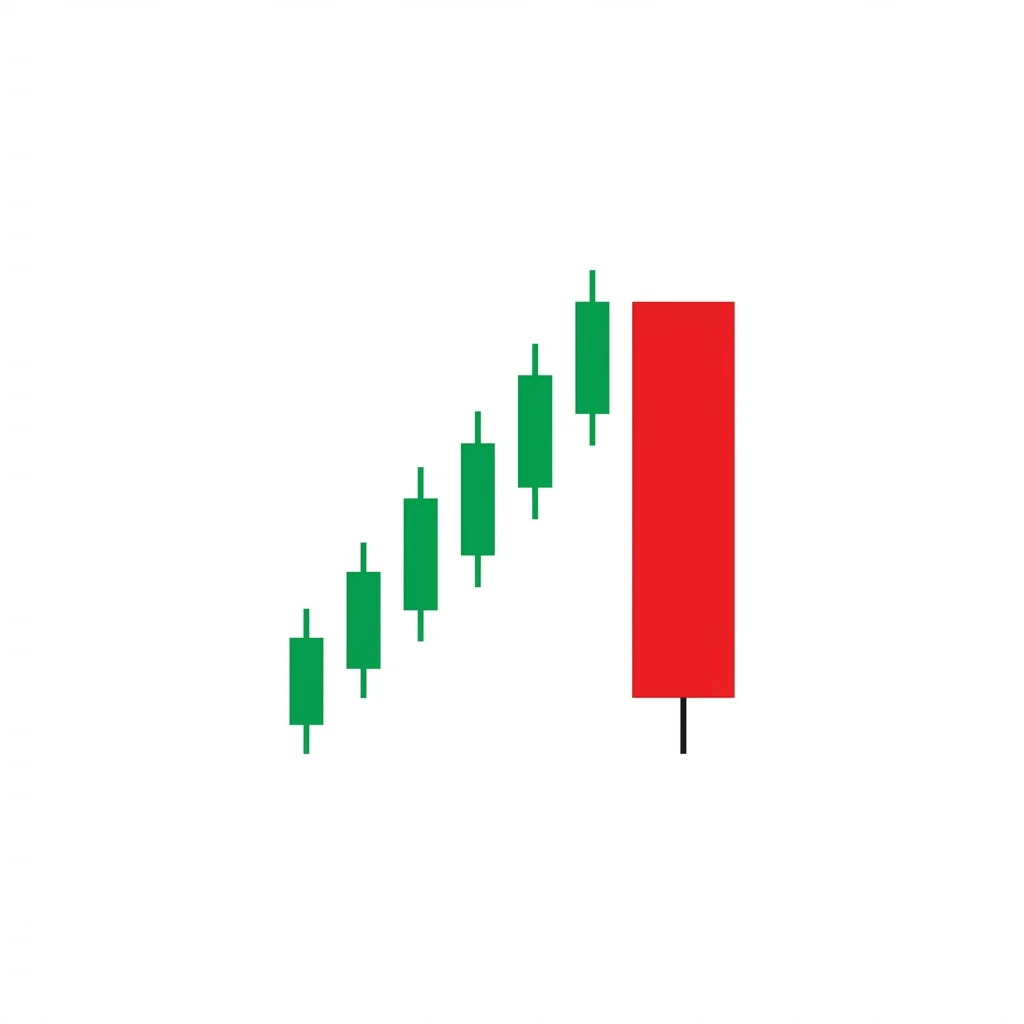
Bearish Opening Marubozu
Yoritsuki Marubozu
Also known as: Opening Shaved Candle, Open Equals High Candle
The bearish opening marubozu is a single candle where the open equals the high (no upper shadow), showing that sellers took immediate control at the open and maintained pressure throughout the session. A small lower shadow may be present.
The opening marubozu is a variant of the marubozu where the open equals the session's high — meaning there was no upside exploration at all. From the opening tick, price only went down. A small lower shadow may exist (some buying near the close), but the key feature is the absence of any upper shadow. This shows that selling began immediately and never relented during the session. It is slightly less powerful than the full marubozu (which has no shadows at all) because the lower shadow shows some late-session buying, but it remains a strong bearish signal indicating institutional selling from the open.
History & Etymology
The opening marubozu (yoritsuki marubozu) is part of the Japanese candlestick classification system. Japanese traders distinguished between opening marubozu (no upper shadow) and closing marubozu (no lower shadow) to understand whether sellers dominated from the open or into the close.
Yoritsuki (寄り付き) means 'opening' in Japanese market terminology. Combined with marubozu (bald/shaved), the name means 'bald from the opening' — no shadow on the opening side.
How It Forms
Formation Steps
- 1Open price equals the high of the session (no upper shadow)
- 2Large bearish body
- 3May have a small lower shadow
- 4Sellers took control immediately at the open and maintained pressure
Prerequisites
- Can appear in any trend context
Confirmation Signals
- Follow-through selling the next session
- Volume above average
- Close near the low of the range
Invalidation Signals
- Strong bullish reversal next session
- Low volume
- Immediate recovery above the open
Candle Breakdown
Opening Marubozu
A bearish candle where the open is at the high (no upper shadow). The body is large, and a small lower shadow may exist.
Sellers controlled from the very first tick. There was zero buying attempt to push above the opening price. The small lower shadow shows minimal late-session buying.
Psychology
The opening marubozu shows that sellers dominated immediately from the session's start. There was no morning rally, no opening range battle — just straight down from tick one.
Buyer Perspective
Buyers never had a chance. The opening marubozu gives them no entry point above the open, and the session's decline only worsens their position.
Seller Perspective
Sellers assert control from the opening bell. The immediate decline shows aggressive market-on-open sell orders and sustained selling pressure.
Smart Money Action
Institutional sell programs often begin at the open with market-on-open orders, creating the opening marubozu. The immediate selling creates the 'shaved' upper side.
Retail Trader Trap
Retail traders looking to buy the open are immediately underwater. The lack of any upside makes it impossible to get a favorable entry.
Emotional Cycle
Trading Strategy
Aggressive Entry
Short during the first 15 minutes of the session if the candle is forming as an opening marubozu.
Conservative Entry
Short on the next session's open if the opening marubozu completes.
Body length projected downward.
Next support level.
2x the body length.
Best Conditions
- Timeframe: daily
- Timeframe: 4h
- Timeframe: 1h
- downtrend
- catalyst-driven selling
- high volatility
- Asset: stocks
- Asset: forex
- Asset: indices
- Asset: crypto
Avoid When
- Timeframe: 1m
- Timeframe: 5m
- low volatility
- oversold
Confluence Factors
- In a downtrend
- High opening volume
- Bearish catalyst
- Below moving averages
- Sector weakness
Scale In Strategy
Enter 50% on the candle, 50% on break below the low.
Scale Out Strategy
Take 50% at TP1, trail rest.
Risk Management
Volume Analysis
Volume Confirmation
High opening volume confirms institutional selling from the open.
Volume Profile
Volume concentrated at the open and distributed throughout the session confirms sustained selling.
Volume Divergence
Low volume opening marubozu is less significant.
Technical Confluence
Support Resistance
The open/high level becomes resistance. The absence of any upper shadow means there was no buying above this level.
Fibonacci Levels
The midpoint (50%) of the opening marubozu often acts as resistance on retests.
Moving Averages
Opening marubozu breaking below MAs confirms bearish momentum.
Rsi Confirmation
RSI declining on the opening marubozu.
Macd Confirmation
MACD negative or crossing bearish.
Bollinger Bands
Opening marubozu near or below the lower band.
Vwap
Opening far below VWAP and staying there throughout confirms selling.
Ichimoku Cloud
Opening marubozu below Kumo.
Elliott Wave
Common in Wave 3 where selling is most aggressive.
Wyckoff Phase
Sign of weakness (SOW) or markdown candle.
Market Profile
Trend day profile — open to low.
Order Flow
Extreme negative delta from the opening tick.
Open Interest
New shorts being initiated.
Multi-Timeframe Analysis
Higher Timeframe Alignment
Weekly opening marubozu is very powerful.
Lower Timeframe Entry
The intraday chart shows an opening selloff — use 15m for confirmation.
Timeframe Confluence
Opening marubozu on daily within a weekly downtrend.
Top-Down Approach
Weekly bearish → Daily opening marubozu → Enter.
Statistics
Historical Examples
Intel Opening Marubozu 2022
successIntel formed a bearish opening marubozu after disappointing earnings. Price opened at the high and sold off throughout the session, with only a tiny lower shadow. The stock declined further over the following weeks.
Lesson: Post-earnings opening marubozu patterns indicate immediate institutional selling and tend to follow through.
Variations
Clean Opening Marubozu
Open equals high with essentially no lower shadow either.
Tailed Opening Marubozu
Open equals high but with a noticeable lower shadow.
Confusion Matrix
Patterns commonly confused with Bearish Opening Marubozu and how to distinguish them.
Bearish Marubozu
90% similarIf there is a lower shadow (even small), it is an opening marubozu. If there are zero shadows, it is a full marubozu.
Key Differences
- Full marubozu has NO shadows at all
- Opening marubozu has no UPPER shadow but may have a LOWER shadow
- Full marubozu shows complete seller control; opening marubozu shows initial seller control with slight late buying
Bearish Closing Marubozu
80% similarCheck which shadow is missing: upper shadow missing = opening marubozu. Lower shadow missing = closing marubozu.
Key Differences
- Opening marubozu: no UPPER shadow (open = high)
- Closing marubozu: no LOWER shadow (close = low)
- They are complementary — opening shows immediate selling, closing shows selling into the close
The Bearish Closing Marubozu is a single bearish candle with no lower shadow — the close is at the exact low of the session. This indicates that sellers controlled the session and maintained pressure through the very last trade, a sign of strong bearish conviction.
The Bearish Engulfing is one of the most powerful and commonly traded two-candle reversal patterns. A large bearish candle completely engulfs the prior bullish candle, demonstrating a decisive shift from buying to selling dominance.
A falling window is a Japanese candlestick term for a gap down in price where the high of the current candle is below the low of the previous candle, signaling strong bearish continuation momentum.
The bearish marubozu is a single candle with no shadows — price opened at the high and closed at the low, showing complete seller domination throughout the entire session with no buying resistance.
The Opening Marubozu is a bullish candle with no lower shadow — the open IS the low — showing that from the moment the session opened, buyers were in control and never let price trade below the open.
The Bearish Belt Hold is a single bearish candle that opens at its high and closes near its low with a long body, indicating that sellers dominated from the opening bell and controlled price action throughout the session.
Pro Tips & Common Mistakes
Pro Tips
- The absence of an upper shadow means sellers were in control from tick one — this is more significant than a candle with early buying that failed.
- Compare with the closing marubozu: the opening marubozu shows decisiveness at the start; the closing marubozu shows decisiveness at the end.
- The lower shadow shows some buying near the close — if the shadow is minimal, the pattern is nearly as strong as a full marubozu.
- Opening marubozu on Monday after negative weekend news is a strong signal.
Common Mistakes
- Confusing opening marubozu with closing marubozu — check which shadow is absent.
- Not accounting for the lower shadow — a long lower shadow weakens the signal.
- Trading opening marubozu in oversold conditions where a bounce is likely.
- Ignoring volume — the signal is much stronger with above-average volume.
Advanced Techniques
- Monitor the opening minute chart to confirm the opening marubozu is forming in real-time.
- Use the body of the opening marubozu as a fair value gap for retest entries.
- Combine with pre-market data: heavy pre-market selling leading to an opening marubozu is extremely bearish.
- Look for opening marubozu across multiple stocks in the same sector for sector-wide signal.
Institutional Perspective
The opening marubozu is the visible result of institutional market-on-open sell orders. Large sell programs that execute at the open create this pattern, and the immediate downside shows that selling absorbed all opening buying.
Fun Facts
- The opening marubozu is sometimes called the 'gap-and-drop' candle because it often forms on days when a stock gaps down and sells off further.
- Japanese traders considered the absence of the upper shadow (no initial buying) to be more significant than the absence of the lower shadow.
- In algorithmic trading, opening marubozu detection is used as a 'momentum at open' signal.
Frequently Asked Questions
A bearish opening marubozu is a candle where the open equals the session high (no upper shadow), showing that sellers took control immediately at the open. A small lower shadow may be present.
A full marubozu has no shadows at all (open=high, close=low). An opening marubozu has no upper shadow (open=high) but may have a small lower shadow (close is slightly above the low).
Both are strong. The opening marubozu shows immediate decisiveness (sellers from tick one). The closing marubozu shows closing decisiveness (sellers into the bell). In combination, they form a full marubozu — the strongest signal.