
Overview
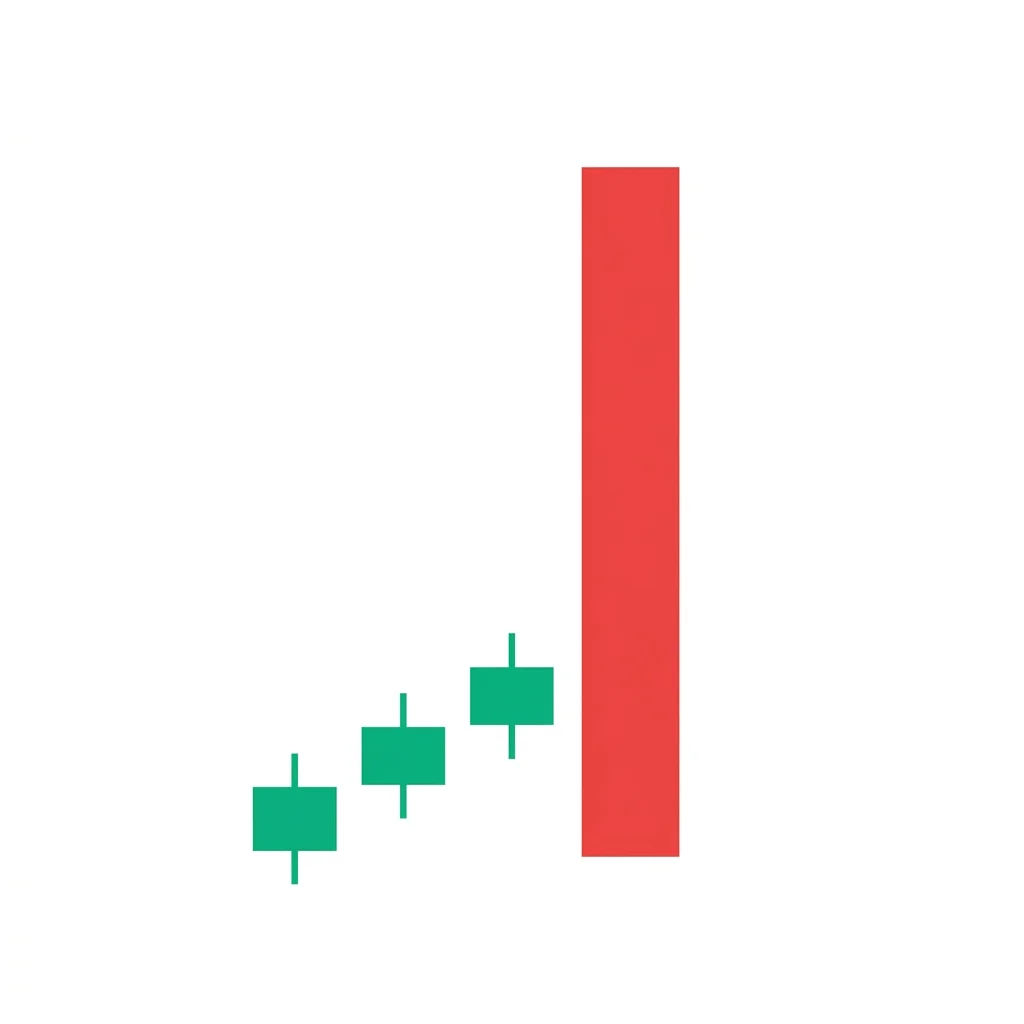
Bearish Marubozu
Marubozu
Also known as: Bearish Shaved Candle, Black Marubozu, Full Body Bearish Candle
The bearish marubozu is a single candle with no shadows — price opened at the high and closed at the low, showing complete seller domination throughout the entire session with no buying resistance.
The marubozu (meaning 'close-cropped' or 'bald' in Japanese) is the purest expression of directional conviction. A bearish marubozu opens at its high and closes at its low with no shadows whatsoever. This means sellers controlled every tick of the session — from the opening bell to the close, there was no meaningful buying attempt. The pattern indicates extreme bearish conviction and often serves as a powerful continuation signal. When it appears at the start of a new downtrend, it can signal the beginning of aggressive selling. In a downtrend, it confirms that selling pressure remains undiminished.
History & Etymology
The marubozu is one of the foundational candles in Japanese candlestick analysis. Japanese rice traders considered it the most decisive candle type because it showed complete one-sided control with no ambiguity.
Marubozu (丸坊主) literally means 'bald' or 'close-cropped head' in Japanese, referring to the candle's lack of 'hair' (shadows). The candle is completely 'shaved' with no wicks extending from the body.
How It Forms
Formation Steps
- 1Open is at the high of the session
- 2Close is at the low of the session
- 3No upper shadow (or negligible)
- 4No lower shadow (or negligible)
- 5The entire candle is a solid bearish body
Prerequisites
- Can appear in any trend context
Confirmation Signals
- Follow-through selling the next session
- Volume is above average
- Price continues in the direction of the marubozu
Invalidation Signals
- Strong bullish candle the next session
- Price immediately recovers above the marubozu's open
- Volume is very low on the marubozu
Candle Breakdown
Bearish Marubozu
A solid bearish body with open at the high and close at the low. No upper or lower shadow.
Total seller domination. Not a single moment during the session showed meaningful buying. This is the strongest possible bearish candle.
Psychology
The marubozu represents absolute one-sided conviction. From open to close, sellers never ceded even momentary control. This is the market equivalent of a rout — no contest whatsoever.
Buyer Perspective
Buyers are completely absent or overwhelmed. There was no point during the session where they could mount even a minor rally.
Seller Perspective
Sellers are in total control with maximum aggression. The marubozu shows that selling pressure was continuous and unchallenged.
Smart Money Action
Institutional sellers execute aggressively throughout the session, using VWAP or TWAP algorithms that maintain constant selling pressure.
Retail Trader Trap
Retail traders who attempt to buy dips during the session are immediately underwater — there are no dips to buy.
Emotional Cycle
Trading Strategy
Aggressive Entry
Short on the close of the marubozu or the next session's open.
Conservative Entry
Short on a pullback to 50% of the marubozu's range.
Marubozu body length projected downward.
Next support level.
2x the marubozu body.
Best Conditions
- Timeframe: daily
- Timeframe: 4h
- Timeframe: 1h
- Timeframe: weekly
- trending down
- high volatility
- catalyst-driven
- Asset: stocks
- Asset: forex
- Asset: indices
- Asset: crypto
Avoid When
- Timeframe: 1m
- Timeframe: 5m
- low volatility
- oversold bounce conditions
Confluence Factors
- Breaks below support
- High volume
- In a downtrend
- At resistance in a downtrend
- Sector weakness
Scale In Strategy
Enter 50% on the marubozu close, add 50% on break below the low.
Scale Out Strategy
Take 50% at 1R, trail rest.
Risk Management
Volume Analysis
Volume Confirmation
High volume on the marubozu is essential for a genuine signal.
Volume Profile
Uniform volume distribution throughout the marubozu confirms sustained selling.
Volume Divergence
Low volume marubozu may be a gap effect rather than genuine selling — be cautious.
Technical Confluence
Support Resistance
The marubozu's open (high) becomes strong resistance. The entire body is a resistance zone on any retest.
Fibonacci Levels
The 50% retracement of the marubozu often acts as resistance on any pullback.
Moving Averages
A marubozu breaking below moving averages confirms the bearish signal.
Rsi Confirmation
RSI dropping significantly on the marubozu confirms momentum.
Macd Confirmation
MACD showing a strong bearish crossover or expanding negative histogram.
Bollinger Bands
Marubozu closing near or below the lower band shows extreme selling.
Vwap
Marubozu closing well below VWAP confirms institutional selling.
Ichimoku Cloud
Marubozu breaking below Kumo cloud is extremely bearish.
Elliott Wave
Marubozu candles often form in Wave 3 where momentum is greatest.
Wyckoff Phase
Marubozu represents the sign of weakness (SOW) in distribution or the driving force in markdown.
Market Profile
The marubozu creates a trend day profile — price moves one direction all session.
Order Flow
Extreme negative delta throughout the entire session. Aggressive selling at every level.
Open Interest
Rising OI on the marubozu confirms new short positions.
Multi-Timeframe Analysis
Higher Timeframe Alignment
Weekly marubozu is extremely powerful — signals a decisive shift.
Lower Timeframe Entry
The daily marubozu will show sustained selling on the 1H chart — use the 1H for confirmation.
Timeframe Confluence
Marubozu on daily with 4H showing no bounces confirms the signal.
Top-Down Approach
Weekly bearish → Daily marubozu → 4H follow-through → Enter.
Statistics
Historical Examples
Netflix Marubozu Post-Earnings
successNetflix formed a massive bearish marubozu (-22%) after reporting subscriber losses. No shadow on either end — pure selling from open to close.
Lesson: Earnings-driven bearish marubozu in large-cap stocks can initiate multi-month declines.
Variations
Closing Marubozu
No lower shadow (close at the low) but may have a small upper shadow.
Opening Marubozu
No upper shadow (open at the high) but may have a small lower shadow.
Confusion Matrix
Patterns commonly confused with Bearish Marubozu and how to distinguish them.
Bearish Closing Marubozu
90% similarIf there is any upper shadow (even small), it is a closing marubozu. A true marubozu has zero shadows — open equals high and close equals low.
Key Differences
- Full marubozu has NO shadows at all
- Closing marubozu has no LOWER shadow but may have a small upper shadow
- Full marubozu is rarer and more powerful
The Bearish Closing Marubozu is a single bearish candle with no lower shadow — the close is at the exact low of the session. This indicates that sellers controlled the session and maintained pressure through the very last trade, a sign of strong bearish conviction.
The Bearish Engulfing is one of the most powerful and commonly traded two-candle reversal patterns. A large bearish candle completely engulfs the prior bullish candle, demonstrating a decisive shift from buying to selling dominance.
A falling window is a Japanese candlestick term for a gap down in price where the high of the current candle is below the low of the previous candle, signaling strong bearish continuation momentum.
The bearish opening marubozu is a single candle where the open equals the high (no upper shadow), showing that sellers took immediate control at the open and maintained pressure throughout the session. A small lower shadow may be present.
Three black crows is a powerful bearish reversal pattern consisting of three consecutive long bearish candles, each opening within the prior candle's body and closing near its low. It signals strong, persistent selling pressure and a likely trend reversal.
The Bullish Marubozu is a single candle with no shadows — it opens at the low and closes at the high, representing complete buyer dominance throughout the entire session with no seller resistance.
Pro Tips & Common Mistakes
Pro Tips
- A true marubozu with zero shadows is rare — even tiny shadows still make it a 'near marubozu' which is almost as powerful.
- The marubozu's midpoint (50% of the body) often acts as a key resistance level on retests.
- The larger the marubozu relative to recent candles, the more significant the signal.
- Marubozu candles in the direction of the trend are continuation signals; against the trend, they can signal reversal.
Common Mistakes
- Shorting into an oversold market after a marubozu — check for exhaustion.
- Not checking volume — low volume marubozu can be gap effects.
- Expecting the exact marubozu (zero shadows) — near-marubozu with tiny shadows are equally valid.
- Placing stops too far from the open — the marubozu open is the natural stop.
Advanced Techniques
- Use the marubozu as the anchor for a fair value gap analysis — the body often contains an FVG that serves as resistance on retests.
- Analyze the tick-by-tick data within the marubozu to confirm sustained selling throughout the session.
- Combine with sector analysis: a marubozu in a sector leader can signal sector-wide weakness.
- Use the marubozu's range as a volatility reference for subsequent stop and target calculations.
Institutional Perspective
The marubozu is the visible result of aggressive institutional selling throughout an entire session. It often marks the start of a significant position by institutional sellers or the execution of a large sell program.
Fun Facts
- The word marubozu (丸坊主) literally means 'bald head' — the candle has no 'hair' (shadows).
- True marubozu candles (with zero shadows) are relatively rare — most candles have at least tiny wicks.
- The bearish marubozu has the highest momentum-per-candle of any single candlestick pattern.
Frequently Asked Questions
A bearish marubozu is a candle with no upper or lower shadows — the open is at the high and the close is at the low. It represents complete seller domination throughout the entire session.
It can be both. In a downtrend, the marubozu is a continuation signal. At the top of an uptrend (especially as part of an engulfing or kicker pattern), it can signal reversal.