
Overview
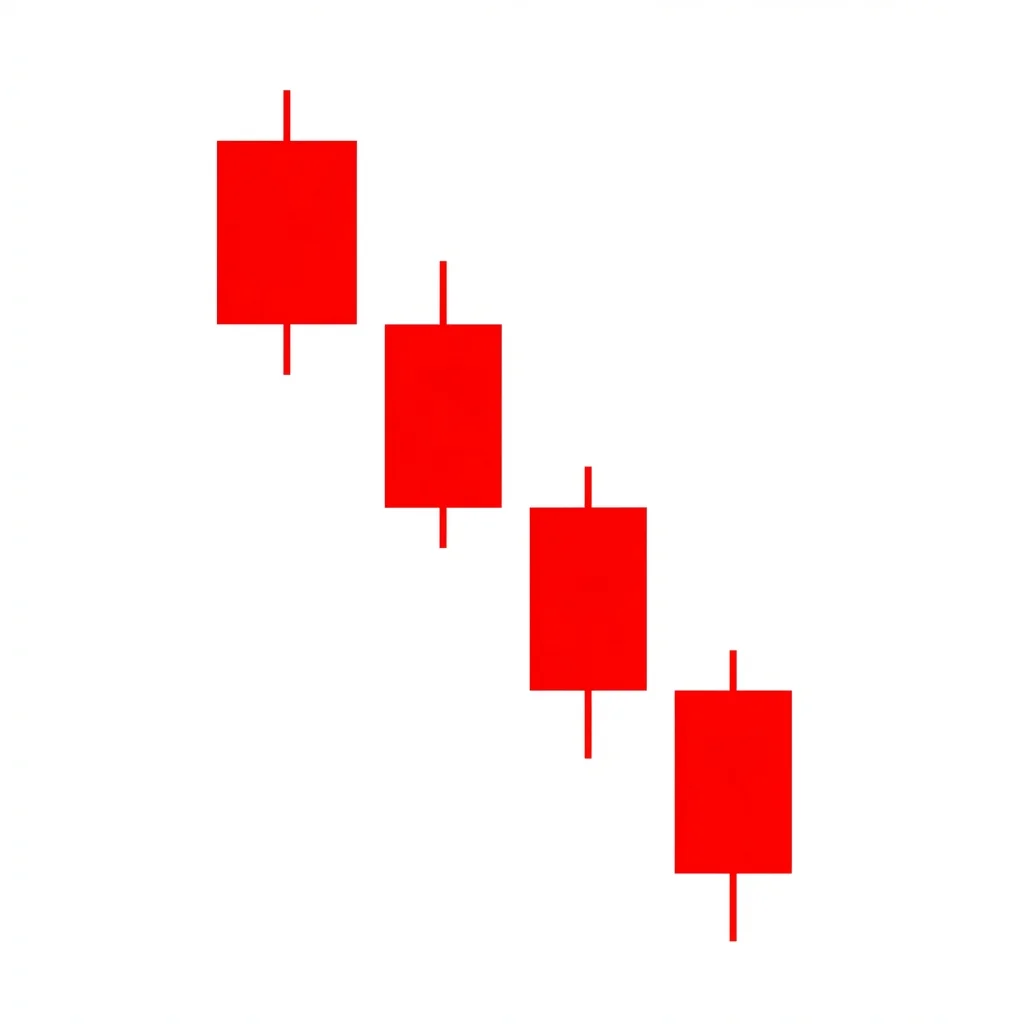
Bearish Three Gap Downs
San Ku Sage
Also known as: Three Falling Windows, Triple Gap Down, San Ku Down
Three gap downs (San Ku) feature three consecutive downward gaps in a downtrend. While initially bearish, the third gap often signals selling exhaustion and a potential reversal. Traders must decide if the gaps represent momentum continuation or capitulation.
The three gap downs pattern is a significant formation in Japanese candlestick analysis. It features three consecutive sessions where price opens below the prior session's low, creating three unfilled gaps (windows). The first gap is typically a breakaway gap (starting the decline), the second is a runaway gap (measuring the move), and the third is often an exhaustion gap (signaling the end of the decline). This pattern has a dual nature: it is extremely bearish in the short term (three gaps in a row represent intense selling) but the third gap frequently marks the point of maximum pessimism, after which a reversal occurs. Japanese traders traditionally view the third gap as a signal to close short positions and prepare for a bounce.
History & Etymology
San Ku (three gaps) is one of the classical Japanese candlestick formations taught by Munehisa Homma. The principle that three gaps in one direction signal exhaustion is one of the oldest rules in Japanese technical analysis, predating Western gap theory by over a century.
'San' means three in Japanese. 'Ku' means gap or window. 'Sage' means down. Together, San Ku Sage means 'three gaps down.' The concept emphasizes that three consecutive gaps in one direction often exhaust the move.
How It Forms
Formation Steps
- 1Three consecutive downward gaps within a downtrend
- 2Each candle opens below the prior candle's low, creating unfilled gaps
- 3The gaps represent increasingly desperate selling
- 4The third gap often signals exhaustion and a potential bottom
Prerequisites
- Established downtrend
- Increasing selling pressure and panic
Confirmation Signals
- Bullish reversal candle after the third gap (for exhaustion interpretation)
- Volume climax on the third gap
- RSI extreme oversold reading
Invalidation Signals
- A fourth gap down continues the pattern
- No reversal sign after the third gap
- Volume continues to increase without reversal
Candle Breakdown
First Gap (Breakaway)
Price gaps down from a consolidation or after the initial decline begins. This is the breakaway gap.
The first gap shocks the market and establishes the bearish trend with conviction.
Second Gap (Runaway)
Price gaps down again, accelerating the decline. This runaway gap marks the midpoint.
Fear builds as the second consecutive gap intensifies selling pressure.
Third Gap (Exhaustion)
The third gap down, often on the highest volume, represents potential capitulation and exhaustion.
Maximum fear and capitulation. The long lower shadow on this candle (if present) suggests buyers are finally stepping in.
Psychology
Three consecutive gaps represent escalating panic. However, the third gap often marks the point of maximum pessimism—when everyone who wanted to sell has sold, and the market is primed for a reversal.
Buyer Perspective
Buyers are terrified during the first two gaps but recognize the third gap as a potential capitulation event. Contrarian buyers begin positioning for a reversal.
Seller Perspective
Sellers become increasingly aggressive with each gap, but by the third, most have already sold. The absence of remaining sellers creates the conditions for a bounce.
Smart Money Action
Smart money begins accumulating during or after the third gap, recognizing the capitulation as a buying opportunity.
Retail Trader Trap
Retail traders who panic-sell on the third gap provide the liquidity that smart money needs to accumulate positions.
Emotional Cycle
Trading Strategy
Aggressive Entry
Enter long on a reversal candle that appears after the third gap (contrarian/exhaustion play).
Conservative Entry
Stay short through the pattern and close shorts after the third gap. Only enter long if a clear bullish pattern forms.
Fill of the third gap (for longs) or continuation target (for shorts)
Fill of the second gap (for longs)
Fill of the first gap (for longs) or measured move (for shorts)
Best Conditions
- Timeframe: 1D
- Timeframe: 1W
- Panic selling
- Bear markets
- Crisis events
- Asset: Stocks
- Asset: Indices
- Asset: Crypto
Avoid When
- Timeframe: 1m
- Timeframe: 5m
- Normal trending markets
- Low-volatility environments
Confluence Factors
- Volume climax on third gap
- RSI extremely oversold (<20)
- Major support level near the third gap
- VIX spike for equity markets
- Sentiment extremes
Scale In Strategy
For longs after the third gap: enter small initially and add if price fills the third gap.
Scale Out Strategy
Take profits as each gap fills (for longs).
Risk Management
Volume Analysis
Volume Confirmation
Volume climax on the third gap is the key signal—it should be the highest volume of the three sessions.
Volume Profile
Increasing volume across the three gaps with a spike on the third confirms exhaustion.
Volume Divergence
Declining volume on the third gap suggests the selling is already fading before exhaustion.
Technical Confluence
Support Resistance
Each gap zone creates resistance overhead. The third gap's low may become significant support.
Fibonacci Levels
The three gaps often span from the 61.8% to the 100% retracement of the prior rally.
Moving Averages
Price is typically far below all moving averages during three gap downs, making mean reversion probable.
Rsi Confirmation
RSI below 20 on the third gap is a strong exhaustion/oversold signal.
Macd Confirmation
MACD at extreme negative levels suggests momentum exhaustion.
Bollinger Bands
Price far below the lower Bollinger Band on all three gaps confirms extreme overextension.
Vwap
Price far below VWAP on all sessions confirms extreme institutional selling.
Ichimoku Cloud
Price far below the Kumo cloud with all indicators bearish-aligned.
Elliott Wave
The three gaps often occur during Wave 3 or Wave 5 of a bearish impulse, with the third gap marking Wave 5 exhaustion.
Wyckoff Phase
The three gaps may mark the selling climax at the end of the markdown phase.
Market Profile
Three consecutive days of single-print excess low indicate extreme selling.
Order Flow
Cumulative delta at extreme negative levels with a sudden flattening after the third gap signals exhaustion.
Open Interest
Monitor open interest changes for additional confirmation of institutional participation in the move.
Multi-Timeframe Analysis
Higher Timeframe Alignment
Three gap downs on the daily chart may represent a single large bearish candle on the weekly chart.
Lower Timeframe Entry
Use the 4H chart to identify the reversal pattern within the third gap for a precise long entry.
Timeframe Confluence
Daily three gaps at a weekly support level provides the highest conviction reversal.
Top-Down Approach
Weekly support > Daily three gap downs > 4H reversal confirmation.
Statistics
Historical Examples
Nikkei 225 Three Gap Downs 2020
successThe Nikkei gapped down three consecutive sessions during the COVID crash. The third gap marked a selling climax, and price rallied 15% over the next two weeks.
Lesson: Three gap downs during crisis selling often mark the point of maximum panic and a tradeable bottom.
Variations
Three Gap Downs with Hammer
The third gap candle forms a hammer or bullish engulfing, providing immediate reversal confirmation.
Confusion Matrix
Patterns commonly confused with Bearish Three Gap Downs and how to distinguish them.
Bearish Exhaustion Gap
7000% similarIf there is a sequence of three consecutive gaps, it is the three gap downs pattern. The third gap within the pattern is the exhaustion gap.
Key Differences
- Exhaustion gap is a single gap; three gap downs is a sequence
- Three gap downs include breakaway and runaway gaps
- The exhaustion is the third gap specifically
The bearish island reversal is a powerful reversal pattern where price gaps up, trades briefly in an isolated range (the island), then gaps down, leaving the island completely separated by gaps on both sides. It signals a decisive sentiment shift.
A bearish runaway gap (or measuring gap) is a gap down that occurs in the middle of a strong downtrend, signaling acceleration of selling pressure. It often marks the midpoint of the total move, making it useful for projecting the ultimate price target.
Bullish Three Gap Ups (Sanku) features three consecutive rising windows in a strong uptrend. While initially bullish, Japanese tradition warns that the third gap often signals exhaustion, making this a dual-purpose pattern — continuation in the short term but a potential warning of an impending reversal.
A falling window is a Japanese candlestick term for a gap down in price where the high of the current candle is below the low of the previous candle, signaling strong bearish continuation momentum.
The bearish gap fill rejection occurs when price rallies to fill a prior gap down but is rejected at or within the gap zone, confirming the gap as resistance and signaling continuation of the downtrend.
The bearish gap momentum pattern occurs when price gaps down on high volume and continues selling throughout the session without filling the gap, indicating powerful one-directional selling pressure.
Pro Tips & Common Mistakes
Pro Tips
- The traditional Japanese rule is: 'After three gaps, close your position.' This applies to both long and short traders.
- The third gap is the most important—watch for volume climax and reversal candles.
- In practice, wait for a bullish candle after the third gap before entering long—the 'three gaps rule' is a warning, not an entry.
- These patterns are most common in markets with regular session gaps (not 24/7 markets).
Common Mistakes
- Shorting after the third gap, when exhaustion is most likely
- Not recognizing the dual nature of the pattern (bearish continuation vs. exhaustion reversal)
- Trading the pattern in 24/7 markets where true gaps are rare
Advanced Techniques
- Track gap fill statistics: the third gap is filled more often (and more quickly) than the first or second.
- Use the midpoint of the three gaps as a key level for the recovery—if price reclaims it, a full reversal is likely.
Institutional Perspective
Institutional traders recognize the three gap downs as a potential capitulation event. Many algorithmic strategies are designed to begin accumulating after the third gap in a recognized sequence.
Fun Facts
- The San Ku (three gaps) principle is one of the oldest rules in Japanese technical analysis, dating back over 200 years.
- Munehisa Homma, the legendary rice trader, considered three consecutive gaps to be one of the most important signals in his trading methodology.
Frequently Asked Questions
Both. The pattern itself is bearish (three consecutive gaps lower), but the third gap often signals selling exhaustion, making it a potential reversal point. Japanese tradition says 'after three gaps, close your position.'