
Overview
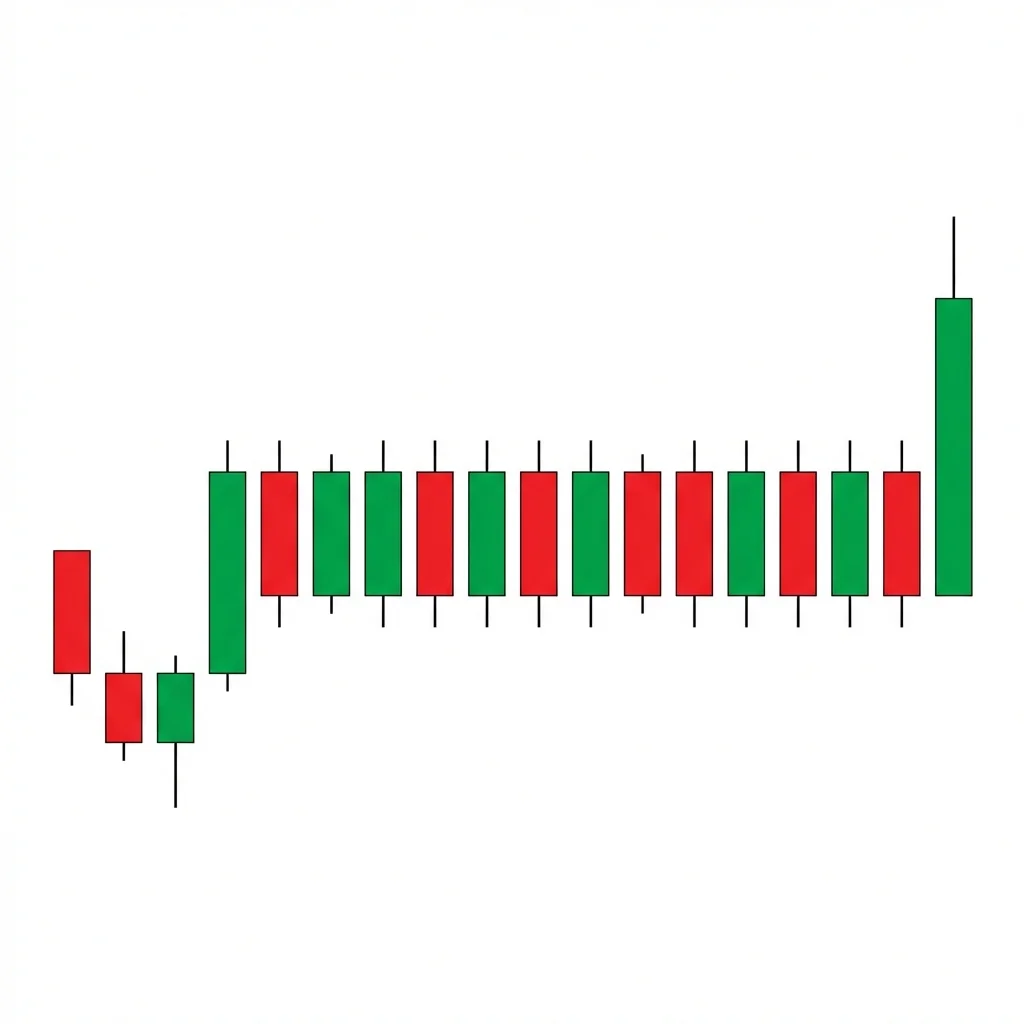
Bullish Accumulation
Also known as: Wyckoff Accumulation, Base Building, Institutional Accumulation Zone
Bullish Accumulation is a Wyckoff-based pattern where institutional investors quietly build large positions over an extended period, creating a trading range before a powerful markup phase begins.
Accumulation is the process by which large institutional players absorb supply (selling) from weaker holders without significantly raising the price. This creates a visible trading range on the chart that can last weeks to months. Richard Wyckoff identified this as one of the four major market phases (accumulation, markup, distribution, markdown). The pattern follows a specific sequence: a selling climax stops the downtrend, an automatic rally defines the upper boundary, and then price oscillates in the range while institutions methodically buy. The spring event — a brief false breakdown — is the final shakeout before the markup begins. Understanding accumulation gives traders insight into what smart money is doing behind the scenes.
History & Etymology
Richard Wyckoff developed this framework in the early 1900s through his study of tape reading and the behavior of legendary operators like Jesse Livermore and J.P. Morgan. Wyckoff observed that markets move in cycles driven by the 'Composite Operator' (institutional money) and that accumulation was the foundation phase for every major bull move.
The term 'accumulation' literally means to gather or collect. In market context, it refers to institutional investors accumulating (gathering) shares from the public during a period of apparent weakness, before driving prices higher.
How It Forms
Formation Steps
- 1Phase A: Selling Climax (SC) followed by Automatic Rally (AR) defining the range
- 2Phase B: Building a cause — price oscillates within the range with tests of support and resistance
- 3Phase C: Spring or shakeout — price briefly breaks below support to trap sellers
- 4Phase D: Sign of Strength (SOS) — price rallies with expanding volume and breaks above range resistance
- 5Phase E: Markup begins — price leaves the accumulation range
Prerequisites
- Extended prior downtrend
- Selling climax with extreme volume
- Clear trading range forms after the climax
Confirmation Signals
- Spring event (false breakdown below support) with quick recovery
- Sign of Strength rally on high volume
- Last Point of Support (LPS) holds above range midpoint
- Volume expands on upswings and contracts on downswings within the range
Invalidation Signals
- Price breaks below the selling climax low and does not recover
- Volume continues to expand on downswings
- Lower highs and lower lows within the range (distribution instead of accumulation)
Candle Breakdown
Selling Climax
Extreme bearish candle(s) with massive volume, marking the end of the downtrend.
Panic selling reaches a peak. Weak hands capitulate and institutions begin absorbing the supply.
Range-Bound Action
Multiple candles oscillating between support (SC low) and resistance (AR high).
The boring phase where most traders lose interest. Institutions are quietly buying on every dip within the range.
Spring and Sign of Strength
A false breakdown below support (spring) followed by a strong bullish surge that breaks above the range.
The spring traps final sellers. The Sign of Strength rally confirms institutions are done accumulating and are now allowing price to rise.
Psychology
Accumulation is a masterclass in market psychology. Institutions need to buy enormous quantities without tipping off the market. The extended range, false breakdowns, and boring price action are all features designed to shake out impatient traders and create selling for institutions to absorb.
Buyer Perspective
Institutional buyers are patient and methodical. They use limit orders within the range, buy every dip, and may even engineer the spring to create final panic selling they can buy. They do not care about short-term price action.
Seller Perspective
Retail sellers are frustrated by the range. Some sell at the bottom of the range expecting a continuation of the downtrend. The spring event triggers stops and panic selling from the last remaining holders.
Smart Money Action
The Composite Operator (institutional money) absorbs supply throughout the range. They may test the supply by allowing rallies to resistance, and they engineer the spring to create the final wave of distressed selling they need to complete their positions.
Retail Trader Trap
Retail traders are trapped at every phase: they sell in panic at the selling climax, buy the automatic rally only to see it fail, get bored and walk away during the range, and then short the spring — getting squeezed in the markup.
Emotional Cycle
Trading Strategy
Aggressive Entry
Enter long on the spring — the false break below support with a quick recovery above the range low.
Conservative Entry
Wait for the Sign of Strength rally and enter on the Last Point of Support (LPS) pullback after the range breakout.
At the range height projected above the breakout point.
Using Point and Figure count — the width of the accumulation range projected upward.
At the next major resistance level from the prior downtrend.
Best Conditions
- Timeframe: daily
- Timeframe: weekly
- After a significant downtrend
- During sector rotation when new money enters beaten-down sectors
- In markets with clear institutional participation
- Asset: stocks
- Asset: ETFs
- Asset: futures
Avoid When
- Timeframe: 1m
- Timeframe: 5m
- Timeframe: 15m
- In a systemic bear market where all sectors decline
- In illiquid, low-cap assets without institutional interest
Confluence Factors
- Accumulation range forms at a major historical support zone
- Volume pattern confirms (decreasing on dips, increasing on rallies)
- Fundamental catalysts support a turnaround
- Sector rotation beginning to favor the asset
- Spring event with quick recovery
Scale In Strategy
Enter 25% on the spring, 25% on the Sign of Strength, 25% on the LPS, and 25% on the breakout above the range.
Scale Out Strategy
Sell 25% at the range height target, 25% at the PnF count target, trail the remainder with the 20 EMA.
Risk Management
Volume Analysis
Volume Confirmation
Volume should diminish on downswings within the range and expand on upswings and the eventual breakout. The spring should show low volume (no real selling pressure).
Volume Profile
The volume profile of the accumulation range should show a high volume node near the midpoint, with low volume at the extremes.
Volume Divergence
If volume remains high on downswings within the range, institutions may not be accumulating — the pattern may be redistribution.
Technical Confluence
Support Resistance
The selling climax low and automatic rally high define the key S/R boundaries. The spring tests below support before the markup.
Fibonacci Levels
The accumulation range often forms near a 61.8% or 78.6% retracement of the prior major upswing.
Moving Averages
During accumulation, the 50 and 200 SMAs often flatten and converge. The markup begins when price breaks above both.
Rsi Confirmation
RSI often shows bullish divergence during Phase C (making higher lows while price makes equal or lower lows).
Macd Confirmation
MACD should show a bullish crossover and histogram turning positive during the Sign of Strength rally.
Bollinger Bands
During accumulation, Bollinger Bands contract (low volatility). The breakout occurs when bands begin expanding again.
Vwap
Anchored VWAP from the selling climax often acts as resistance during the range and becomes support once broken.
Ichimoku Cloud
Price often consolidates within or just below the Ichimoku cloud during accumulation, then breaks above for the markup.
Elliott Wave
Accumulation often corresponds to the formation of Wave 1 or the beginning of a new impulse cycle after a completed corrective pattern.
Wyckoff Phase
This IS the Wyckoff accumulation phase. It precedes the markup phase (Phase D and E).
Market Profile
The accumulation range typically shows a balanced, bell-shaped volume profile. The breakout creates a 'p-shaped' profile as price discovers new value higher.
Order Flow
Cumulative delta should trend positive during accumulation even as price ranges, showing buying absorption.
Open Interest
In futures, rising open interest during the range confirms new positions being built rather than position unwinding.
Multi-Timeframe Analysis
Higher Timeframe Alignment
The weekly chart should show the end of a major downtrend and the beginning of the accumulation range.
Lower Timeframe Entry
Use the 4-hour or 1-hour chart to time entries during the spring event or Sign of Strength breakout.
Timeframe Confluence
The monthly chart should show price at or near a long-term support zone, confirming the significance of the accumulation.
Top-Down Approach
Monthly confirms long-term support → Weekly identifies the accumulation range → Daily spots Wyckoff events → 4-hour times entries.
Statistics
Historical Examples
Amazon Wyckoff Accumulation 2022-2023
successAfter the 2022 bear market, Amazon formed a textbook Wyckoff accumulation pattern between $80-$100 over several months. The spring occurred in late December 2022, and the markup phase carried the stock above $180 by mid-2023.
Lesson: Patience is essential. The accumulation range lasted months, testing the conviction of early buyers. The spring provided the best risk/reward entry.
Bitcoin Accumulation After 2018 Bear Market
successBitcoin accumulated between $3,000-$4,200 from late 2018 through early 2019. The selling climax hit $3,100 in December 2018, and the markup began in April 2019, eventually reaching $13,000 by June.
Lesson: Crypto accumulation zones can be highly volatile but follow the same Wyckoff principles. The volume patterns were clear — declining on dips, expanding on rallies within the range.
Variations
Accumulation with Double Spring
Price springs below support twice before the markup begins, offering two entry opportunities.
Shortened Accumulation
A compressed version where the range forms and resolves in 2-3 weeks instead of months.
Confusion Matrix
Patterns commonly confused with Bullish Accumulation and how to distinguish them.
Bearish Distribution
5000% similarCheck what preceded the range (downtrend = accumulation, uptrend = distribution) and analyze the volume behavior within the range.
Key Differences
- Accumulation follows a downtrend; distribution follows an uptrend
- Accumulation volume expands on rallies; distribution volume expands on declines
Bullish Rounding Bottom
5500% similarAccumulation has sharp events (selling climax, spring) while rounding bottoms are gradual transitions.
Key Differences
- Rounding bottoms have a smooth U-shape; accumulation has a more rectangular range
- Accumulation has specific Wyckoff events (spring, SOS); rounding bottoms are more gradual
The Distribution phase is a Wyckoff concept where institutional investors systematically sell (distribute) their holdings to the public within a trading range at a market top, before the subsequent markdown (decline) begins.
The Bullish Rounding Bottom (Saucer Bottom) is a long-term reversal pattern that forms a U-shaped curve as selling pressure gradually gives way to buying pressure, signaling a major trend change from bearish to bullish.
The Bullish Selling Climax occurs when an extended downtrend reaches a point of maximum panic, producing a wide-range bearish candle on extraordinary volume. The exhaustion of selling pressure creates conditions for a sharp reversal as the last sellers capitulate.
The Bullish Spring is a Wyckoff pattern where price briefly breaks below trading range support to trigger stop losses, then immediately reverses back above support, trapping shorts and initiating a markup phase.
The Triple Bottom is a major reversal pattern featuring three distinct lows at approximately the same price level, separated by two intermediate peaks. The breakout above the neckline confirms the reversal and targets a measured move equal to the pattern height.
Bearish redistribution is a Wyckoff concept describing a trading range that forms during a downtrend, where institutional sellers redistribute their remaining positions before the markdown resumes. It mirrors distribution but occurs mid-trend rather than at a top.
Pro Tips & Common Mistakes
Pro Tips
- Count the number of tests at support — each successful test absorbs more supply and strengthens the base
- Use Point and Figure charts to measure the width of the accumulation range and project the price target
- The spring is the highest-conviction entry point in all of technical analysis — when you see it, act
- Watch for 'jumping the creek' — when price breaks above the range midpoint on volume, it is a key early signal
- Compare the effort (volume) vs. result (price movement) on each swing within the range to gauge supply absorption
Common Mistakes
- Getting bored and selling within the accumulation range — patience is the key virtue here
- Confusing accumulation with distribution — always check what preceded the range
- Buying every test of support without waiting for the spring confirmation
- Ignoring volume analysis — volume is the most critical element in identifying accumulation
- Setting targets too small for such a powerful pattern — accumulation moves are major trend changes
Advanced Techniques
- Use Wyckoff's 'nine buying/selling tests' to grade the quality of the accumulation
- Monitor cumulative delta and volume profile within the range for institutional footprints
- Apply Point and Figure chart counting methods to project the target based on the width of the cause
- Use anchored VWAP from the selling climax to identify when price has shifted into an uptrend
Institutional Perspective
Accumulation IS the institutional perspective. Large funds need weeks or months to build positions without moving price. The entire range exists because institutions are slowly buying. Understanding this gives individual traders an enormous edge.
Fun Facts
- Richard Wyckoff estimated that the 'Composite Operator' (combined institutional money) controlled about 80% of market moves — a figure that modern research largely supports.
- The concept of accumulation explains why most retail traders lose — they sell in panic at exactly the time institutions are buying.
- Warren Buffett's famous quote 'Be greedy when others are fearful' is essentially describing the accumulation phase.
Frequently Asked Questions
Accumulation can take anywhere from 3 weeks to several months, depending on the asset and the size of positions institutions are building. Larger-cap stocks tend to have longer accumulation phases because more supply needs to be absorbed.
The spring is a deliberate or natural false breakdown below the accumulation range support. It traps sellers and triggers stop-losses, creating the final wave of selling that institutions need to complete their buying. A quick recovery above support confirms the spring.
Check three things: (1) What preceded the range — accumulation follows downtrends, distribution follows uptrends. (2) Volume behavior — accumulation shows increasing volume on rallies and decreasing volume on declines within the range. (3) The spring vs. upthrust — accumulation ends with a spring (false breakdown), distribution ends with an upthrust (false breakout).