
Overview
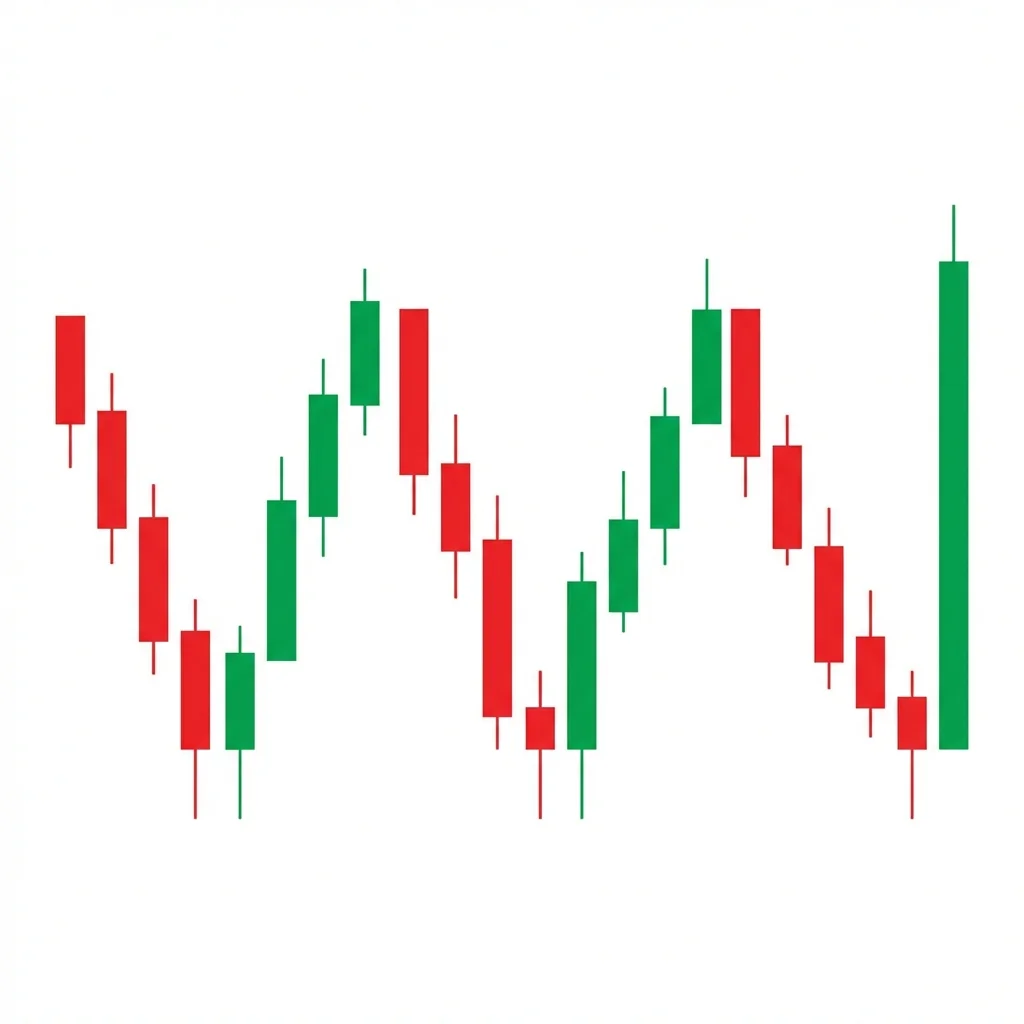
Bullish Triple Bottom
Also known as: Triple Bottom Reversal, Three-Touch Bottom
The Triple Bottom is a major reversal pattern featuring three distinct lows at approximately the same price level, separated by two intermediate peaks. The breakout above the neckline confirms the reversal and targets a measured move equal to the pattern height.
The Triple Bottom is considered more reliable than the Double Bottom because the additional test of support demonstrates even stronger demand at the support level. Three failed attempts to break support prove that sellers are exhausted and buyers are firmly defending the level. The pattern completes when price breaks above the neckline (the line connecting the two intermediate peaks). The measured move target is the height of the pattern projected above the neckline. Volume should ideally decline on each successive bottom, confirming diminishing selling pressure.
History & Etymology
The Triple Bottom has been recognized in Western technical analysis since Edwards and Magee's 1948 classic. It is considered one of the most reliable chart formations, particularly when volume confirms the diminishing selling pressure on each successive low.
Named straightforwardly for the three distinct price lows (bottoms) that form at approximately the same level. The 'triple' designation distinguishes it from the more common double bottom.
How It Forms
Formation Steps
- 1First low: price declines to a support level and bounces
- 2First peak: price rallies to a resistance level (neckline) and reverses
- 3Second low: price returns to approximately the same support level and bounces again
- 4Second peak: price rallies back toward the neckline
- 5Third low: price tests the support level a final time and bounces
- 6Breakout: price breaks above the neckline with volume
Prerequisites
- Prior downtrend
- Three distinct touches of approximately the same support level
- Two peaks between the lows forming the neckline
- Volume typically declines on each successive low
Confirmation Signals
- Breakout above the neckline with volume 50%+ above average
- Successful retest of the neckline as support
- Volume declines on each successive bottom touch
Invalidation Signals
- Price breaks below the triple bottom support
- Volume increases on the third bottom
- Neckline breakout fails with heavy selling
Candle Breakdown
Bottom Touch Candles
Candles that test the support level three times, each time showing rejection with lower shadows or hammer formations
Each successive touch of support shows less selling conviction. Volume declining on each bottom confirms that sellers are running out.
Breakout Candle
A strong bullish candle that breaks above the neckline with expanding volume
Buyers overwhelm remaining sellers at the neckline. Volume expansion confirms institutional commitment to the reversal.
Psychology
The Triple Bottom shows that sellers attempted three times to break through support and failed each time. This triple failure exhausts bearish conviction and sets up a powerful reversal when the neckline breaks.
Buyer Perspective
Buyers have successfully defended support three times, gaining confidence with each defense. The neckline breakout validates their thesis.
Seller Perspective
Three failed breakdowns demoralize sellers. Each bounce from support makes shorting less attractive, and the neckline breakout forces final capitulation.
Smart Money Action
Institutions accumulate at each bottom touch, building large positions over the pattern's development. The neckline breakout is when they allow price to run.
Retail Trader Trap
Retail traders short each bounce from the neckline, expecting a continuation lower. The neckline breakout squeezes all three sets of shorts.
Emotional Cycle
Trading Strategy
Aggressive Entry
Enter long at the third bottom when price shows a bullish rejection candle at support.
Conservative Entry
Wait for the neckline breakout with volume, then enter on a retest of the neckline as support.
The measured move: pattern height projected above the neckline.
1.5x the pattern height.
2x the pattern height or the prior downtrend's origin.
Best Conditions
- Timeframe: daily
- Timeframe: weekly
- after extended downtrend
- at major support
- improving fundamentals
- Asset: stocks
- Asset: ETFs
- Asset: crypto
Avoid When
- Timeframe: 1m
- Timeframe: 5m
- deteriorating fundamentals
- strong bear market
- declining sector
Confluence Factors
- Volume declining on each bottom
- RSI divergence across the three lows
- Support at a major Fibonacci level
- 200-day MA flattening during the pattern
- Improving fundamentals
Scale In Strategy
Buy at each bottom touch and add on the neckline breakout.
Scale Out Strategy
Take one-third at the measured move, trail the rest.
Risk Management
Volume Analysis
Volume Confirmation
Volume should decline on each successive bottom and expand on the neckline breakout.
Volume Profile
Declining volume on bottoms, expanding volume on the breakout is the ideal signature.
Volume Divergence
Increasing volume on the third bottom may indicate genuine selling, not exhaustion.
Technical Confluence
Support Resistance
The triple bottom support is one of the strongest support levels in technical analysis — three confirmed touches.
Fibonacci Levels
The neckline often aligns with a Fibonacci retracement level from the prior downtrend.
Moving Averages
The 200-day MA often flattens during the pattern and turns up at the breakout.
Rsi Confirmation
RSI making higher lows across the three bottoms (bullish divergence) is powerful confirmation.
Macd Confirmation
MACD bullish crossover near the third bottom adds conviction.
Bollinger Bands
Bollinger Band squeeze during the pattern with expansion on the breakout.
Vwap
Anchored VWAP from the first bottom should act as reference; breaking above it confirms the reversal.
Ichimoku Cloud
Price emerging above the Kumo cloud at the breakout is very bullish.
Elliott Wave
Triple bottoms often mark the end of a complex corrective wave pattern.
Wyckoff Phase
The pattern corresponds to accumulation with three tests of support.
Market Profile
Developing value area around the neckline with breakout above the value area high.
Order Flow
Cumulative delta trending positive across the pattern despite sideways price.
Open Interest
Rising OI across the pattern confirms position building.
Multi-Timeframe Analysis
Higher Timeframe Alignment
A monthly or weekly triple bottom is a major reversal signal for position traders.
Lower Timeframe Entry
Use the daily chart to time the neckline breakout of a weekly triple bottom.
Timeframe Confluence
Weekly triple bottom, daily neckline breakout, 4-hour entry on retest.
Top-Down Approach
Weekly identifies the pattern, daily times the breakout, intraday optimizes entry.
Statistics
Historical Examples
SPY Triple Bottom 2022
successSPY formed a triple bottom near $350 in September-October 2022. Three tests of support with declining volume preceded a neckline breakout that launched a multi-month rally.
Lesson: Triple bottoms in major indices are high-conviction reversal signals, especially with declining volume on each test.
BTC Triple Bottom
successBitcoin tested $15,500-$16,000 three times in November 2022. The triple bottom held and BTC rallied above $25,000.
Lesson: Crypto triple bottoms at capitulation levels can produce explosive reversals.
Failed Triple Bottom
failureFTT appeared to form a triple bottom at $22 but the support broke catastrophically on fundamental collapse.
Lesson: No chart pattern can override fundamental catastrophe. Always verify the fundamental backdrop.
Variations
Ascending Triple Bottom
Each bottom is slightly higher than the previous one, showing increasing buyer eagerness.
Wide Triple Bottom
The three bottoms are separated by significant time and distance.
Confusion Matrix
Patterns commonly confused with Bullish Triple Bottom and how to distinguish them.
Bullish Inverse Head Shoulders
7000% similarIf the middle low is significantly lower than the other two, it is an Inverse Head & Shoulders. If all three are at the same level, it is a Triple Bottom.
Key Differences
- Inverse H&S has a lower middle low (head) between two higher lows (shoulders)
- Triple Bottom has all three lows at approximately the same level
The triple top is a powerful bearish reversal pattern formed by three peaks at approximately the same price level, separated by two pullbacks. The pattern confirms when price breaks below the neckline, with a measured target equal to the pattern's height projected downward.
The Double Bottom is one of the most recognized reversal patterns, forming a W-shape where price tests a support level twice and bounces, signaling that sellers cannot push through and buyers are gaining control.
The Inverse Head and Shoulders is one of the most reliable bullish reversal patterns, featuring three troughs with the middle one (head) being the deepest, signaling a major transition from a downtrend to an uptrend.
The Bullish Rounding Bottom (Saucer Bottom) is a long-term reversal pattern that forms a U-shaped curve as selling pressure gradually gives way to buying pressure, signaling a major trend change from bearish to bullish.
The Broadening Top (Megaphone) is a chart formation characterized by expanding price swings that create higher highs and lower lows, reflecting increasing volatility and instability at market tops before a bearish breakdown.
The Descending Channel is a chart formation where price trends lower within two parallel downward-sloping trendlines, making consistent lower highs and lower lows in an orderly bearish progression.
Pro Tips & Common Mistakes
Pro Tips
- Volume declining on each successive bottom is the most important confirmation element
- The measured move target (pattern height above the neckline) is achieved roughly 70% of the time
- A neckline retest that holds as support provides the highest probability entry with the tightest stop
- RSI bullish divergence across the three bottoms dramatically increases win rate
- The third bottom often shows the least volume — this is the strongest sign of seller exhaustion
Common Mistakes
- Not waiting for the neckline breakout to confirm the pattern
- Ignoring volume — if volume increases on the third bottom, the support may break
- Confusing a triple bottom with a downtrend that bounces multiple times (the lows must be at approximately the same level)
- Setting take profit too conservatively — the measured move is often exceeded
- Not checking fundamentals — triple bottoms need at least neutral fundamentals to succeed
Advanced Techniques
- Use point and figure charting to count the horizontal development for target projection
- Apply Wyckoff accumulation analysis to the pattern for phase identification
- Monitor institutional flow data during the pattern for signs of accumulation
- Use the pattern as a sector rotation signal — triple bottoms in sector ETFs can predict sector leadership
Institutional Perspective
The triple bottom represents thorough institutional accumulation. Three tests of support allow institutions to fill their entire buy program at favorable prices. The neckline breakout is when they stop accumulating and allow the markup to begin.
Fun Facts
- Edwards and Magee considered the triple bottom one of the most reliable reversal patterns, noting that 'the third time is the charm' for bottom testing.
- Triple bottoms in major stock indices (S&P 500, NASDAQ) have preceded some of the most significant bull markets in history.
- The triple bottom is sometimes called 'the W+' pattern because it looks like a W with an extra trough.
Frequently Asked Questions
A major reversal pattern with three distinct lows at approximately the same price level. The breakout above the neckline (connecting the two peaks between the lows) confirms the reversal.
Yes, generally. The additional test of support provides more confidence that sellers are truly exhausted. Triple bottoms have a slightly higher win rate and typically produce larger measured moves.
The height of the pattern (neckline to support) projected above the neckline. This target is achieved approximately 70% of the time.