
Overview
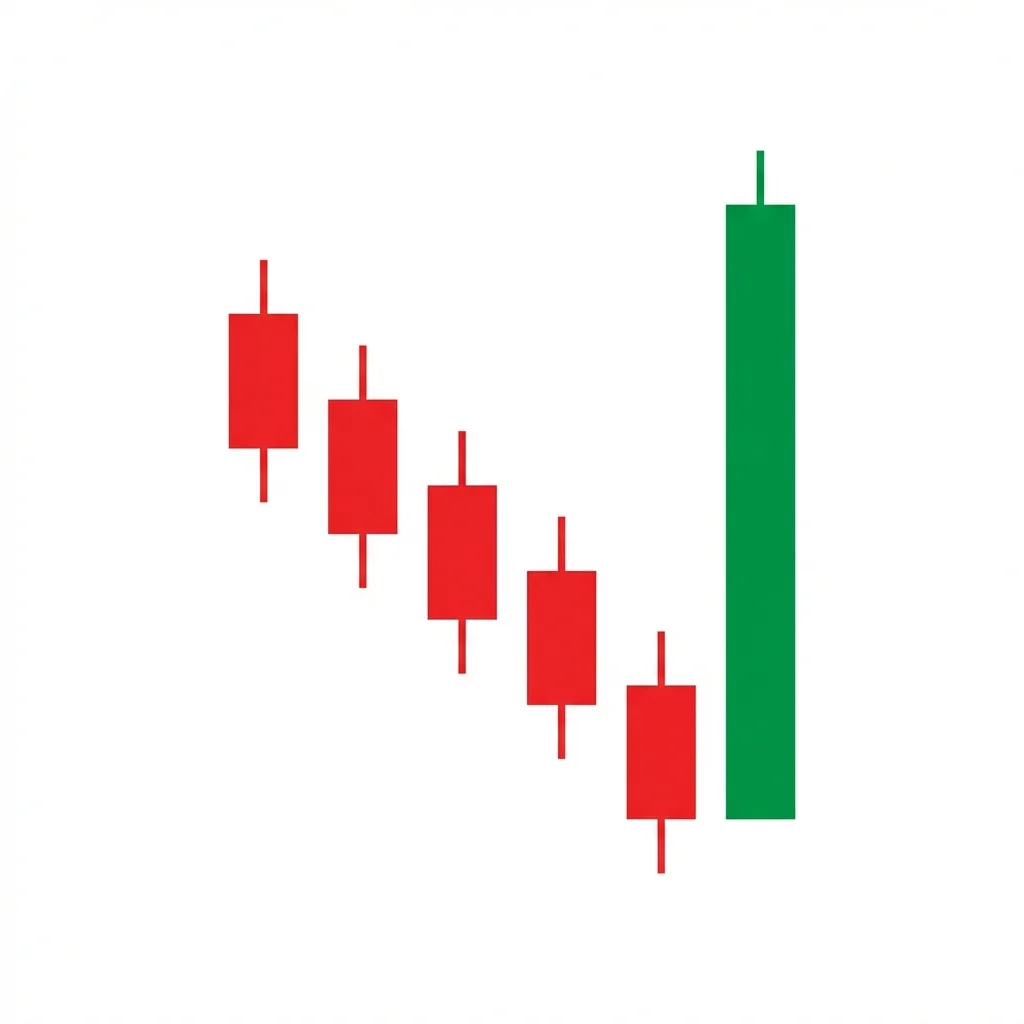
Bullish Belt Hold
Yorikiri
Also known as: White Opening Marubozu, Bullish Opening Shaven Bottom
The Bullish Belt Hold is a single-candle reversal pattern that opens at the low of the session and rallies strongly to close near the high, signaling a potential shift from bearish to bullish control.
The Bullish Belt Hold is characterized by a long white (bullish) candle that opens at or very near the session low with no lower shadow. From the open, buyers dominate the entire session, pushing price steadily higher to close near the high. This shows that from the first trade of the session, buyers were in complete control — there was no initial selling pressure. The pattern is most significant after a downtrend, where it suggests that bearish momentum has been decisively broken. The longer the candle body relative to recent candles, the more significant the signal. While the Belt Hold can indicate a reversal, it is a relatively weak single-candle signal and benefits greatly from confirmation on the following session.
History & Etymology
The Belt Hold originates from Japanese candlestick analysis and is called 'Yorikiri' in Japanese, a term borrowed from sumo wrestling. In sumo, Yorikiri means to force your opponent out of the ring by grabbing their belt — symbolizing the decisive, uncontested control that buyers exert during this candle.
The Japanese term 'Yorikiri' comes from sumo wrestling, where it describes a winning technique of grabbing the opponent's belt (mawashi) and pushing them out. In candlestick terms, it represents one side (buyers) grabbing control and pushing the other side (sellers) out completely.
How It Forms
Formation Steps
- 1Single long bullish candle that opens at or very near its low
- 2No lower shadow (or extremely small lower shadow)
- 3May have a small upper shadow
- 4Close is well above the open, creating a large bullish body
Prerequisites
- Prior downtrend for the pattern to act as a reversal signal
- The candle should be notably longer than recent average candles
Confirmation Signals
- Next candle closes above the belt hold candle's high
- Volume on the belt hold is above average
- Follow-through buying in subsequent sessions
Invalidation Signals
- Next candle closes below the belt hold candle's midpoint
- Price drops below the belt hold candle's low
- No follow-through — subsequent candles are indecisive or bearish
Candle Breakdown
Belt Hold Candle
A long bullish candle opening at the low with no lower shadow and closing near the high.
Buyers are in complete control from the opening bell. There is zero concession to sellers — the opening price is the lowest price, showing immediate and sustained buying conviction.
Psychology
The Belt Hold represents a session where buyers dominated from start to finish. In a downtrend, this sudden shift suggests that bearish momentum has been broken and a new group of buyers has entered with conviction.
Buyer Perspective
Buyers entered aggressively at the open, likely due to overnight positive news, institutional order execution, or a perceived value opportunity at depressed prices. Their sustained buying throughout the session shows conviction.
Seller Perspective
Sellers were completely overwhelmed. They could not push price below the opening price at any point during the session, which is demoralizing after a downtrend.
Smart Money Action
Institutional buying at the open, possibly executing large buy orders accumulated overnight. The lack of any dip below the open suggests strong passive bids protecting the low.
Retail Trader Trap
Shorts expecting the downtrend to continue are caught off-guard by the strong open and find no pullback to exit their positions at a reasonable price.
Emotional Cycle
Trading Strategy
Aggressive Entry
Enter long at the close of the belt hold candle if it closes in the upper quarter of its range.
Conservative Entry
Wait for the next candle to close above the belt hold candle's high before entering.
At the nearest resistance level above.
At a distance equal to the belt hold candle's body length projected above its close.
At the next major resistance from higher timeframe analysis.
Best Conditions
- Timeframe: daily
- Timeframe: weekly
- After extended downtrends
- At major support levels
- When market sentiment is shifting
- Asset: stocks
- Asset: futures
- Asset: ETFs
Avoid When
- Timeframe: 1m
- Timeframe: 5m
- Timeframe: 15m
- In strong bear markets with no support nearby
- During options expiration when price action is distorted
Confluence Factors
- Forms at a key support level
- RSI is oversold (below 30)
- Occurs after an extended downtrend (5+ bars)
- Volume is significantly above average
- The candle body is longer than the 14-day ATR
Scale In Strategy
Enter 50% on the belt hold close, add 50% if next candle confirms above the high.
Scale Out Strategy
Take 50% at the first resistance, trail the remainder.
Risk Management
Volume Analysis
Volume Confirmation
Volume should be above the 20-day average. Higher volume adds confidence that the buying is genuine.
Volume Profile
Heavy volume at the open (market-on-open orders) that sustains throughout the session.
Volume Divergence
Low volume on a belt hold reduces its significance — it may just be a low-participation gap up.
Technical Confluence
Support Resistance
Most effective when the belt hold opens at a major support level, confirming that buyers defend that price aggressively.
Fibonacci Levels
A belt hold at a 61.8% or 78.6% Fibonacci retracement level adds significant confluence.
Moving Averages
A belt hold bouncing off the 200 SMA or 50 SMA is more significant than one forming in a vacuum.
Rsi Confirmation
RSI in oversold territory (below 30) combined with a belt hold creates a stronger reversal signal.
Macd Confirmation
A bullish MACD crossover on the same day as the belt hold strengthens the signal.
Bollinger Bands
A belt hold that opens at or below the lower Bollinger Band and closes back inside is a strong mean-reversion signal.
Vwap
The belt hold opening near VWAP and closing well above it shows buyers driving price above fair value.
Ichimoku Cloud
Limited significance unless the belt hold reclaims a key Ichimoku level like the Kijun-sen.
Elliott Wave
May mark the beginning of a new impulse wave after a completed corrective pattern.
Wyckoff Phase
Can serve as the Sign of Strength candle in a Wyckoff accumulation phase.
Market Profile
A belt hold that starts at the value area low and pushes above the value area high indicates a strong value shift.
Order Flow
Aggressive market buy orders from the open, with continuous positive delta throughout the session.
Open Interest
In futures, rising open interest confirms new long positions are being established.
Multi-Timeframe Analysis
Higher Timeframe Alignment
A daily belt hold in a weekly uptrend (pullback entry) has the highest success rate.
Lower Timeframe Entry
Use the 1-hour chart to see how the belt hold develops during the session — look for sustained buying from the open.
Timeframe Confluence
A weekly belt hold at a monthly support level is a strong long-term reversal signal.
Top-Down Approach
Weekly/monthly identifies support → Daily identifies belt hold at support → Confirmation from the next session.
Statistics
Historical Examples
JPMorgan Belt Hold After Banking Fear
successAfter the regional banking crisis sent all bank stocks plummeting, JPM formed a bullish belt hold with a strong open at the 200-day SMA. The stock opened at the low of the day and rallied 4% by close, followed by weeks of recovery.
Lesson: Belt holds at major moving averages during sector-wide fear events can signal that the selling has been overdone for quality names.
Variations
Gap-Up Belt Hold
The candle gaps up from the prior close and opens at its low, creating a gap-up belt hold.
Long Belt Hold
A belt hold where the body is at least 2x the 14-day ATR.
Confusion Matrix
Patterns commonly confused with Bullish Belt Hold and how to distinguish them.
Bullish Marubozu
8000% similarCheck the upper shadow — if there is absolutely no upper shadow, it is a marubozu. If there is a small upper shadow, it is a belt hold.
Key Differences
- A full marubozu has no shadows at all (neither upper nor lower)
- A belt hold may have a small upper shadow
Bullish Opening Marubozu
9000% similarIn practice, these terms refer to the same candle structure. 'Belt hold' emphasizes the reversal context.
Key Differences
- They are essentially the same pattern — opening marubozu and belt hold are used interchangeably
- Some analysts use 'belt hold' specifically in the context of a downtrend reversal
The Bearish Belt Hold is a single bearish candle that opens at its high and closes near its low with a long body, indicating that sellers dominated from the opening bell and controlled price action throughout the session.
The Bullish Closing Marubozu is a single-candle pattern where the close equals the session high (no upper shadow), signaling that buyers maintained control through the closing bell with zero pullback.
The Bullish Engulfing is one of the most popular and reliable two-candle reversal patterns. A large bullish candle completely engulfs the prior bearish candle body, signaling a decisive shift from selling to buying control.
The Bullish Marubozu is a single candle with no shadows — it opens at the low and closes at the high, representing complete buyer dominance throughout the entire session with no seller resistance.
The Opening Marubozu is a bullish candle with no lower shadow — the open IS the low — showing that from the moment the session opened, buyers were in control and never let price trade below the open.
The Bullish Three Inside Up is a three-candle reversal pattern that combines a bullish harami with a confirming third candle that closes above the first candle's open, providing a more reliable reversal signal than the harami alone.
Pro Tips & Common Mistakes
Pro Tips
- The longer the belt hold candle relative to recent candles, the more significant the signal
- Belt holds after gaps down (opening at a gap low and rallying) are particularly powerful
- Always require confirmation from the next session — a single candle is not enough for high-conviction trades
- The pattern is more meaningful on daily charts where the opening price has real significance
- Combine with oversold RSI readings for the best setups
Common Mistakes
- Trading every belt hold without context — they need a downtrend and support to be meaningful
- Ignoring the need for confirmation — single-candle patterns have high false-signal rates
- Using belt holds on intraday charts where the 'open at the low' has less significance
- Confusing any strong bullish candle with a belt hold — the key requirement is opening at the low
- Not verifying volume — a low-volume belt hold is meaningless
Advanced Techniques
- Use pre-market data to anticipate belt holds — if pre-market shows heavy buying, the regular session may open at the low and rally
- Combine multiple timeframe belt holds for extra confirmation
- Monitor overnight institutional order flow for signs of large buy programs that create belt holds
- Use the belt hold as a filter in a systematic strategy that requires additional confirmation signals
Institutional Perspective
Belt holds often result from institutional market-on-open (MOO) orders that create immediate and sustained buying pressure. When large funds decide to accumulate, they often execute at the open, creating the characteristic open-at-the-low pattern.
Fun Facts
- The name 'Yorikiri' is the most common winning technique in professional sumo wrestling, representing about 30% of all bout outcomes.
- In traditional Japanese charting, the Belt Hold was considered more significant on the first trading day of the week or month.
- Steve Nison noted that longer-bodied belt holds appearing at support areas were historically used by Japanese rice traders as immediate buy signals.
Frequently Asked Questions
The Belt Hold is a relatively weak signal when used alone. It has a win rate of about 55%, which means you should always combine it with other factors — support levels, oversold RSI, volume confirmation, and follow-through on the next candle. Think of it as a first clue, not a trading signal by itself.
A full Marubozu has no shadows at all — the open equals the low AND the close equals the high. A Belt Hold (Opening Marubozu) only requires the open to be at or near the low; it may have a small upper shadow. The Belt Hold is the more common of the two.