
Overview
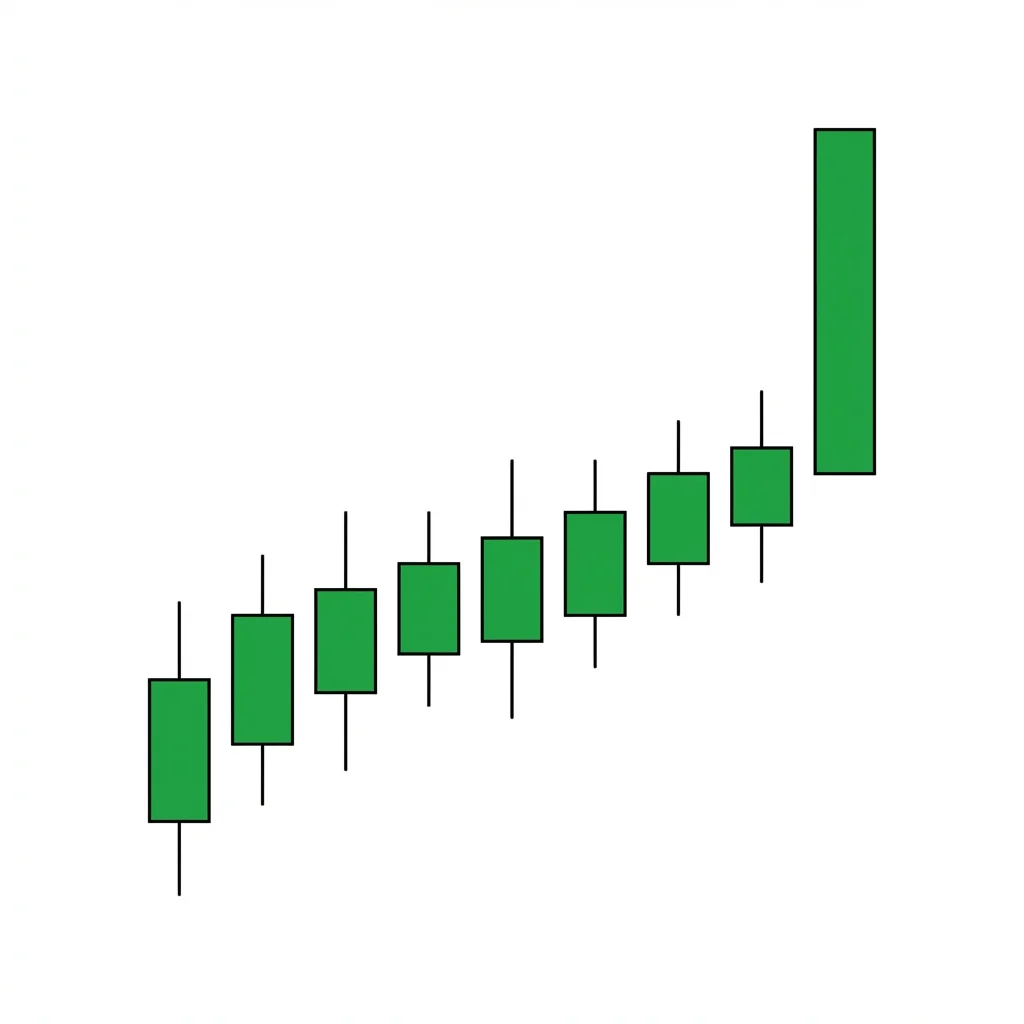
Bullish Marubozu
Marubozu (丸坊主)
Also known as: Shaven Head/Bottom, Full Body Candle, No Shadow Candle
The Bullish Marubozu is a single candle with no shadows — it opens at the low and closes at the high, representing complete buyer dominance throughout the entire session with no seller resistance.
The Marubozu (meaning 'bald head' in Japanese) is a candle without shadows. A Bullish Marubozu opens at the session low and closes at the session high, meaning buyers controlled the market from the opening bell to the close without any meaningful pullback. This represents the purest form of bullish sentiment — total buyer dominance. As a continuation signal, it indicates strong momentum. As a reversal signal (after a downtrend), it indicates a decisive shift in control. The candle's power comes from the absence of any shadow, meaning sellers never gained even temporary control at any point during the session.
History & Etymology
The Marubozu is one of the fundamental candle types in Japanese candlestick analysis, documented since the earliest rice trading texts. The name refers to the 'shaved' appearance of the candle — smooth and clean with no protruding shadows.
Marubozu (丸坊主) literally means 'bald' or 'shaved head' in Japanese, referring to the candle's clean appearance without any shadows (hair).
How It Forms
Formation Steps
- 1A long bullish candle with no upper shadow (or negligible) and no lower shadow (or negligible)
- 2The open equals the low of the session
- 3The close equals the high of the session
Prerequisites
- No specific trend requirement — can appear in any context
- The candle should have a notably large body
- Shadows should be absent or negligible
Confirmation Signals
- Next candle continues higher
- Volume is above average on the marubozu
- Gap up on the following session
Invalidation Signals
- Immediate reversal the next session
- Next candle engulfs the marubozu bearishly
- Low volume on the marubozu
Candle Breakdown
Bullish Marubozu
A long bullish candle with open at the low and close at the high, no shadows
Buyers controlled every moment of the session. From open to close, there was never a meaningful pullback — pure bullish conviction.
Psychology
The Marubozu represents absolute buyer dominance. Not a single moment during the session did sellers gain control. This unanimity of bullish sentiment is a powerful signal.
Buyer Perspective
Buyers are fully in control and aggressive throughout the session. There is no hesitation or profit-taking visible in the candle.
Seller Perspective
Sellers are completely absent or overwhelmed. They could not push price back even momentarily during the session.
Smart Money Action
A marubozu often results from institutional buying programs executing throughout the session. The lack of pullback shows continuous, systematic accumulation.
Retail Trader Trap
Retail shorts are squeezed throughout the session with no pullback to add to positions or manage stops. Their covering adds fuel to the advance.
Emotional Cycle
Trading Strategy
Aggressive Entry
Enter long at the close of the marubozu.
Conservative Entry
Wait for any pullback after the marubozu and enter on the first sign of support.
1:1 R:R (equal to the marubozu's body size).
Next resistance level.
2x the marubozu body projected higher.
Best Conditions
- Timeframe: daily
- Timeframe: 4h
- Timeframe: weekly
- breakout situations
- after earnings/news
- trend continuation
- Asset: stocks
- Asset: indices
- Asset: forex
- Asset: crypto
Avoid When
- Timeframe: 1m
- Timeframe: 5m
- end of trends (potential exhaustion)
- overbought conditions
- low liquidity
Confluence Factors
- Breakout from a chart pattern
- High volume
- Fundamental catalyst
- Trend continuation context
- Support level bounce
Scale In Strategy
Enter on the marubozu close, add on any pullback to the marubozu midpoint.
Scale Out Strategy
Scale out at resistance levels above.
Risk Management
Volume Analysis
Volume Confirmation
High volume confirms genuine institutional buying. Low-volume marubozus are less reliable.
Volume Profile
Volume should be consistently high throughout the session, not front-loaded.
Volume Divergence
Low volume on a marubozu suggests thin market conditions rather than genuine demand.
Technical Confluence
Support Resistance
The marubozu's body range (open to close) often becomes a support zone on pullbacks.
Fibonacci Levels
Pullbacks to the 38.2% or 50% of the marubozu's body are common entry points.
Moving Averages
A marubozu that breaks above the 50 or 200-day MA is an extremely strong signal.
Rsi Confirmation
RSI rising sharply on the marubozu confirms strong momentum.
Macd Confirmation
MACD showing a strong bullish surge on the marubozu day.
Bollinger Bands
A marubozu breaking above the upper band signals strong momentum (not necessarily overbought).
Vwap
The entire session above VWAP confirms institutional buying.
Ichimoku Cloud
A marubozu breaking above the cloud is a powerful trend change signal.
Elliott Wave
Marubozus often appear as the body of Wave 3 — the strongest impulse.
Wyckoff Phase
Can represent the sign of strength (SOS) jumping the creek.
Market Profile
The marubozu creates a strong initiative move visible as a single-print area.
Order Flow
Continuous buy-side aggression throughout the session.
Open Interest
Rising OI on a marubozu confirms new long positions.
Multi-Timeframe Analysis
Higher Timeframe Alignment
A daily marubozu aligned with a weekly uptrend is a strong continuation signal.
Lower Timeframe Entry
After a daily marubozu, use the 4H chart to find a pullback entry to the marubozu's midpoint.
Timeframe Confluence
Marubozus on multiple timeframes simultaneously are extremely rare and powerful.
Top-Down Approach
Confirm weekly trend, trade daily marubozus in that direction, use 4H for precision entries.
Statistics
Historical Examples
Apple Earnings Marubozu
successApple printed a near-perfect bullish marubozu after earnings, opening near the low and closing near the high. The stock continued higher for several weeks.
Lesson: Earnings-driven marubozus often signal the start of sustained moves.
Gold Breakout Marubozu
successGold printed a strong marubozu on a breakout above $2,100, confirming the bullish breakout with pure buyer dominance.
Lesson: Marubozus on breakout days provide strong confirmation of the breakout's validity.
Variations
Opening Marubozu
No lower shadow but a small upper shadow is present.
Closing Marubozu
No upper shadow but a small lower shadow is present.
Confusion Matrix
Patterns commonly confused with Bullish Marubozu and how to distinguish them.
Bullish Opening Marubozu
8500% similarIf there's ANY upper shadow, it's an opening marubozu, not a full marubozu.
Key Differences
- Full marubozu has no shadows at all
- Opening marubozu has no lower shadow but may have an upper shadow
Bullish Belt Hold
7000% similarThe marubozu is a stricter version — no shadows at all. Belt hold allows an upper shadow.
Key Differences
- Belt hold opens at the low but may have an upper shadow
- Marubozu has no shadows at either end
The bearish marubozu is a single candle with no shadows — price opened at the high and closed at the low, showing complete seller domination throughout the entire session with no buying resistance.
The Bullish Belt Hold is a single-candle reversal pattern that opens at the low of the session and rallies strongly to close near the high, signaling a potential shift from bearish to bullish control.
The Bullish Closing Marubozu is a single-candle pattern where the close equals the session high (no upper shadow), signaling that buyers maintained control through the closing bell with zero pullback.
The Gap and Go occurs when price gaps up on a catalyst, and instead of filling the gap, continues higher as momentum buying drives the stock to new levels throughout the session.
The Opening Marubozu is a bullish candle with no lower shadow — the open IS the low — showing that from the moment the session opened, buyers were in control and never let price trade below the open.
Three White Soldiers is one of the strongest bullish reversal patterns: three consecutive long bullish candles with progressively higher closes, each opening within the prior candle's body, signaling a powerful shift from bearish to bullish sentiment.
Pro Tips & Common Mistakes
Pro Tips
- A true marubozu has NO shadows — even small shadows technically make it an 'opening' or 'closing' marubozu variant
- The marubozu's midpoint often serves as support on pullbacks — use it as a stop-loss reference
- In practice, allow shadows up to 5% of the body length for a 'near marubozu'
- The highest-probability marubozus occur at breakout points from established patterns
- Volume is critical — a low-volume marubozu in a thin market is not the same signal
Common Mistakes
- Buying at the close of the marubozu and getting caught in a profit-taking pullback the next day
- Not recognizing that a marubozu after an extended advance may signal exhaustion rather than continuation
- Confusing candles with small shadows for true marubozus — the strict definition requires no shadows
- Ignoring the context — a marubozu in a strong downtrend (countertrend) is less reliable
- Setting stops too tight above the open — use the midpoint as minimum
Advanced Techniques
- Wait for a pullback to the marubozu's body (38.2-50% of the candle) for a better entry
- Use the marubozu as a 'line in the sand' — if price retraces below the open, the signal has failed
- In SMC, a marubozu often creates a fair value gap or order block that can be used for re-entry
- Combine with volume profile to confirm the entire body range was heavily traded
Institutional Perspective
Institutional buying programs often produce marubozu candles as algorithms execute continuously throughout the session. The absence of pullback indicates the buying program was not contested at any price level.
Fun Facts
- Marubozu literally means 'bald head' in Japanese — the candle is clean-shaven with no shadow 'hair'.
- True marubozus are rarer than most traders realize — most 'marubozus' actually have tiny shadows that technically disqualify them.
- The marubozu is one of the only candle patterns that can serve as both a continuation and reversal signal depending on context.
Frequently Asked Questions
A Bullish Marubozu is a candlestick with no upper or lower shadows — it opens at the session low and closes at the session high, showing complete buyer dominance.
It depends on the color. A green/white Marubozu is bullish (buyers dominated). A red/black Marubozu is bearish (sellers dominated).