
Overview
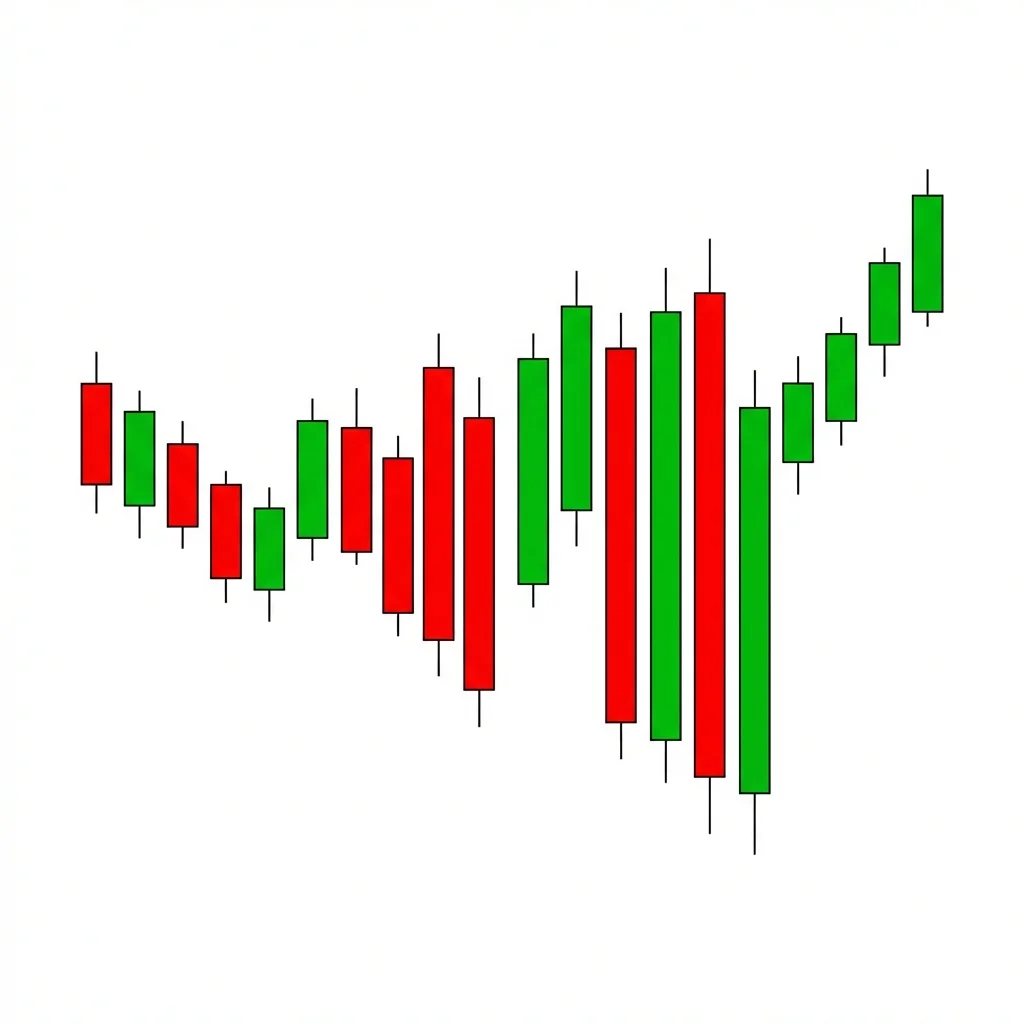
Bullish Broadening Bottom
Also known as: Megaphone Bottom, Expanding Triangle Bottom, Reverse Symmetrical Triangle
The Bullish Broadening Bottom is an expanding volatility pattern where price makes successively wider swings. When it resolves with an upside breakout above the upper trendline, it signals a powerful reversal higher.
The Broadening Bottom, also called a Megaphone pattern, is characterized by price swings that get progressively larger — each high is higher than the last, and each low is lower. This creates two diverging trendlines that form a megaphone or horn shape. The pattern reflects increasing volatility and disagreement between buyers and sellers. Broadening bottoms often form at major market turning points when uncertainty is high. The bullish resolution occurs when price breaks above the upper trendline, indicating that buyers have finally gained the upper hand. These patterns are more common during periods of high market emotion, such as after major news events, during geopolitical uncertainty, or at the end of prolonged bear markets.
History & Etymology
The broadening formation was first described by Edwards and Magee as one of the more challenging patterns to trade. It is sometimes called the 'formation of confusion' because the expanding swings create a chaotic appearance. Richard Schabacker, an early pioneer of chart pattern analysis, also documented this pattern in the 1930s.
The name 'broadening' refers to the widening of the price range over time. 'Bottom' indicates this variation forms at lows and resolves bullishly. The 'megaphone' nickname comes from the shape of the diverging trendlines resembling a megaphone or bullhorn.
How It Forms
Formation Steps
- 1Price makes a series of higher highs and lower lows, creating diverging trendlines
- 2Each swing is wider than the previous one (expanding volatility)
- 3The upper trendline connects at least two higher highs
- 4The lower trendline connects at least two lower lows
- 5Bullish resolution occurs when price breaks above the upper trendline
Prerequisites
- Prior downtrend or sideways price action
- At least two higher highs and two lower lows
- Clearly diverging trendlines
Confirmation Signals
- Price closes above the upper trendline with volume
- Subsequent candles hold above the breakout level
- Volume expands on the upside breakout
Invalidation Signals
- Price breaks below the lower trendline and continues lower
- The pattern takes too long to resolve (over 3 months on daily charts)
- Volume pattern does not support the bullish breakout
Candle Breakdown
Initial Swing High
Price rallies to form the first swing high on the upper trendline.
Initial buying interest creates the first upper boundary. Sellers step in at this level.
Deeper Low
Price declines past the prior low, creating a lower low and expanding the pattern.
Sellers push prices to new lows, creating fear. The expanding range shows growing disagreement.
Breakout Rally
Price rallies through the upper trendline, breaking the pattern to the upside.
Buyers overwhelm the expanding uncertainty. The breakout above the upper line resolves the disagreement in favor of the bulls.
Psychology
The broadening bottom represents maximum market disagreement. Both bulls and bears are becoming more aggressive, creating wider swings. The pattern resolves when one side capitulates — in the bullish case, sellers give up and price breaks higher.
Buyer Perspective
Buyers see increasingly attractive prices at each lower low but are frustrated by the volatility. When the upper trendline is broken, their conviction is rewarded and latecomers pile in.
Seller Perspective
Sellers push price to new lows each swing but cannot maintain control — price keeps bouncing back harder. Eventually, they exhaust themselves.
Smart Money Action
Institutions accumulate near each lower low, knowing the volatility will eventually resolve. They allow the wide swings to shake out weak hands before supporting the breakout.
Retail Trader Trap
Retail traders get whipsawed by the expanding swings — buying at highs and selling at lows. Many give up entirely before the breakout happens.
Emotional Cycle
Trading Strategy
Aggressive Entry
Buy when price bounces from the lower trendline for the third or fourth time, targeting a move to the upper trendline.
Conservative Entry
Wait for a confirmed close above the upper trendline with volume, then enter on a pullback to the breakout level.
The widest swing within the pattern projected above the breakout point.
The height of the pattern at its widest point projected above the breakout.
The next major resistance from higher timeframe analysis.
Best Conditions
- Timeframe: daily
- Timeframe: weekly
- High-volatility market transitions
- End of bear markets
- Major geopolitical uncertainty periods
- Asset: stocks
- Asset: indices
- Asset: futures
Avoid When
- Timeframe: 1m
- Timeframe: 5m
- Low-volatility trending markets
- When the pattern is too noisy to trade
Confluence Factors
- Pattern forms at a major historical support zone
- RSI divergence at the lower lows
- Volume higher on up-swings than down-swings
- The breakout occurs at a significant Fibonacci level
Scale In Strategy
Enter 30% at a lower trendline bounce, add 30% on break above the midline, add 40% on the upper trendline breakout.
Scale Out Strategy
Take 40% at the pattern height target, trail the remainder with the 20 EMA.
Risk Management
Volume Analysis
Volume Confirmation
Volume should generally increase throughout the pattern and spike on the breakout. Higher volume on up-swings versus down-swings favors bullish resolution.
Volume Profile
Increasing volume on each successive swing reflects growing participation and conviction.
Volume Divergence
If volume is higher on the down-swings, the pattern may resolve bearishly instead.
Technical Confluence
Support Resistance
The diverging trendlines define dynamic support and resistance. Horizontal levels within the pattern add extra significance.
Fibonacci Levels
Each swing within the pattern often respects Fibonacci relationships to the previous swing.
Moving Averages
Moving averages whipsaw during broadening patterns. The breakout above the 50 SMA after the pattern is a strong confirmation.
Rsi Confirmation
Bullish divergence (higher RSI lows while price makes lower lows) is the best confirmation for a bullish resolution.
Macd Confirmation
MACD showing less negative readings at each lower low confirms weakening bearish momentum.
Bollinger Bands
Bollinger Bands expand during broadening patterns, reflecting the increased volatility.
Vwap
Not particularly useful during the formation, but reclaiming VWAP after the breakout confirms the trend change.
Ichimoku Cloud
The chaotic price action often moves above and below the cloud. Staying above the cloud after the breakout confirms the bullish trend.
Elliott Wave
Broadening patterns sometimes appear as expanded flats (3-3-5) in Elliott Wave corrections.
Wyckoff Phase
May represent a volatile accumulation phase with an exaggerated spring and test sequence.
Market Profile
The broadening range creates an expanding value area, with the breakout establishing a new point of control higher.
Order Flow
Cumulative delta rising despite price making lower lows shows aggressive institutional buying — a bullish resolution clue.
Open Interest
Rising open interest during the pattern shows new positions being built on both sides. The breakout determines which side wins.
Multi-Timeframe Analysis
Higher Timeframe Alignment
A weekly broadening bottom that resolves bullishly signals a major trend change.
Lower Timeframe Entry
Use the 4-hour chart to time entries at the lower trendline bounces or the upper trendline breakout.
Timeframe Confluence
Daily broadening bottom at a weekly support level offers the highest conviction.
Top-Down Approach
Weekly identifies the macro support → Daily identifies the broadening pattern → 4-hour times the entries.
Statistics
Historical Examples
S&P 500 Broadening Bottom Late 2018
successThe S&P 500 formed a broadening bottom in Q4 2018 during trade war fears. Price made successively wider swings before breaking above the upper trendline in early January 2019, launching a sustained rally.
Lesson: Broadening patterns at major market bottoms can precede significant rallies. The key was waiting for the upper trendline breakout rather than trying to trade within the chaotic pattern.
Variations
Right-Angled Broadening Bottom
One trendline is flat (horizontal support or resistance) while the other diverges.
Confusion Matrix
Patterns commonly confused with Bullish Broadening Bottom and how to distinguish them.
Bullish Diamond Bottom
6000% similarIf the pattern expands and then contracts (diamond shape), it is a diamond. If it only expands, it is a broadening pattern.
Key Differences
- Diamond bottoms expand then contract; broadening bottoms only expand
- Diamonds have four trendlines; broadening bottoms have two
The Broadening Top (Megaphone) is a chart formation characterized by expanding price swings that create higher highs and lower lows, reflecting increasing volatility and instability at market tops before a bearish breakdown.
The Bullish Diamond Bottom is a complex reversal formation that transitions from expanding volatility to contracting volatility in a diamond shape, resolving with a bullish breakout as uncertainty transforms into directional conviction.
The Bullish Engulfing is one of the most popular and reliable two-candle reversal patterns. A large bullish candle completely engulfs the prior bearish candle body, signaling a decisive shift from selling to buying control.
Three White Soldiers is one of the strongest bullish reversal patterns: three consecutive long bullish candles with progressively higher closes, each opening within the prior candle's body, signaling a powerful shift from bearish to bullish sentiment.
The Triple Bottom is a major reversal pattern featuring three distinct lows at approximately the same price level, separated by two intermediate peaks. The breakout above the neckline confirms the reversal and targets a measured move equal to the pattern height.
The Descending Channel is a chart formation where price trends lower within two parallel downward-sloping trendlines, making consistent lower highs and lower lows in an orderly bearish progression.
Pro Tips & Common Mistakes
Pro Tips
- Broadening patterns are chaotic — avoid trading inside them unless you have a specific plan for each swing
- The breakout direction is uncertain until it happens — do not assume bullish resolution
- Volume analysis is your best tool: higher volume on up-swings suggests bullish resolution
- These patterns often appear at major turning points — the bigger the pattern, the bigger the subsequent move
- Use wider stops than normal — the volatility within broadening patterns can trigger tight stops easily
Common Mistakes
- Getting whipsawed by trading inside the pattern without clear rules
- Assuming the pattern will resolve bullishly before the breakout confirms it
- Using stops that are too tight for the high-volatility environment
- Trading broadening patterns on short timeframes where the noise is overwhelming
- Ignoring the pattern because it looks 'messy' — broadening patterns are powerful when they resolve
Advanced Techniques
- Use RSI divergence to predict the breakout direction before it occurs
- Trade each swing within the pattern as a separate trade with the appropriate trendline as the target
- Combine with options strategies — buy straddles during the pattern and close the losing side on the breakout
- Measure the average swing amplitude to set realistic targets for swing trades within the pattern
Institutional Perspective
Institutional traders are often the source of broadening patterns. Disagreement between large funds about fair value creates the expanding swings. The breakout occurs when a consensus finally forms, usually driven by fundamental data or policy changes.
Fun Facts
- Edwards and Magee called the broadening formation the 'pattern of confusion' — a name many traders would enthusiastically agree with.
- Broadening patterns are more common in markets with high institutional disagreement, which is why they often appear during major policy debates or geopolitical crises.
- The megaphone pattern was particularly common in the highly volatile markets of 2020-2022.
Frequently Asked Questions
The broadening pattern itself is neutral — it can resolve in either direction. It becomes a 'bullish broadening bottom' only when price breaks above the upper trendline. The term 'bottom' implies it forms at a low and resolves upward. Always wait for the breakout to confirm direction.
The expanding swings create a chaotic environment that whipsaws most traders. Stops get hit frequently, and the breakout direction is uncertain until it happens. They require patience, wider stops, and smaller position sizes than most patterns.