
Overview
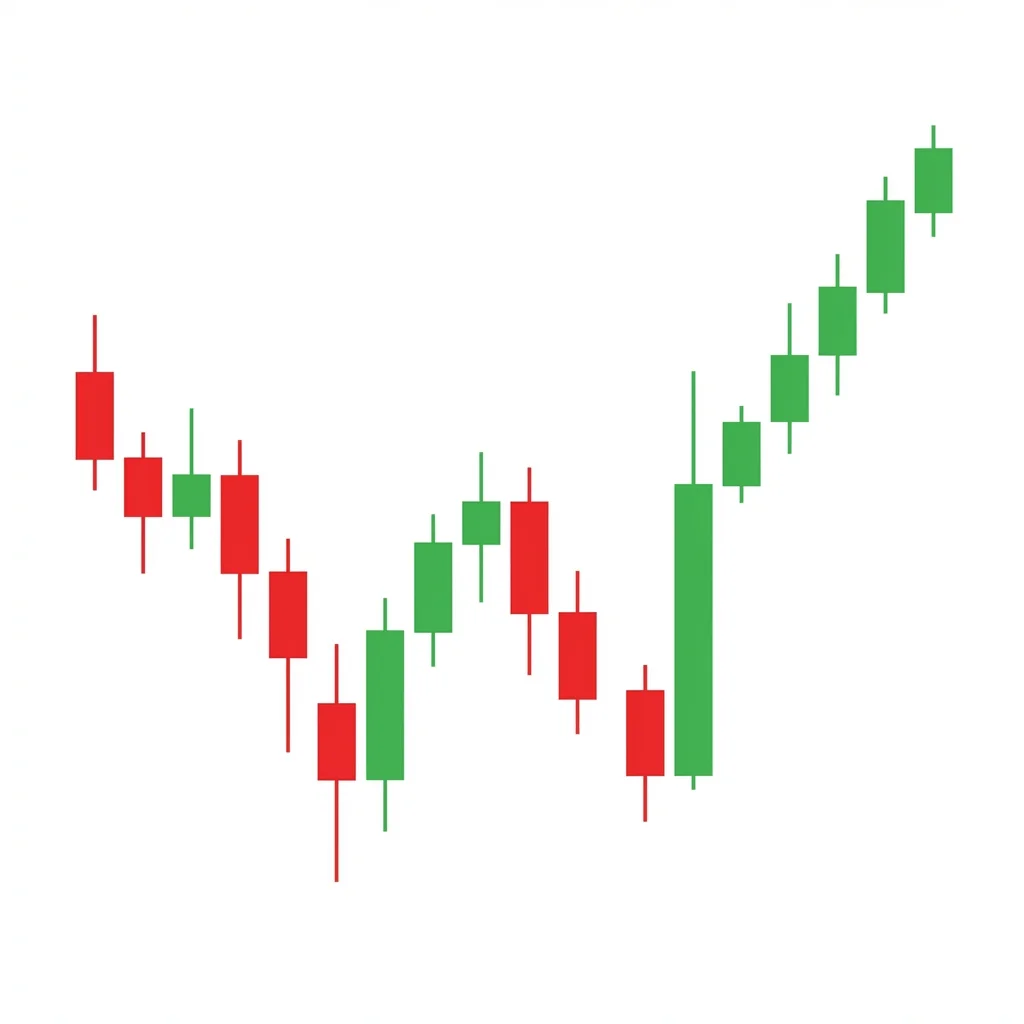
Bullish Double Bottom Breakout
Also known as: W-Breakout, Confirmed Double Bottom, Neckline Break
The Double Bottom Breakout focuses specifically on the confirmed neckline break of a double bottom pattern, which is the highest-conviction entry point with a clear measured move target and defined risk.
While the double bottom pattern describes the entire W-formation, the Double Bottom Breakout specifically addresses the critical moment when price breaks above the neckline resistance. This breakout is the official confirmation of the pattern and the most commonly traded entry point. The breakout occurs when the supply of sellers at the neckline level (often breakeven sellers from the rally between the two bottoms) is finally absorbed. Volume expansion on the breakout is essential, as it confirms genuine institutional buying rather than a false push. Approximately 50% of double bottom breakouts will pull back to retest the neckline as support, providing a second-chance entry for those who missed the initial breakout.
History & Etymology
The neckline breakout concept was formalized by Edwards and Magee, who emphasized that patterns are not confirmed until the neckline is decisively broken. This principle applies to double bottoms, head and shoulders, and other patterns with defined necklines.
The breakout refers to price breaking out above the neckline resistance, which is the line drawn across the middle peak of the W formation. The term emphasizes the decisive moment rather than the entire pattern formation.
How It Forms
Formation Steps
- 1Two troughs at approximately the same price level forming a W shape
- 2A middle peak creating the neckline resistance
- 3Price breaks above the neckline with volume, completing the pattern
- 4Optional: pullback to the neckline (now support) before continuation
Prerequisites
- Completed double bottom formation
- Price approaching or touching the neckline
- Volume building as price nears the breakout level
Confirmation Signals
- Close above the neckline on volume at least 40% above average
- Successful neckline retest holds as support
- Follow-through buying continues past the breakout
Invalidation Signals
- Price falls back below the neckline and the midpoint between neckline and bottoms
- Volume absent on the breakout (false breakout)
- Immediate reversal below the neckline after breakout attempt
Candle Breakdown
Approach Candle
Price nearing the neckline from below, often with increasing momentum.
Building momentum as price approaches the key resistance. Buyers are gaining confidence from the double bottom support.
Breakout Candle
The candle that closes decisively above the neckline on strong volume.
The neckline sellers are overwhelmed. Stops above the neckline trigger, adding fuel. This is the confirmation moment.
Psychology
The neckline breakout is where theory becomes reality. The double bottom suggested a reversal, but the breakout confirms it. This is the moment when the market collectively accepts that the downtrend is over.
Buyer Perspective
Buyers who accumulated at the double bottom lows are now in profit. New momentum buyers enter on the breakout. Institutional algorithms trigger breakout-buying programs.
Seller Perspective
Sellers at the neckline (often those who bought during the middle rally and are selling at breakeven) are finally exhausted. Once their supply is absorbed, there are no more sellers at this level.
Smart Money Action
Institutions that accumulated at the double bottom now add to positions on the breakout, using the high volume to mask their buying. They also defend the neckline on any retest.
Retail Trader Trap
Retail traders who tried to sell at the neckline are stopped out. Those who waited too long and missed the breakout chase at extended prices.
Emotional Cycle
Trading Strategy
Aggressive Entry
Enter on the breakout candle as price crosses the neckline with expanding volume.
Conservative Entry
Wait for the neckline retest (occurs about 50% of the time) and enter when price bounces off the neckline from above.
Measured move: pattern height above the neckline.
1.618x the pattern height.
Prior major resistance from the downtrend.
Best Conditions
- Timeframe: 4h
- Timeframe: daily
- Timeframe: weekly
- Improving market conditions
- Sector leadership emerging
- After oversold bounces gain traction
- Asset: stocks
- Asset: ETFs
- Asset: forex
- Asset: crypto
- Asset: futures
Avoid When
- Timeframe: 1m
- Timeframe: 5m
- Deteriorating fundamentals
- Bear market rallies that tend to fail
Confluence Factors
- Volume spike on breakout
- RSI above 50 and rising
- MACD bullish crossover
- Neckline aligns with moving average
- Sector showing strength
Scale In Strategy
Enter 60% on the breakout, add 40% on the neckline retest.
Scale Out Strategy
Take 33% at the measured move, 33% at 1.618x, trail the rest.
Risk Management
Volume Analysis
Volume Confirmation
Volume must expand on the breakout day. This is the single most important confirmation factor.
Volume Profile
Breakout volume should exceed the highest volume seen during the pattern formation.
Volume Divergence
A breakout on declining volume is a major red flag for a false breakout.
Technical Confluence
Support Resistance
The neckline transitions from resistance to support after the breakout. This role reversal is a key concept in technical analysis.
Fibonacci Levels
The measured move target often aligns with a Fibonacci extension from the pattern.
Moving Averages
The 50 SMA often supports the neckline retest, adding confluence.
Rsi Confirmation
RSI should be above 50 and ideally above 60 on the breakout, confirming bullish momentum.
Macd Confirmation
MACD above the signal line and histogram expanding confirms the breakout momentum.
Bollinger Bands
The breakout often pushes price above the upper Bollinger Band, signaling strong momentum.
Vwap
Breakout day price should stay above VWAP throughout the session.
Ichimoku Cloud
Breaking above the Kumo cloud simultaneously with the neckline is a powerful double confirmation.
Elliott Wave
The breakout often initiates Wave 3 of a new impulse sequence.
Wyckoff Phase
The neckline breakout corresponds to the Jump Across the Creek (JAC) event in Wyckoff analysis.
Market Profile
The breakout creates a range extension above the neckline, establishing a new higher value area.
Order Flow
Aggressive market buy orders driving price through the neckline, with positive delta expansion.
Open Interest
Rising open interest on the breakout confirms new positions being established.
Multi-Timeframe Analysis
Higher Timeframe Alignment
A daily neckline breakout within a weekly uptrend is the optimal setup.
Lower Timeframe Entry
Use the 1-hour chart to see the breakout develop in real-time for precise entry.
Timeframe Confluence
A weekly double bottom breakout is a major signal for a multi-month trend change.
Top-Down Approach
Weekly identifies the double bottom, daily identifies the neckline approach, 4-hour times the breakout entry.
Statistics
Historical Examples
Meta Platforms Double Bottom Breakout
successMETA formed a double bottom at the $90 level and broke above the $130 neckline in November 2022 on massive volume. The measured move target of $170 was reached within weeks, and the stock continued to $300+.
Lesson: When a high-quality double bottom breaks out on volume with improving fundamentals, the measured move target can be just the beginning of a much larger move.
Variations
Gap Breakout
Price gaps above the neckline rather than gradually breaking through.
Slow Grind Breakout
Price gradually pushes through the neckline over 2-3 sessions.
Confusion Matrix
Patterns commonly confused with Bullish Double Bottom Breakout and how to distinguish them.
Bullish Double Bottom
9500% similarThe double bottom breakout is the confirmation event within the larger double bottom pattern. It is not a separate pattern but the specific entry trigger.
Key Differences
- Double bottom describes the entire W formation
- Double bottom breakout focuses on the neckline break confirmation
The Double Top Breakdown is the confirmed version of the Double Top — the precise moment when price breaks below the neckline, triggering the measured move decline. This is the actionable event that converts the pattern from potential to confirmed.
The Double Bottom is one of the most recognized reversal patterns, forming a W-shape where price tests a support level twice and bounces, signaling that sellers cannot push through and buyers are gaining control.
The Bullish Engulfing is one of the most popular and reliable two-candle reversal patterns. A large bullish candle completely engulfs the prior bearish candle body, signaling a decisive shift from selling to buying control.
The Inverse Head and Shoulders is one of the most reliable bullish reversal patterns, featuring three troughs with the middle one (head) being the deepest, signaling a major transition from a downtrend to an uptrend.
The Bullish Rectangle Breakout is a continuation pattern where price consolidates between horizontal support and resistance before breaking above the upper boundary to resume the uptrend.
Three White Soldiers is one of the strongest bullish reversal patterns: three consecutive long bullish candles with progressively higher closes, each opening within the prior candle's body, signaling a powerful shift from bearish to bullish sentiment.
Pro Tips & Common Mistakes
Pro Tips
- The breakout volume is the most important single factor. No volume = likely false breakout
- Neckline retests that hold as support provide excellent second-chance entries with reduced risk
- Calculate the measured move target before entering so you have a clear profit plan
- The best breakouts close near the high of the day with increasing volume into the close
- Monitor the behavior at the neckline for 2-3 sessions before the breakout to see if supply is diminishing
Common Mistakes
- Entering on intraday neckline touches that fail by the close
- Not requiring volume confirmation and getting caught in false breakouts
- Setting targets too conservatively since double bottom breakouts often exceed the measured move
- Missing the neckline retest entry because of fear that the pattern failed
Advanced Techniques
- Use the breakout candle range to set an initial target then extend using Fibonacci projections
- Monitor options open interest at the neckline strike for clues about institutional positioning
- Use a volume-weighted breakout filter requiring the breakout candle volume to be in the top 10% of recent sessions
Institutional Perspective
The neckline breakout is where institutional breakout algorithms activate. Quantitative systems monitor volume-price relationships at necklines and add exposure when the breakout meets their criteria. This creates a feedback loop of buying.
Fun Facts
- Thomas Bulkowski found that double bottom neckline breakouts have a slightly higher success rate than head and shoulders neckline breakouts.
- The concept of neckline role reversal (resistance becoming support) is one of the most fundamental principles in technical analysis and applies to virtually all chart patterns.
Frequently Asked Questions
Both approaches are valid. Entering on the breakout captures the move immediately but may face a pullback. Waiting for the retest (occurs about 50% of the time) gives better prices but risks missing the move if no retest occurs. A split approach (50% breakout, 50% retest) captures both scenarios.