
Overview
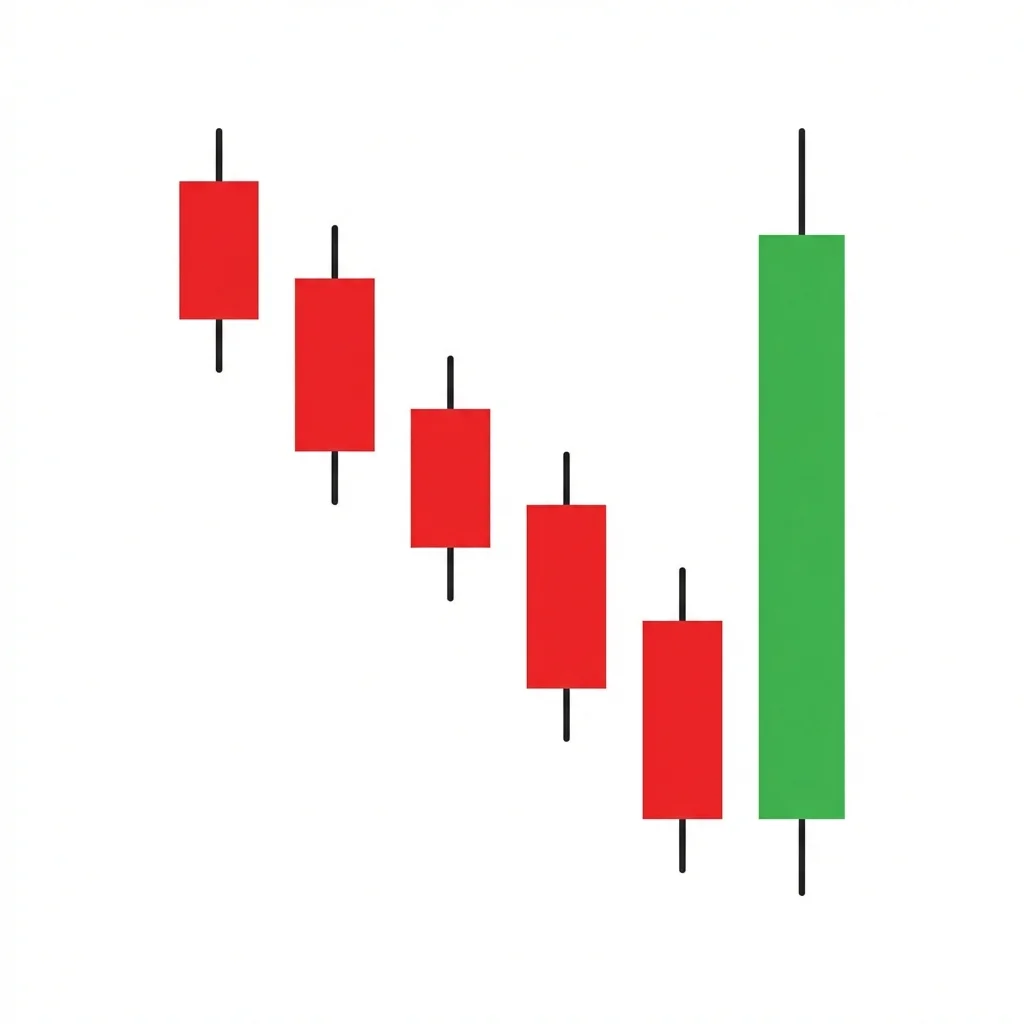
Bullish Outside Reversal
Also known as: Bullish Outside Day, Bullish Engulfing Bar, Outside Bar Reversal
The Bullish Outside Reversal is a two-bar pattern where the second bar has a wider range than the first, trading both below its low and above its high before closing bullish. This dramatic range expansion signals a powerful shift from bearish to bullish control.
The Bullish Outside Reversal (or Outside Day) is one of the most powerful two-bar reversal signals. The second bar trades below the first bar's low (testing sellers' conviction), then reverses and trades above the first bar's high (proving buyers' strength), closing near the top of its range. This 'outside bar' engulfs the first bar's entire range, showing a complete shift in control within a single session. The pattern is similar to the bullish engulfing but focuses on the high-low range rather than just the body. Heavy volume on the outside bar is essential — it confirms that the range expansion was driven by genuine participation.
History & Etymology
The outside reversal day is one of the oldest patterns in Western bar chart analysis, predating Japanese candlestick analysis in the West. It has been a staple of futures and stock trading since the early 1900s.
'Outside' refers to the second bar being 'outside' the first bar's range (its high is higher and its low is lower). 'Reversal' indicates the directional change from bearish to bullish.
How It Forms
Formation Steps
- 1First candle: any candle (typically bearish in a downtrend)
- 2Second candle: a bullish candle whose high exceeds the first candle's high AND whose low is below the first candle's low (wider range), closing near its high
Prerequisites
- Prior downtrend
- Second candle's range completely engulfs the first candle's range (highs AND lows)
- Second candle closes near its high, above the first candle's high
Confirmation Signals
- Heavy volume on the outside bar
- Close in the upper quarter of the range
- Next bar continues higher
Invalidation Signals
- Low volume on the outside bar
- Close in the lower half of the range
- Immediate bearish follow-through
Candle Breakdown
Inside Bar
The reference bar whose range will be engulfed by the outside bar
Normal trading in the existing trend. This bar sets the range that will be engulfed.
Outside Reversal Bar
A wide-range bullish bar that trades below the first bar's low and above its high, closing near the high
A complete shift in control. The bar tests both extremes — the low tests seller conviction, the high tests buyer strength — and buyers win decisively.
Psychology
The outside reversal captures a dramatic intraday battle. Bears push to new lows, but buyers overwhelm them and close above the prior session's high. The wide range on heavy volume shows genuine conviction in the reversal.
Buyer Perspective
Buyers see the failed attempt at new lows and use it as a springboard. Their ability to not only reverse the decline but surpass the prior high shows overwhelming demand.
Seller Perspective
Sellers who pushed for new lows are caught in a reversal trap. The close above the prior high forces them to cover, adding to the buying pressure.
Smart Money Action
Institutions use the push to new lows to accumulate from panicked sellers, then drive the close higher, revealing their buying.
Retail Trader Trap
Retail shorts who entered on the new low are immediately trapped by the reversal above the prior high.
Emotional Cycle
Trading Strategy
Aggressive Entry
Enter at the close of the outside bar.
Conservative Entry
Enter on the next bar's open or first pullback.
Previous swing high or 1:1 R:R.
2:1 R:R.
Measured move equal to the outside bar's range.
Best Conditions
- Timeframe: daily
- Timeframe: weekly
- Timeframe: 4h
- oversold
- at support
- after extended decline
- Asset: stocks
- Asset: indices
- Asset: futures
- Asset: commodities
Avoid When
- Timeframe: 1m
- Timeframe: 5m
- low liquidity
- choppy markets
Confluence Factors
- Support level
- Heavy volume
- RSI divergence
- Moving average support
- Fibonacci level
Scale In Strategy
Full entry on the outside bar — the signal is immediate.
Scale Out Strategy
Scale out at profit levels.
Risk Management
Volume Analysis
Volume Confirmation
Volume on the outside bar should be significantly above average — ideally 1.5-2x.
Volume Profile
Heavy volume throughout the session, especially at the lows and on the reversal.
Volume Divergence
Low volume outside bars are unreliable.
Technical Confluence
Support Resistance
The outside bar's low becomes strong support.
Fibonacci Levels
At key Fibonacci retracements, the pattern is stronger.
Moving Averages
Outside reversal at the 200-day MA is a classic high-probability setup.
Rsi Confirmation
RSI bullish divergence adds strong confirmation.
Macd Confirmation
MACD bullish crossover on the outside bar.
Bollinger Bands
Outside bar piercing the lower band and recovering.
Vwap
Reclaiming VWAP during the reversal.
Ichimoku Cloud
Outside reversal at cloud support.
Elliott Wave
Commonly marks the end of Wave 5 or Wave C.
Wyckoff Phase
The outside bar can be the selling climax candle in accumulation.
Market Profile
The wide range creates a high-volume profile day.
Order Flow
Buy absorption at the lows followed by aggressive buying.
Open Interest
Declining OI on the reversal suggests short covering.
Multi-Timeframe Analysis
Higher Timeframe Alignment
A daily outside reversal at weekly support is powerful.
Lower Timeframe Entry
Use the 4H chart to see the reversal developing within the daily outside bar.
Timeframe Confluence
Outside reversals on both daily and weekly are rare but extremely powerful.
Top-Down Approach
Identify weekly support, trade the daily outside reversal, use 4H for entry.
Statistics
Historical Examples
Crude Oil Outside Reversal
successCrude oil formed a bullish outside reversal at $92 support with volume 2x average. The pattern launched a $10 rally over the next two weeks.
Lesson: Commodity outside reversals on heavy volume at key levels are among the most reliable setups.
Variations
Key Reversal Day
An outside reversal that makes a new trend low before reversing.
Weekly Outside Reversal
The outside reversal on a weekly chart.
Confusion Matrix
Patterns commonly confused with Bullish Outside Reversal and how to distinguish them.
Bullish Engulfing
8500% similarOutside reversal requires the second bar's HIGH to be above the first bar's high AND the second bar's LOW to be below the first bar's low. Engulfing only requires body engulfment.
Key Differences
- Engulfing focuses on body engulfment
- Outside reversal requires full range engulfment (high and low)
Bullish Key Reversal
9000% similarA key reversal requires a new low below the prior bar AND close above the prior bar's high. All key reversals are outside reversals, but not all outside reversals make new trend lows.
Key Differences
- Key reversal specifically requires a new low in the trend
- Outside reversal focuses on range engulfment
A bearish outside reversal occurs when a candle's range completely engulfs the prior candle's entire range (highs and lows), closing near its low. It signals that sellers have overwhelmed buyers and a reversal is likely.
The Bullish Engulfing is one of the most popular and reliable two-candle reversal patterns. A large bullish candle completely engulfs the prior bearish candle body, signaling a decisive shift from selling to buying control.
A Bullish Key Reversal occurs when price makes a new low during a downtrend but reverses to close above the prior bar's high on heavy volume, signaling a dramatic single-day shift in control from sellers to buyers.
The Morning Star is a three-candle bullish reversal pattern consisting of a large bearish candle, a small star candle showing indecision, and a large bullish candle confirming the reversal. It is one of the most widely recognized and reliable bottom reversal signals.
The Confirmed Shooting Star adds a bearish confirmation candle to the classic shooting star, eliminating the ambiguity of the standalone pattern and creating a higher-probability reversal signal at the top of uptrends.
The Bearish Counterattack Line features a bullish candle followed by a bearish candle that gaps up at the open but closes back to the same level as the first candle's close, signaling that sellers 'counterattacked' the bullish advance.
Pro Tips & Common Mistakes
Pro Tips
- Volume is non-negotiable — a low-volume outside bar is just noise
- The close should be in the upper quarter of the range for maximum bullish signal
- The wider the range relative to recent bars, the more powerful the signal
- This pattern is especially effective in commodities and futures where volume data is reliable
- Use the outside bar's low as your line in the sand — if it breaks, exit
Common Mistakes
- Ignoring volume — this is the most common error with outside reversals
- Confusing a wide-range bar with an outside reversal when it doesn't engulf the prior bar's range
- Entering when the close is in the lower half of the range (not bullish)
- Not requiring the bar to trade below the prior bar's low
- Using the pattern on very short timeframes where range expansion is meaningless
Advanced Techniques
- Use the outside bar's midpoint as a key level — bullish above, bearish below
- Combine with volume profile to see where the most trading occurred during the bar
- Apply the pattern to weekly charts for powerful swing trading signals
- Track outside reversals in index futures for market-wide reversal signals
Institutional Perspective
The outside reversal is one of the patterns most tracked by institutional traders, especially in futures and commodities. The volume expansion and range engulfment confirm genuine institutional participation in the reversal.
Fun Facts
- The outside reversal is one of the oldest patterns in Western technical analysis, documented well before candlestick analysis arrived.
- Many legendary traders, including Richard Wyckoff, considered the outside day one of the most reliable reversal signals.
- The pattern is structurally similar to the Japanese bullish engulfing but uses range (high/low) rather than body (open/close) as the reference.
Frequently Asked Questions
A two-bar pattern where the second bar's high exceeds the first bar's high AND its low is below the first bar's low, while closing bullish near the high. It shows a complete shift in control.
Yes. Heavy volume (1.5-2x average) is essential for a valid outside reversal. Without it, the range expansion may be noise rather than genuine institutional activity.