
Overview
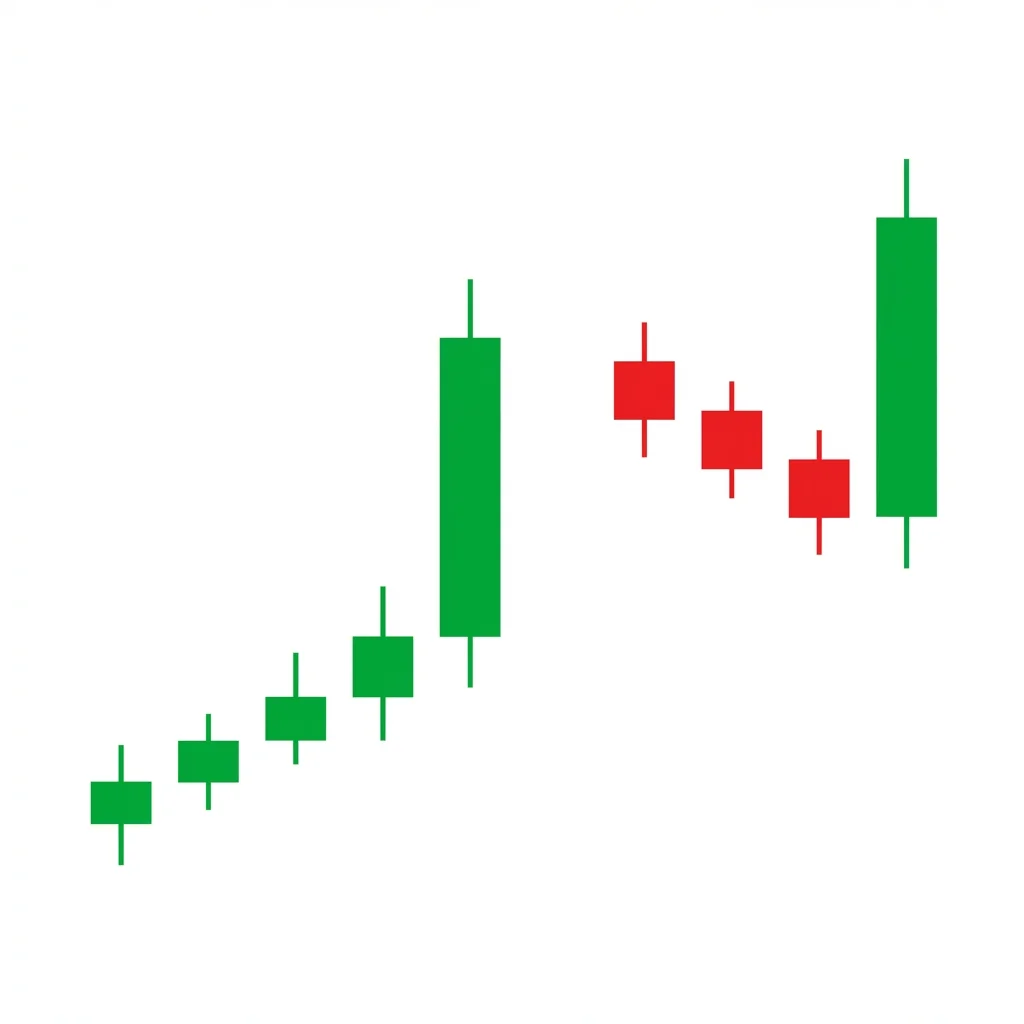
Bullish Mat Hold
Uwate Sanpoo Ohdatekomi
Also known as: Mat Hold Continuation, Rising Mat Hold
The Mat Hold is a five-candle bullish continuation pattern where a strong bullish candle is followed by a brief, shallow pullback of small bearish candles, then a final bullish candle resumes the advance — indicating the trend remains intact.
The Mat Hold is considered one of the most reliable bullish continuation patterns. It begins with a large bullish candle that establishes momentum. Over the next 2-3 sessions, small bearish candles pull back slightly but crucially hold above the first candle's midpoint — the trend's 'mat' (foundation) holds. The fifth candle surges higher, closing above the first candle's high and confirming that the pullback was merely a pause in the uptrend. The pattern is similar to the Rising Three Methods but is considered slightly more bullish because the pullback is shallower.
History & Etymology
The Mat Hold is documented in traditional Japanese candlestick analysis as a strong continuation pattern. It was one of the patterns described by Munehisa Homma in his rice trading strategies, emphasizing the importance of shallow pullbacks within strong trends.
The 'mat' refers to the floor or foundation of the trend — the support level established by the first candle. 'Hold' indicates that this mat holds firm during the pullback, preserving the trend's integrity.
How It Forms
Formation Steps
- 1Candle 1: large bullish candle establishing the trend
- 2Candles 2-4: small bearish candles that drift lower but stay above the first candle's midpoint or body open
- 3Candle 5: strong bullish candle that closes above the first candle's high, resuming the uptrend
Prerequisites
- Existing uptrend
- First candle is a large bullish candle
- Subsequent small candles must not close below the first candle's body midpoint
- Final candle must close above the first candle's high
Confirmation Signals
- Fifth candle closes above the first candle's high
- Volume increases on the fifth candle
- The small bearish candles have declining volume
Invalidation Signals
- The small candles close below the first candle's open
- The fifth candle fails to surpass the first candle's high
- Volume increases on the bearish candles
Candle Breakdown
Trend Candle
A large bullish candle showing strong buying momentum
Strong institutional buying drives price higher, establishing the trend leg.
First Pullback Candle
A small bearish candle that drifts slightly lower
Minor profit-taking begins, but selling is weak.
Second Pullback Candle
Another small bearish candle continuing the shallow drift
Selling remains minimal. The trend's foundation holds.
Third Pullback Candle (optional)
A third small candle, possibly bullish, showing the pullback is ending
The pullback has run its course. Sellers have nothing left.
Continuation Candle
A large bullish candle that closes above the first candle's high
Buyers return with force, confirming the pullback was merely a pause and the trend continues.
Psychology
The Mat Hold shows that even the mildest profit-taking cannot dent the trend's momentum. The shallow pullback followed by a strong continuation signals deeply embedded bullish conviction.
Buyer Perspective
Buyers are confident enough to let the small pullback play out without concern. They use the pause to add positions before the next leg higher.
Seller Perspective
Sellers attempted to push back but could only manage a minor pullback. Their inability to close below the first candle's midpoint reveals weakness.
Smart Money Action
Institutions use the shallow pullback to quietly add to positions. The low-volume pullback is exactly the environment they need to accumulate without moving the market.
Retail Trader Trap
Retail traders who sold the pullback hoping for a deeper correction are trapped when the continuation candle surges above the pattern.
Emotional Cycle
Trading Strategy
Aggressive Entry
Enter when the fifth candle breaks above the first candle's high.
Conservative Entry
Wait for the fifth candle to close above the first candle's high.
Measured move equal to the first candle's body projected from the breakout.
2:1 R:R.
Next major resistance level.
Best Conditions
- Timeframe: daily
- Timeframe: 4h
- Timeframe: weekly
- strong uptrend
- bull market
- sector leadership
- Asset: stocks
- Asset: indices
- Asset: commodities
Avoid When
- Timeframe: 1m
- Timeframe: 5m
- choppy market
- end of trend
- approaching resistance
Confluence Factors
- Existing uptrend
- Pullback holds above 38.2% Fibonacci
- Volume confirms
- Moving averages trending up
- Relative strength positive
Scale In Strategy
Enter on the fifth candle, add on the first pullback after the continuation.
Scale Out Strategy
Take one-third at each profit level.
Risk Management
Volume Analysis
Volume Confirmation
Volume should decline during pullback candles and surge on the continuation candle.
Volume Profile
High-low-low-low-high volume pattern across the five candles.
Volume Divergence
Rising volume during the pullback suggests genuine selling, not consolidation.
Technical Confluence
Support Resistance
The first candle's midpoint becomes the critical support level that must hold.
Fibonacci Levels
The pullback staying above the 38.2% retracement of the first candle confirms trend strength.
Moving Averages
The pattern typically forms above the 20-day EMA, which supports the pullback.
Rsi Confirmation
RSI staying above 50 during the pullback confirms maintained bullish momentum.
Macd Confirmation
MACD remaining positive with the histogram merely pulling back confirms the trend.
Bollinger Bands
The pullback to the middle band before the continuation is textbook.
Vwap
Pullback candles holding above VWAP confirms institutional interest.
Ichimoku Cloud
Pattern well above the cloud confirms the uptrend's strength.
Elliott Wave
The Mat Hold often forms within Wave 3 as a consolidation before continuing.
Wyckoff Phase
Represents a brief re-accumulation within the markup phase.
Market Profile
The pullback creates a brief balance area before the next initiative buying.
Order Flow
Passive buying absorbs the minor selling during the pullback.
Open Interest
Stable OI during pullback confirms no significant position changes.
Multi-Timeframe Analysis
Higher Timeframe Alignment
A daily mat hold within a weekly uptrend is the ideal context.
Lower Timeframe Entry
Use 4H to time the entry on the continuation candle.
Timeframe Confluence
The pattern on the daily with a clean weekly trend is optimal.
Top-Down Approach
Confirm weekly uptrend, identify daily mat hold, enter on confirmation.
Statistics
Historical Examples
Microsoft Mat Hold in Uptrend
successMicrosoft formed a textbook mat hold during its AI-driven rally. A strong bullish candle was followed by three tiny dips that held above the candle's midpoint, then a powerful continuation.
Lesson: Mat Hold patterns in sector leaders with fundamental catalysts produce strong continuation moves.
Variations
Rising Three Methods
Similar pattern but with a deeper pullback that may reach the first candle's open.
Two-Candle Mat Hold
Only two small pullback candles before the continuation.
Confusion Matrix
Patterns commonly confused with Bullish Mat Hold and how to distinguish them.
Bullish Rising Three Methods
8500% similarMeasure the pullback depth. If it stays above the first candle's midpoint, it's a Mat Hold. If it reaches the open, it's Rising Three Methods.
Key Differences
- Mat Hold has a shallower pullback than Rising Three Methods
- Rising Three Methods allows pullback to the first candle's open; Mat Hold stays above midpoint
The Bullish Flag is the quintessential continuation pattern: a sharp rally (pole) followed by a brief, tight consolidation (flag) before the next leg up. It represents a healthy pause in a strong uptrend.
The Bullish Marubozu is a single candle with no shadows — it opens at the low and closes at the high, representing complete buyer dominance throughout the entire session with no seller resistance.
The Bullish Pennant is a continuation pattern featuring a sharp advance (flagpole) followed by a brief triangular consolidation (pennant), before price breaks out and continues higher with a measured move equal to the flagpole.
The Rising Three Methods is a five-candle bullish continuation pattern where a long bullish candle is followed by three small bearish candles within its range, then a final bullish candle closes above the first, confirming the uptrend will continue.
Three White Soldiers is one of the strongest bullish reversal patterns: three consecutive long bullish candles with progressively higher closes, each opening within the prior candle's body, signaling a powerful shift from bearish to bullish sentiment.
The Bearish Breakaway is a five-candle reversal pattern where a gap-up rally stalls over three sessions before a powerful bearish candle breaks back down into the gap, signaling the uptrend is exhausted.
Pro Tips & Common Mistakes
Pro Tips
- The shallower the pullback, the more bullish the pattern — ideally the small candles stay above the first candle's 2/3 level
- Volume pattern is critical: declining during pullback, surging on continuation
- This pattern appears most often in the strongest trending stocks — it's a sign of institutional conviction
- Use the first candle's midpoint as your key support level for the pullback
- The mat hold is essentially a 'bull flag within a candle' — same concept, more refined
Common Mistakes
- Confusing a genuine reversal with a mat hold — if the pullback is deep, it's not a mat hold
- Not requiring the continuation candle to close above the first candle's high
- Entering during the pullback phase before the continuation is confirmed
- Ignoring volume — the pullback must show declining volume
- Trading the pattern in a weakening or sideways trend
Advanced Techniques
- Measure the pullback as a percentage of the first candle — under 38.2% is ideal for a mat hold
- Use the pullback candles' bodies to identify the precise support zone for the pattern
- Combine with relative strength analysis — mat holds in the market's strongest stocks are the best
- Trail the stop below the pullback zone for maximum profit capture
Institutional Perspective
The Mat Hold is a favorite of institutional trend followers. The shallow pullback in a strong trend provides an opportunity to add to positions without significant price impact. The low volume during the pullback confirms that institutional holders are not selling.
Fun Facts
- The Mat Hold is considered one of the most reliable continuation patterns in all of candlestick analysis.
- The shallow pullback (above the midpoint) that defines the Mat Hold reflects exceptionally strong holder conviction.
- Some quantitative studies show the Mat Hold has a higher success rate than many better-known patterns.
Frequently Asked Questions
The Mat Hold is a five-candle continuation pattern: a strong bullish candle, 2-3 small pullback candles that stay above the first candle's midpoint, and a final bullish candle closing above the first candle's high.
The Mat Hold has a shallower pullback (stays above the midpoint), while Rising Three Methods allows the pullback to reach the first candle's open level.