
Overview
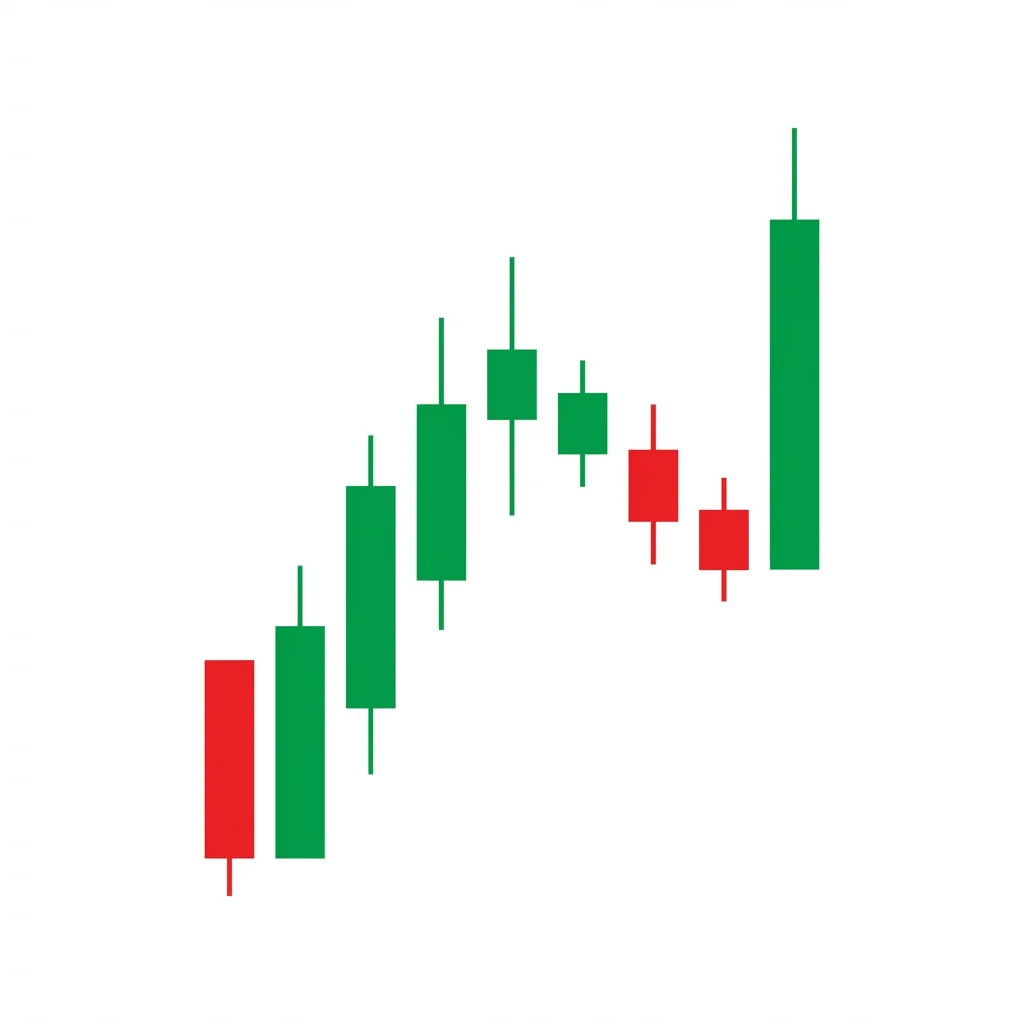
Bullish Order Block
Also known as: Demand Zone, Institutional Buying Zone, OB Long
A Bullish Order Block is the last bearish candle before a strong upside displacement. It marks where institutional buying occurred, and when price returns to this zone, it often bounces as institutions defend their entry level.
The Bullish Order Block (OB) is a core concept in Smart Money Concepts (SMC) and ICT methodology. The theory is that institutional traders place large buy orders that cannot be filled in a single session. The last bearish candle before a sharp upside move represents the zone where these institutions accumulated — the candle is bearish because the selling was still present, but the buying underneath was massive enough to launch the subsequent rally. When price later returns to this zone, the unfilled institutional orders act as demand, creating a bounce. The OB is defined by the body of the last bearish candle (open to close range), and the low of that candle is the critical support level.
History & Etymology
The Order Block concept was developed and popularized by ICT (Inner Circle Trader / Michael Huddleston) as part of the Smart Money Concepts framework. While the underlying idea — that institutional footprints are visible in price action — has existed for decades, the specific Order Block methodology gained massive popularity in the 2020s through social media and YouTube.
'Order Block' refers to a block of institutional orders resting at a specific price level. The price zone where these orders were placed (and partially filled) is the 'block' that acts as future support or resistance.
How It Forms
Formation Steps
- 1A strong impulse move to the upside creates a displacement
- 2The last bearish (down-close) candle BEFORE the impulse move is identified as the order block
- 3Price later returns to the order block zone (the body of that bearish candle)
- 4Price bounces from the order block, confirming institutional demand at that level
Prerequisites
- A clear impulse move (displacement) to the upside
- An identifiable last bearish candle before the displacement
- The order block zone (bearish candle body) should not have been revisited yet
Confirmation Signals
- Price returns to the order block zone and bounces
- A bullish candle closes above the order block
- The bounce creates a new higher low in the developing uptrend
Invalidation Signals
- Price closes below the order block's low
- The order block is swept and price doesn't recover
- No displacement occurred from the candle identified as the OB
Candle Breakdown
Order Block Candle
The last bearish candle before the displacement — this is the institutional accumulation zone
This candle appears bearish on the surface, but underneath, massive institutional buy orders are being filled. The selling provides the liquidity institutions need.
Displacement Candle(s)
One or more strong bullish candles that create the displacement away from the order block
The displacement reveals the institutional buying. The aggressive upside move shows that buying overwhelmed selling at the OB level.
Psychology
The Order Block captures the footprint of institutional accumulation. Large players need liquidity (sellers) to fill their buy orders. The bearish candle provides this liquidity. The subsequent displacement proves their buying was present.
Buyer Perspective
Smart money buyers placed orders at the OB level. When price returns, they defend this level because they don't want to see their positions go underwater.
Seller Perspective
Retail sellers who sold during the OB candle unknowingly provided liquidity to institutions. Their selling was absorbed by institutional bids.
Smart Money Action
Institutions place large limit buy orders that create the OB. They defend this level on retests because their positions are anchored there. Additional unfilled orders may rest at the same level.
Retail Trader Trap
Retail traders who short the return to the OB (seeing it as a previous selling zone) are trapped when institutional buying resumes at the level.
Emotional Cycle
Trading Strategy
Aggressive Entry
Place a limit buy order at the top of the order block zone (the open of the bearish candle).
Conservative Entry
Wait for price to enter the OB zone and print a bullish candle before entering.
The most recent swing high before the return to the OB.
The next liquidity level above (equal highs, previous swing).
The opposite order block (supply zone) on the same timeframe.
Best Conditions
- Timeframe: 15m
- Timeframe: 1h
- Timeframe: 4h
- Timeframe: daily
- after a market structure break
- at HTF support
- during London or NY session
- Asset: forex
- Asset: indices
- Asset: crypto
- Asset: stocks
Avoid When
- Timeframe: 1m
- Timeframe: tick
- low-volatility consolidation
- news events
- illiquid periods
Confluence Factors
- Market structure break in the same direction
- Higher-timeframe order block alignment
- Liquidity sweep below the OB before the bounce
- Fair value gap within the OB zone
- Fibonacci OTE zone alignment (61.8-78.6%)
Scale In Strategy
Enter at the OB with a limit order; add if a lower-timeframe confirmation appears.
Scale Out Strategy
Take partials at each liquidity target.
Risk Management
Volume Analysis
Volume Confirmation
High volume on the displacement confirms institutional participation.
Volume Profile
Volume should be elevated during the displacement candles.
Volume Divergence
Low volume displacement may indicate a weak OB.
Technical Confluence
Support Resistance
The OB IS the support level — it's a specific, institutionally-defined zone.
Fibonacci Levels
The OB often falls within the 61.8-78.6% retracement zone (OTE — Optimal Trade Entry).
Moving Averages
OBs that coincide with the 50 or 200-period MA have added confluence.
Rsi Confirmation
RSI approaching oversold as price enters the OB supports the bounce thesis.
Macd Confirmation
MACD bullish crossover at the OB adds momentum confirmation.
Bollinger Bands
OB at the lower Bollinger Band confirms an oversold zone.
Vwap
OB at or below VWAP on intraday charts shows value buying.
Ichimoku Cloud
OB at cloud support adds structural confluence.
Elliott Wave
OBs often form at the start of Wave 3 — the strongest impulse.
Wyckoff Phase
The OB concept maps to Wyckoff's 'last point of support' in accumulation.
Market Profile
OBs at the Point of Control or Value Area Low align with institutional defense.
Order Flow
The original OB candle should show buy absorption (passive buying against active selling).
Open Interest
Rising OI at the OB suggests new positioning, not just stop-running.
Multi-Timeframe Analysis
Higher Timeframe Alignment
A 1H OB within a daily order block is the optimal setup.
Lower Timeframe Entry
Refine the daily OB by finding the 15M or 1H OB within it for a precise entry.
Timeframe Confluence
OBs aligning across timeframes create premium entry zones.
Top-Down Approach
Identify daily bias, find 4H OB at key levels, enter on 15M confirmation within the OB.
Statistics
Historical Examples
EUR/USD Order Block at 1.0700
successA bullish order block formed at 1.0700 when the last bearish candle preceded a strong displacement through 1.0750. Price returned to the OB two days later and bounced 80 pips.
Lesson: Intraday order blocks in forex provide precise entry levels with tight risk parameters.
NQ Daily Order Block
successNasdaq formed a daily bullish OB at 14,200. The displacement pushed to 14,800. Price returned to 14,250, bounced from the OB, and rallied to new highs.
Lesson: Higher-timeframe order blocks in indices provide swing-trading opportunities with excellent risk-reward.
Variations
Breaker Block
A former order block that failed and has been 'broken' — it flips from support to resistance or vice versa.
Refined Order Block
The OB zone is refined on a lower timeframe to find a more precise entry.
Confusion Matrix
Patterns commonly confused with Bullish Order Block and how to distinguish them.
Bullish Support Bounce
7000% similarAn OB requires a specific bearish candle followed by displacement. A support bounce is any bounce from any support level.
Key Differences
- OB is defined by a specific candle (last bearish before displacement)
- Support bounce is a broader concept at any support level
Bullish Fair Value Gap
6000% similarFVG is a gap between candle 1's high and candle 3's low. OB is the body of the last opposing candle before displacement. They often overlap.
Key Differences
- FVG is a gap in price between candle shadows
- OB is the body of a specific candle
A bearish order block is the last bullish candle before a significant bearish displacement, representing an area where institutional sellers placed large sell orders. When price returns to this zone, it often reverses downward as unfilled orders are executed.
The Bullish Fair Value Gap (FVG) is a smart money concept identifying price imbalances where aggressive buying creates a gap between the first candle high and third candle low. Price often returns to this zone to fill the inefficiency before continuing higher.
A Bullish Market Structure Break (MSB/BOS) occurs when price in a downtrend breaks above the most recent swing high, signaling that the series of lower highs has ended and a potential trend reversal is underway.
The Bullish Spring is a Wyckoff pattern where price briefly breaks below trading range support to trigger stop losses, then immediately reverses back above support, trapping shorts and initiating a markup phase.
The Bullish Support Bounce is one of the most fundamental trading patterns where price declines to a well-established support level and bounces higher, confirmed by bullish price action and volume at the support zone.
A bearish market structure break occurs when price in an uptrend breaks below a prior swing low, invalidating the series of higher highs and higher lows that defined the uptrend. It signals a potential trend reversal from bullish to bearish.
Pro Tips & Common Mistakes
Pro Tips
- The displacement from the OB must be strong — weak moves don't create valid OBs
- The best OBs are the ones that haven't been retested yet (unmitigated OBs)
- Combine with a market structure break for the highest-probability OB trades
- The OB zone is the BODY of the candle, not the shadows — the body is where institutional orders rested
- Higher-timeframe OBs are more significant than lower-timeframe ones
Common Mistakes
- Identifying every bearish candle before a green candle as an order block — displacement is required
- Not verifying that the OB is unmitigated (hasn't been revisited)
- Using OBs against the higher-timeframe trend
- Placing stops above the OB instead of below it
- Over-complicating the concept — the OB is simply the last opposing candle before a strong move
Advanced Techniques
- Refine the OB entry by dropping to a lower timeframe and finding the exact candle within the higher-TF OB
- Look for liquidity sweeps below the OB before the bounce for the highest-probability entries
- Combine OBs with fair value gaps — when they overlap, the zone is especially strong
- Use the OB's body midpoint (equilibrium) as a decision level — price should react there
Institutional Perspective
The Order Block concept attempts to map institutional order placement by identifying the candle where large buy orders were likely filled. While the concept is simplified for retail traders, the underlying principle — that institutions leave footprints in price action — is valid and recognized by professional traders.
Fun Facts
- The Order Block concept has become the most searched Smart Money topic on YouTube, with billions of cumulative views.
- While ICT popularized the terminology, the underlying concept of 'institutional footprints in price' has been discussed by market microstructure researchers for decades.
- Many professional traders use the OB concept under different names — 'demand zones,' 'accumulation areas,' or simply 'key levels.'
Frequently Asked Questions
The last bearish candle before a strong upside displacement. It marks where institutional buying occurred, and when price returns to this zone, it often bounces.
Look for a strong displacement (impulse move) to the upside. The last bearish candle before that move is the OB. The OB is valid if it hasn't been revisited (unmitigated).
An OB fails when price closes below the OB's low on the retest. This means institutional buying was insufficient, and the level should be abandoned.