
Overview
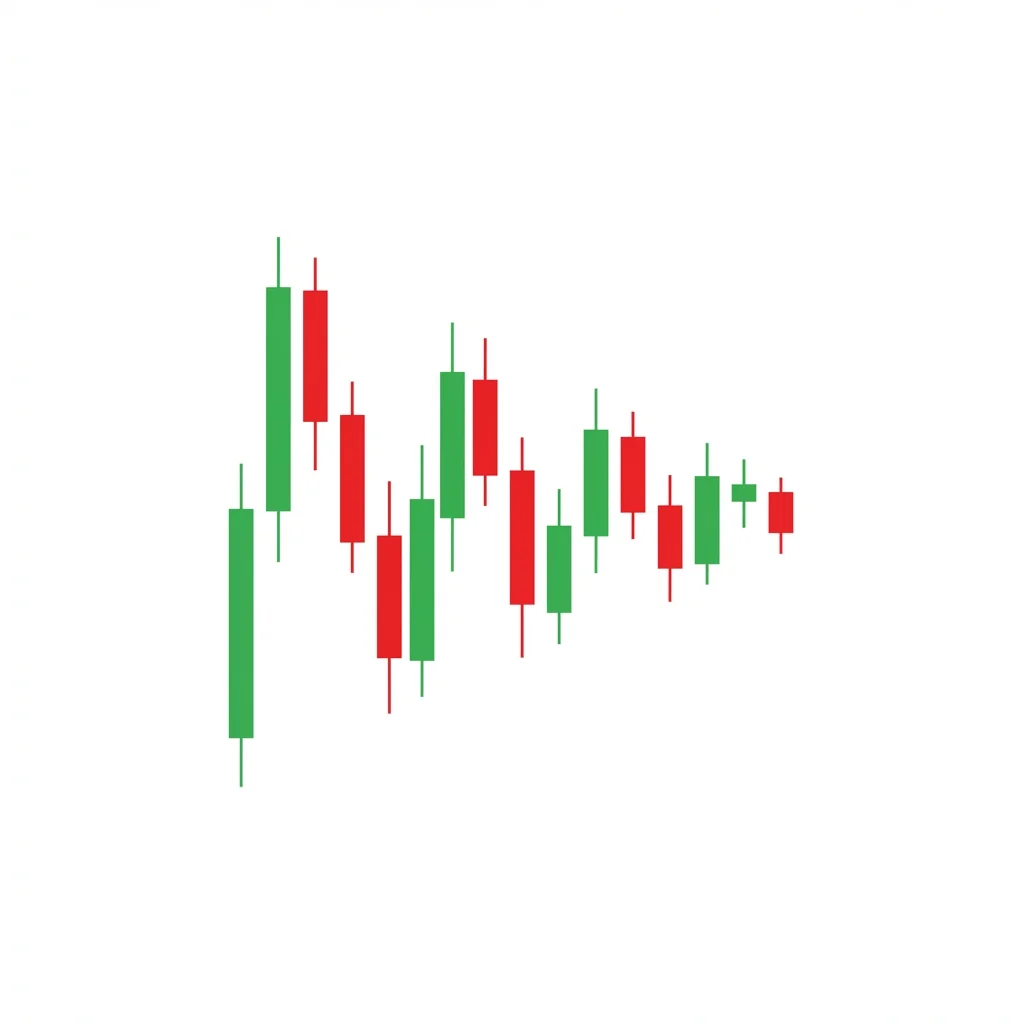
Symmetrical Triangle
Also known as: Coil, Isosceles Triangle, Converging Triangle
The Symmetrical Triangle is a chart formation where converging trendlines of roughly equal slope create a coiling pattern, indicating a period of equilibrium that will resolve with an explosive breakout in either direction.
The Symmetrical Triangle forms when price creates a series of lower highs and higher lows, bounded by two converging trendlines of approximately equal slope. This convergence reflects a market where both buyers and sellers are becoming increasingly aggressive — buyers willing to pay more each swing and sellers willing to accept less — until they converge at the apex. The pattern is inherently neutral as it can break in either direction. Statistically, the symmetrical triangle breaks in the direction of the prevailing trend roughly 60% of the time, making it a slight continuation bias, but it is traded as a neutral pattern. The breakout typically occurs in the first two-thirds of the triangle, and the measured move target equals the widest part of the triangle projected from the breakout point.
History & Etymology
The Symmetrical Triangle has been recognized in Western technical analysis since the early 20th century. Richard Schabacker described it in detail in the 1930s, and Edwards & Magee formalized its trading rules in 'Technical Analysis of Stock Trends' (1948). It remains one of the most traded chart patterns worldwide.
Named 'symmetrical' because both trendlines converge at roughly equal angles (unlike ascending or descending triangles where one line is flat). The pattern's triangular shape is formed by the converging boundaries.
How It Forms
Formation Steps
- 1Descending upper trendline connecting lower highs
- 2Ascending lower trendline connecting higher lows
- 3Both trendlines converge at roughly equal angles toward an apex
Prerequisites
- At least two lower highs touching the upper trendline
- At least two higher lows touching the lower trendline
- The trendlines must converge (not parallel)
- Both trendlines should have roughly equal slopes
Confirmation Signals
- Decisive close above the upper trendline (bullish) or below the lower trendline (bearish)
- Volume surge on the breakout candle
- Breakout occurs in the first two-thirds of the triangle (before apex)
Invalidation Signals
- Price reaches the apex without breaking out (may morph into a pennant)
- False breakout that reverses back inside the triangle
- Low volume on the breakout attempt
Candle Breakdown
Triangle Body Candles
Multiple candles forming lower highs and higher lows within converging trendlines, with decreasing range over time
Each swing within the triangle is shorter than the last. Buyers push higher each time but face resistance sooner. Sellers push lower but find support faster. The compression builds energy.
Psychology
The Symmetrical Triangle reflects a gradual consensus-building process. Each lower high shows sellers becoming more aggressive, while each higher low shows buyers becoming bolder. The narrowing range forces a confrontation that must resolve with a breakout, as the market literally runs out of room.
Buyer Perspective
Buyers notice higher lows and interpret them as building demand. Each bounce from the lower trendline reinforces their bullish thesis. They prepare for a breakout above the upper trendline.
Seller Perspective
Sellers see lower highs as evidence of weakening buying. Each rejection from the upper trendline confirms selling pressure. They position for a breakdown below the lower trendline.
Smart Money Action
Institutional traders accumulate positions during the triangle's formation, using the predictable range to fill orders. They may trigger the breakout once their positions are built, often creating the final decisive move that breaks the trendline.
Retail Trader Trap
Retail traders attempt to trade each swing within the triangle, getting whipsawed as the range narrows. False breakouts near the apex trap both bulls and bears before the real move.
Emotional Cycle
Trading Strategy
Aggressive Entry
Enter on the first close outside the trendline in the breakout direction.
Conservative Entry
Wait for a close outside the trendline followed by a successful retest of the broken trendline as new support/resistance.
Measured move: the widest part of the triangle (first swing height) projected from the breakout point.
1.5x the measured move.
2x the measured move or next major support/resistance level.
Best Conditions
- Timeframe: daily
- Timeframe: 4h
- Timeframe: weekly
- after a trending move that consolidates
- in liquid markets
- before catalytic events
- Asset: stocks
- Asset: forex
- Asset: indices
- Asset: crypto
Avoid When
- Timeframe: 1m
- Timeframe: 5m
- extremely low volume environments
- in the final third of the triangle (near apex)
Confluence Factors
- Breakout direction aligns with the prior trend
- Volume surges on the breakout candle
- The breakout occurs in the first half of the triangle
- Key support/resistance level aligns with a trendline
- Multiple timeframe triangle alignment
Scale In Strategy
Enter half on the breakout, add on the retest of the broken trendline.
Scale Out Strategy
Take one-third at the measured move, trail the rest.
Risk Management
Volume Analysis
Volume Confirmation
Volume should decline throughout the triangle and surge on the breakout. This is the most reliable confirmation signal.
Volume Profile
Decreasing volume during the triangle with a burst of 50-100% above average on breakout is ideal.
Volume Divergence
If volume consistently favors one side during the triangle (more on up swings vs. down swings), it provides a directional clue.
Technical Confluence
Support Resistance
Triangle trendlines act as dynamic support/resistance. Once broken, the trendline flips roles.
Fibonacci Levels
Fibonacci retracement within the triangle helps identify the internal structure and likely breakout timing.
Moving Averages
Moving averages converge during the triangle. Their expansion on breakout confirms the new trend.
Rsi Confirmation
RSI oscillating in a narrowing range mirrors the triangle. RSI breakout above 60 or below 40 confirms direction.
Macd Confirmation
MACD histogram compressing toward zero during the triangle, then expanding on breakout.
Bollinger Bands
Bollinger Bands squeeze during the triangle, confirming volatility compression.
Vwap
VWAP flattens during the triangle. Breakout candle's position relative to VWAP confirms direction.
Ichimoku Cloud
The Kumo cloud often flattens or thins during the triangle, and the breakout resolves above or below the cloud.
Elliott Wave
Symmetrical triangles are the most common Wave 4 pattern in Elliott Wave theory.
Wyckoff Phase
The triangle can represent the final testing phase in both accumulation and distribution schematics.
Market Profile
The triangle creates a balanced profile that narrows over time. Breakout represents value migration.
Order Flow
Balanced delta during the triangle with a sudden directional delta shift on breakout.
Open Interest
Rising open interest during the triangle with a price breakout confirms genuine new positioning.
Multi-Timeframe Analysis
Higher Timeframe Alignment
A daily symmetrical triangle within a weekly trend provides high-conviction breakout trades in the trend direction.
Lower Timeframe Entry
After identifying a daily triangle, use the 1-hour chart for precise entry on the trendline breakout.
Timeframe Confluence
Triangles visible on multiple timeframes produce the most significant breakouts.
Top-Down Approach
Weekly trend direction determines breakout bias. Daily triangle provides the setup. 4-hour chart provides the entry.
Statistics
Historical Examples
Tesla Symmetrical Triangle Breakout
successTSLA formed a symmetrical triangle between $160-$210 over two months. The bullish breakout above the upper trendline with massive volume led to a rally to $290.
Lesson: Symmetrical triangles in high-beta stocks with volume confirmation produce explosive breakouts.
EUR/USD Symmetrical Triangle Continuation
successEUR/USD formed a symmetrical triangle during an uptrend. The bullish breakout continued the trend with a 200-pip measured move.
Lesson: Symmetrical triangles that break in the direction of the prior trend have the highest success rate.
Bitcoin Triangle False Breakout
failureBTC formed a symmetrical triangle near $30,000. The initial bullish breakout was a fakeout that reversed sharply, eventually breaking the lower trendline.
Lesson: False breakouts from symmetrical triangles are common. Wait for volume confirmation and consider the retest entry.
Variations
Expanding Symmetrical Triangle
A broadening pattern where the trendlines diverge rather than converge, indicating increasing volatility.
Pennant
A small symmetrical triangle that forms after a sharp move (flagpole), acting as a continuation pattern.
Confusion Matrix
Patterns commonly confused with Symmetrical Triangle and how to distinguish them.
Neutral Wedge Apex
7000% similarCheck if both trendlines slope toward each other symmetrically (triangle) or if both slope in the same direction (wedge).
Key Differences
- Symmetrical Triangle has converging lines of equal slope
- Wedge has both lines sloping in the same direction
Neutral Rectangle
4000% similarParallel boundaries = Rectangle. Converging boundaries = Triangle.
Key Differences
- Rectangle has parallel horizontal lines
- Symmetrical Triangle has converging diagonal lines
The Rectangle is a chart formation where price consolidates between parallel horizontal support and resistance levels, creating a box-like pattern that can break in either direction.
The Squeeze Breakout occurs when volatility compresses to extreme levels (tight Bollinger Bands or low ATR) before an explosive directional move, representing the market's transition from consolidation to trending.
The Tight Coil is a multi-candle pattern where each successive candle has a smaller range than the last, creating a coiled-spring effect that typically precedes an explosive directional breakout.
The Volatility Contraction Pattern (VCP) shows progressively smaller price swings as ATR declines, signaling that the market is absorbing supply and preparing for a significant directional breakout.
The Wedge Apex occurs when price reaches the convergence point of two trendlines that slope in the same direction, creating maximum compression that forces a breakout. The pattern is neutral at the apex because the breakout direction depends on context.
The Broadening Top (Megaphone) is a chart formation characterized by expanding price swings that create higher highs and lower lows, reflecting increasing volatility and instability at market tops before a bearish breakdown.
Pro Tips & Common Mistakes
Pro Tips
- Breakouts in the first two-thirds of the triangle are more reliable than those near the apex
- Volume declining during the triangle is essential — if volume is not declining, the pattern may not be valid
- The measured move target (widest part of the triangle) is achieved approximately 65-70% of the time
- The prior trend direction provides a slight statistical edge for the breakout direction (60/40 continuation)
- Draw the trendlines using candle wicks, not bodies, for more accurate boundary identification
Common Mistakes
- Trading breakouts near the apex where false signals are most common
- Not waiting for a close outside the trendline (intraday breaches often reverse)
- Ignoring volume on the breakout — low-volume breakouts fail frequently
- Forcing the pattern by drawing trendlines that don't connect at least two clear points
- Setting stops outside the triangle rather than using the internal swing structure
Advanced Techniques
- Count the number of internal touches on each trendline — more touches increase breakout reliability
- Use the E-wave (thrust from the triangle) concept for aggressive targeting beyond the measured move
- Monitor volume imbalance within the triangle for advance directional clues
- Apply the triangle to options: sell premium during the triangle, buy premium before the expected breakout
Institutional Perspective
Institutional traders use the symmetrical triangle's predictable swings to accumulate positions. The narrowing range allows them to buy lower lows and sell higher highs, building a range position. The breakout direction reveals their net positioning. Watch for unusual block trades near the trendlines.
Fun Facts
- The Symmetrical Triangle is the most commonly identified chart pattern by professional technical analysts worldwide.
- In Elliott Wave theory, the symmetrical triangle is the 'textbook' Wave 4 pattern, appearing in this position more than any other formation.
- Thomas Bulkowski's statistical analysis found that symmetrical triangles in bull markets break upward 60% of the time, but the downward breakouts produce larger average moves.
Frequently Asked Questions
A Symmetrical Triangle forms when price creates lower highs and higher lows within converging trendlines of equal slope, indicating narrowing indecision that will resolve with a breakout.
It can break either way. Statistically, it breaks in the prior trend direction about 60% of the time. Always wait for confirmation rather than predicting.
Measure the widest part of the triangle (the first swing height) and project it from the breakout point in the breakout direction.