
Overview
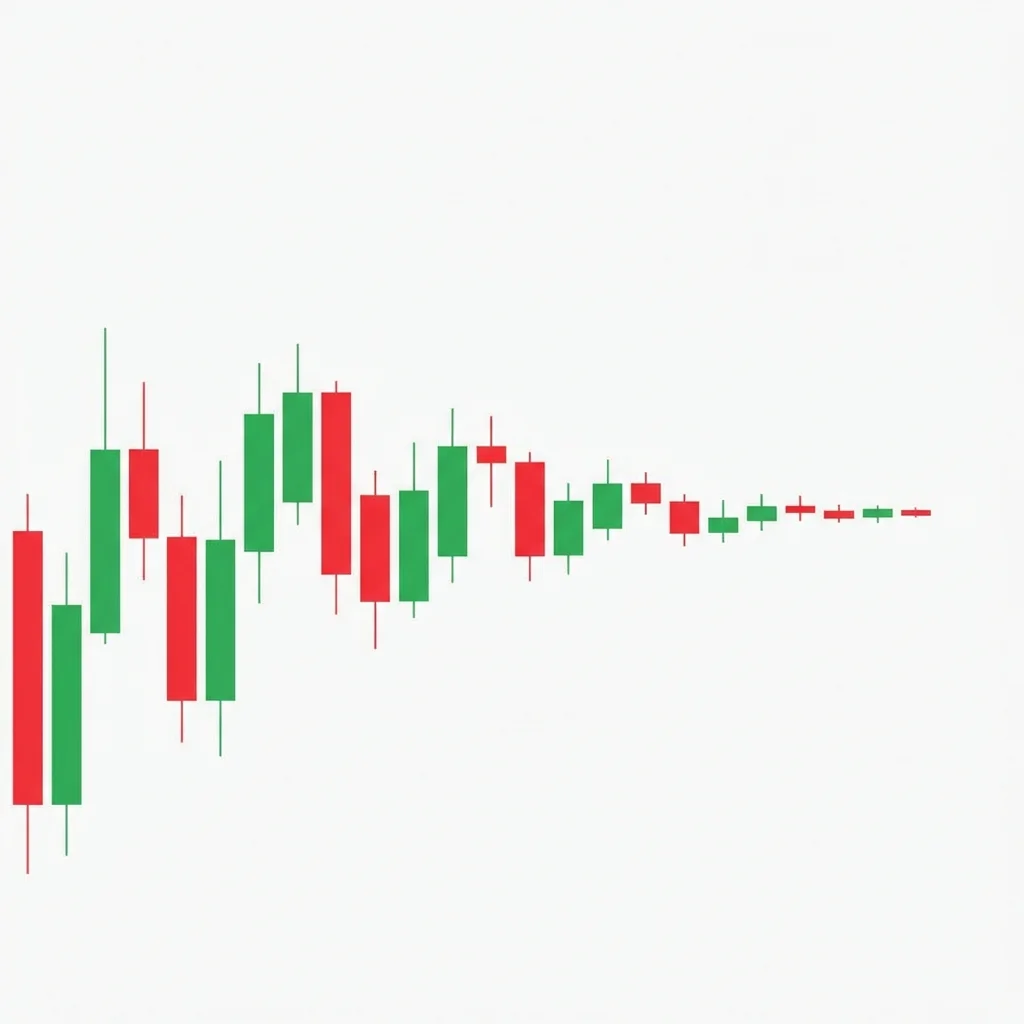
Tight Coil
Also known as: NR7, Narrow Range, Coiled Spring, Compression Coil
The Tight Coil is a multi-candle pattern where each successive candle has a smaller range than the last, creating a coiled-spring effect that typically precedes an explosive directional breakout.
The Tight Coil forms when the market prints a sequence of candles with progressively narrowing ranges. Unlike the doji cluster (which requires doji candles) or the inside bar (which is two candles), the Tight Coil is defined by the progressive range compression across multiple candles. This pattern is often quantified as NR7 (Narrowest Range of 7 sessions) or similar narrow-range indicators. The coiling effect compresses market energy, and the longer the compression continues, the more powerful the eventual breakout. The pattern works on the principle that periods of low volatility precede periods of high volatility — the market breathes in before breathing out.
History & Etymology
The Tight Coil concept was popularized by Toby Crabel in his 1990 book 'Day Trading with Short Term Price Patterns and Opening Range Breakout'. Crabel's NR4 and NR7 patterns formalized the narrow-range breakout concept that had been observed by floor traders for decades.
'Tight' describes the narrowing ranges, and 'coil' refers to the spring-like compression of price action. Just as a coiled spring stores energy, the pattern stores market energy for the eventual release.
How It Forms
Formation Steps
- 1Three or more consecutive candles with progressively shrinking ranges
- 2Each candle's high-low range is smaller than the previous candle
- 3The sequence creates a visual compression or coiling effect
Prerequisites
- At least three candles with decreasing ranges
- The range contraction should be visually obvious
- Can appear in any trend context
Confirmation Signals
- A candle with a range significantly larger than the coil candles, breaking out of the coil range
- Volume surge on the breakout candle
- The breakout candle closes near its extreme (high for bullish, low for bearish)
Invalidation Signals
- Price drifts sideways without a decisive breakout
- The coil continues beyond 10 candles without resolution
- Volume remains low on the expansion attempt
Candle Breakdown
Initial Candle
The first candle in the sequence, typically the largest, setting the reference range for the contraction
Normal market activity that sets the baseline range. Subsequent contractions are measured against this candle.
Narrowing Candle
A candle with a smaller range than the previous, beginning the compression sequence
Activity begins to contract. Market participants are becoming less aggressive, waiting for new information.
Tightest Candle
The most compressed candle in the sequence, with the narrowest range, representing maximum compression
Maximum compression achieved. The market is wound tightly, and the next decisive candle will trigger the breakout.
Psychology
The Tight Coil represents the gradual withdrawal of aggressive participants from both sides. As each candle produces less range, it shows that the market is running out of participants willing to push prices at current levels. This creates a vacuum that will be filled explosively when a new catalyst or aggressive order flow arrives.
Buyer Perspective
Buyers see the narrowing ranges as a potential accumulation phase. The decreasing volatility allows patient position building. They prepare for a breakout that will propel price higher.
Seller Perspective
Sellers view the contraction as potential distribution or exhaustion. The lack of downside progress suggests selling pressure is waning. They prepare for a breakdown but are wary of a squeeze.
Smart Money Action
Institutional traders use tight coil periods to accumulate positions with minimal market impact. The low volatility enables large order fills without slippage. The breakout is often triggered by institutional order flow.
Retail Trader Trap
Retail traders become bored during the coil and reduce their attention. They miss the breakout setup or chase the move too late after it has already expanded.
Emotional Cycle
Trading Strategy
Aggressive Entry
Enter on the first candle that exceeds the range of the tightest coil candle in the expected direction.
Conservative Entry
Wait for a close beyond the entire coil range (highest high to lowest low of all coil candles) with volume.
Measured move equal to the range of the widest candle in the coil projected from the breakout.
Next major support or resistance level.
2x the measured move or the prior swing high/low.
Best Conditions
- Timeframe: daily
- Timeframe: 4h
- Timeframe: 1h
- after trending moves
- before catalytic events
- at technical inflection points
- Asset: stocks
- Asset: forex
- Asset: futures
- Asset: crypto
Avoid When
- Timeframe: 1m
- Timeframe: 5m
- extended low-volatility environments where coils are noise
- holiday trading
Confluence Factors
- Coil forms at a key support or resistance level
- Bollinger Bands are simultaneously squeezing
- ATR is at a multi-period low
- The coil aligns with a moving average
- Prior trend direction supports the expected breakout
Scale In Strategy
Enter half on the initial expansion candle, add on confirmation of sustained direction.
Scale Out Strategy
Take one-third at each profit target.
Risk Management
Volume Analysis
Volume Confirmation
Volume should decline progressively during the coil and surge on the breakout candle.
Volume Profile
Each coil candle should have lower volume than the last. The breakout candle should have the highest volume in the sequence.
Volume Divergence
If volume increases on one specific candle within the coil, it may indicate which direction the breakout will favor.
Technical Confluence
Support Resistance
Tight coils at major support/resistance levels produce the most significant breakouts.
Fibonacci Levels
Coil at a Fibonacci retracement level suggests the market is coiling for a move from a key technical zone.
Moving Averages
Tight coil at a major moving average (20, 50, or 200 EMA) creates a trend-definition breakout setup.
Rsi Confirmation
RSI compressing near 50 during the coil with a breakout above 60 or below 40 confirms direction.
Macd Confirmation
MACD histogram shrinking to near-zero during the coil, expanding on breakout.
Bollinger Bands
Tight coil coinciding with a Bollinger squeeze doubles the compression signal.
Vwap
Coil near VWAP indicates the market is compressed at fair value before a directional move.
Ichimoku Cloud
Coil at the Kumo cloud boundary creates a defined breakout setup.
Elliott Wave
Tight coils commonly form during Wave 4 or Wave 2 corrections before the next impulse.
Wyckoff Phase
The coil can represent the final compression in the Spring or Test phase before markup.
Market Profile
The coil creates an extremely narrow value area. Breakout signals dramatic value migration.
Order Flow
Diminishing order flow during the coil with a sudden burst of directional flow on breakout.
Open Interest
Rising open interest during the coil despite low price movement suggests positioning for breakout.
Multi-Timeframe Analysis
Higher Timeframe Alignment
A daily tight coil at a weekly key level is a premium setup.
Lower Timeframe Entry
After a daily tight coil, use the 1-hour chart for precise breakout entry timing.
Timeframe Confluence
Tight coils on multiple timeframes simultaneously signal extreme compression.
Top-Down Approach
Weekly trend provides bias. Daily tight coil provides the setup. 4-hour chart provides the entry.
Statistics
Historical Examples
Microsoft Tight Coil Before Earnings
successMSFT formed a 5-day tight coil with progressively narrowing ranges before earnings. The post-earnings breakout produced a $15 rally.
Lesson: Tight coils before known catalysts produce reliable breakout trades with defined risk.
USD/CHF Tight Coil at Support
successUSD/CHF formed a tight coil at the 0.8900 support level. The upside breakout with volume produced a 150-pip rally.
Lesson: Tight coils at key support levels provide excellent risk-reward long entries.
Ethereum Tight Coil Resolution Failure
failureETH formed a tight coil near $1,800 but the breakout attempt was a false start that reversed back into the range.
Lesson: Volume confirmation is essential. The false breakout had below-average volume.
Variations
NR7 (Narrowest Range of 7)
The most recent candle has the narrowest range of the last 7 candles.
NR4/Inside Day Combo
An inside bar where the inside bar also has the narrowest range of 4 sessions.
Confusion Matrix
Patterns commonly confused with Tight Coil and how to distinguish them.
Neutral Doji Cluster
6500% similarIf the candles have bodies but decreasing ranges, it is a Tight Coil. If they are all doji, it is a Doji Cluster.
Key Differences
- Doji Cluster requires doji candles; Tight Coil requires progressively narrowing ranges
- Tight Coil can include candles with visible bodies
Neutral Inside Bar
5500% similarCount the candles. Two candles = Inside Bar. Three+ with shrinking ranges = Tight Coil.
Key Differences
- Inside Bar is a two-candle pattern
- Tight Coil requires three or more candles with progressive narrowing
A Doji Cluster consists of two or more consecutive doji candles, indicating prolonged indecision and compressed volatility that typically precedes a significant breakout move.
The Inside Bar is a two-candle pattern where the second candle's entire range is contained within the first candle, signaling a contraction in volatility and a pending breakout in either direction.
The Squeeze Breakout occurs when volatility compresses to extreme levels (tight Bollinger Bands or low ATR) before an explosive directional move, representing the market's transition from consolidation to trending.
The Volatility Contraction Pattern (VCP) shows progressively smaller price swings as ATR declines, signaling that the market is absorbing supply and preparing for a significant directional breakout.
The Bearish Breakaway is a five-candle reversal pattern where a gap-up rally stalls over three sessions before a powerful bearish candle breaks back down into the gap, signaling the uptrend is exhausted.
The ladder top is a five-candle bearish reversal pattern where three bullish candles climb like a ladder, a fourth candle shows hesitation, and a fifth bearish candle confirms the reversal by closing below the third candle's close.
Pro Tips & Common Mistakes
Pro Tips
- The more candles in the coil (3, 4, 5+), the more explosive the breakout tends to be
- NR7 (Narrowest Range of 7 bars) is a quantitative way to identify tight coil setups in screeners
- The tight coil provides the best risk-reward ratio of any compression pattern due to the narrow stop distance
- Volume declining on each successive coil candle is the ideal setup — confirms genuine compression
- Combine with Bollinger Band Width for quantitative confirmation of the compression
Common Mistakes
- Entering during the coil in anticipation of the breakout direction
- Not requiring volume confirmation on the expansion candle
- Confusing any low-volatility period with a genuine tight coil pattern
- Using stops too far from the coil range, negating the risk-reward advantage
- Ignoring tight coils because they appear boring — the boredom is the signal
Advanced Techniques
- Use the coil as a systematic screen: NR4 + inside bar combination produces the tightest setups
- Apply the coil concept to options: buy straddles when the coil is identified and volatility is cheap
- Backtest different coil lengths (3, 4, 5, 7 bar) to find the optimal lookback for each market
- Use the coil's narrowest candle range as a future micro-support/resistance level
Institutional Perspective
Institutional traders scan for tight coils programmatically as part of their breakout detection systems. The narrow range enables large position entry with minimal slippage. The tight coil is one of the most popular quantitative setups in systematic trading strategies.
Fun Facts
- Toby Crabel's book on narrow range patterns, where the tight coil concept was popularized, is so rare that used copies sell for over $1,000.
- NR7 bars appear roughly once every 10-15 trading days in major markets, making them a moderately rare but reliable signal.
- The tight coil concept maps directly to physics: compressed springs release energy proportional to the compression distance.
Frequently Asked Questions
A Tight Coil is three or more consecutive candles with progressively shrinking ranges, creating a compression pattern that typically precedes an explosive breakout move.
NR7 stands for Narrowest Range of 7. It means the most recent candle has the smallest high-low range of the last 7 candles. It is a quantitative version of the Tight Coil concept.
The direction is unknown during the coil. Wait for the breakout, confirm with volume, and enter in the breakout direction. Prior trend alignment improves the odds.