
Overview
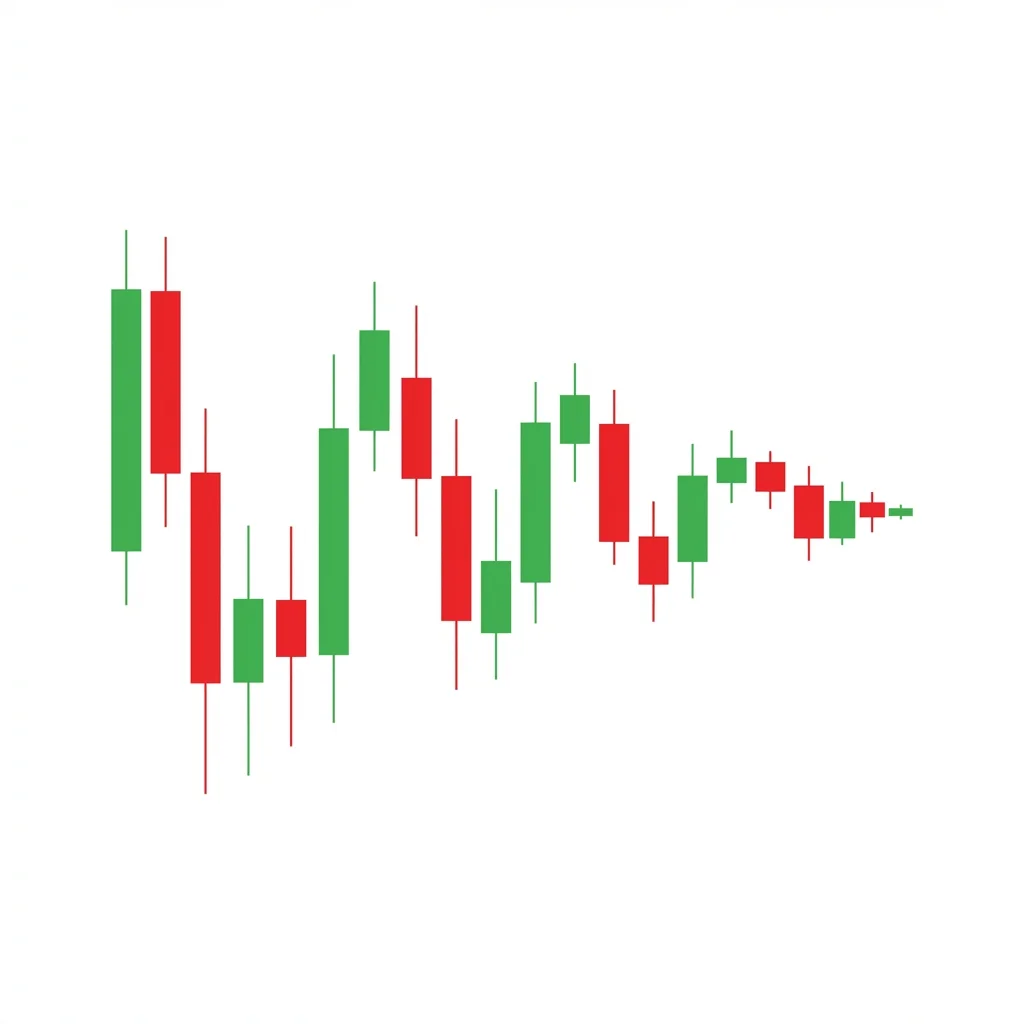
Wedge Apex
Also known as: Converging Wedge, Apex Pattern, Terminal Wedge, Wedge Point
The Wedge Apex occurs when price reaches the convergence point of two trendlines that slope in the same direction, creating maximum compression that forces a breakout. The pattern is neutral at the apex because the breakout direction depends on context.
The Wedge Apex is the critical decision point where the two trendlines of a wedge formation converge. Unlike a symmetrical triangle where the lines have equal opposing slopes, a wedge has both trendlines sloping in the same direction — either both upward (rising wedge) or both downward (falling wedge). At the apex, price is maximally compressed and must break one of the trendlines. While rising wedges typically break downward and falling wedges typically break upward, at the apex itself the direction is uncertain until confirmed. The apex is the most dangerous and most potentially profitable point in the wedge, as the compressed energy can produce explosive moves in either direction.
History & Etymology
Wedge patterns have been recognized in technical analysis since the early 20th century. The concept of the apex as a critical decision point was emphasized by Edwards and Magee. The apex specifically has gained attention in modern trading as the point of maximum opportunity and maximum risk.
The 'wedge' comes from the pattern's resemblance to a physical wedge (a triangular tool). The 'apex' is the pointed tip where the two sides converge. Together, 'Wedge Apex' describes the narrowest point of this convergent formation.
How It Forms
Formation Steps
- 1Two converging trendlines that slope in the same direction (both upward or both downward)
- 2Price compresses toward the apex (convergence point) of the trendlines
- 3The apex represents the maximum compression before the breakout
Prerequisites
- Both trendlines must slope in the same general direction
- At least two touches on each trendline
- Price must be near or at the apex (convergence point)
- The narrowing range confirms the compression
Confirmation Signals
- Decisive break above or below one of the trendlines with volume
- Price closes beyond the trendline boundary on the breakout candle
- Volume expansion on the breakout
Invalidation Signals
- Price drifts through the apex without a clear breakout
- No volume on the breakout attempt
- Immediate reversal after the break
Candle Breakdown
Apex Compression Candles
The final candles before the breakout, showing extremely narrow ranges as price is squeezed between converging trendlines
Maximum compression creates maximum tension. Traders on both sides are positioned and awaiting the breakout. The smallest candles in the wedge appear at the apex as room to move runs out.
Psychology
The Wedge Apex represents the moment of maximum uncertainty and compressed energy. All the buying and selling that created the wedge has narrowed to a single point. The market has literally run out of room and must make a decision. This creates extreme tension that resolves with a violent directional move.
Buyer Perspective
Buyers at the apex of a falling wedge see the narrowing declines as an exhaustion of selling. They prepare for an upside breakout. At a rising wedge apex, buyers may be the last optimists before the bearish break.
Seller Perspective
Sellers at the apex of a rising wedge see the narrowing rallies as exhaustion of buying. They prepare for a downside break. At a falling wedge apex, sellers may be the last bears before the bullish reversal.
Smart Money Action
Institutional traders position throughout the wedge, using the predictable trendline bounces. At the apex, they may trigger the breakout by placing large directional orders once their positions are fully built.
Retail Trader Trap
Retail traders at the apex are the most vulnerable to whipsaws. The narrow range tempts tight stop placement, which gets triggered by the volatile breakout-retest sequence.
Emotional Cycle
Trading Strategy
Aggressive Entry
Enter on the first close outside the trendline from the apex with any directional candle.
Conservative Entry
Wait for a close outside the trendline followed by a retest of the broken trendline that holds as new support/resistance.
Measured move based on the widest part of the wedge projected from the breakout point.
The origin point of the wedge (where the trendlines began).
2x the wedge height or the next major support/resistance level.
Best Conditions
- Timeframe: daily
- Timeframe: 4h
- Timeframe: weekly
- after trending moves that form wedge corrections
- at major technical inflection points
- Asset: stocks
- Asset: forex
- Asset: crypto
- Asset: commodities
Avoid When
- Timeframe: 1m
- Timeframe: 5m
- choppy markets where wedges form inconclusively
- low volume environments
Confluence Factors
- Wedge apex coincides with a major support or resistance level
- The expected breakout direction aligns with the higher timeframe trend
- Volume declined throughout the wedge
- RSI divergence at the apex
- Fibonacci level alignment at the apex
Scale In Strategy
Enter half on the breakout from the apex, add on successful retest.
Scale Out Strategy
Take one-third at the measured move, one-third at the wedge origin, trail the remainder.
Risk Management
Volume Analysis
Volume Confirmation
Volume should decline throughout the wedge and spike on the breakout from the apex. This is critical confirmation.
Volume Profile
Declining volume during the wedge with a breakout volume surge of 50-100%+ is the ideal signature.
Volume Divergence
If volume picks up near the apex without a breakout, it may indicate the breakout is imminent.
Technical Confluence
Support Resistance
The trendlines define dynamic support and resistance. Once broken at the apex, the trendline flips roles.
Fibonacci Levels
The apex often coincides with a Fibonacci level of the move that preceded the wedge.
Moving Averages
Moving averages converge at the apex, and their expansion on breakout confirms the new trend.
Rsi Confirmation
RSI divergence at the apex (e.g., rising RSI in a falling wedge) is a powerful confirmation of the expected breakout direction.
Macd Confirmation
MACD crossover at the apex confirms momentum shift, supporting the breakout direction.
Bollinger Bands
Bollinger Bands squeeze to their tightest at the apex, confirming maximum volatility compression.
Vwap
The apex often forms near VWAP, indicating fair value compression. The breakout reveals the new imbalance.
Ichimoku Cloud
Wedge apex at the Kumo cloud boundary creates a decisive setup — breakout above or below the cloud.
Elliott Wave
Wedges are common in Wave C, Wave 5 (ending diagonal), and Wave B positions.
Wyckoff Phase
The apex can represent the Last Point of Support or Last Point of Supply before the final directional move.
Market Profile
The apex creates the narrowest value area. Breakout signals dramatic value migration.
Order Flow
Balanced but diminishing order flow at the apex with a sudden directional burst on breakout.
Open Interest
Rising open interest at the apex suggests new positions being built for the expected breakout.
Multi-Timeframe Analysis
Higher Timeframe Alignment
A daily wedge apex at a weekly support/resistance level creates a maximum-conviction setup.
Lower Timeframe Entry
After identifying a daily wedge apex, use the 1-hour chart for precise breakout entry timing.
Timeframe Confluence
Wedge apexes visible on multiple timeframes produce the most significant breakouts.
Top-Down Approach
Weekly trend provides directional bias. Daily wedge apex provides the setup. 4-hour chart provides the entry.
Statistics
Historical Examples
S&P 500 Falling Wedge Apex Breakout
successSPX formed a falling wedge throughout September-October 2022. At the apex near 3,500, the bullish breakout initiated a rally above 4,100.
Lesson: Falling wedge apex breakouts in major indices during corrections can mark the start of significant rallies.
Bitcoin Rising Wedge Apex
successBTC formed a rising wedge near its all-time high. At the apex near $69,000, the bearish breakdown initiated the 2022 crypto winter.
Lesson: Rising wedge apex at all-time highs is an extremely reliable distribution signal.
GBP/USD Wedge Apex False Break
failureGBP/USD formed a wedge near the apex at 1.2600. The initial bullish break reversed quickly, trapping breakout buyers.
Lesson: False breakouts at wedge apexes are more common on lower timeframes. Require close confirmation.
Variations
Rising Wedge Apex
Both trendlines slope upward, converging to a bearish apex where the expected break is downward.
Falling Wedge Apex
Both trendlines slope downward, converging to a bullish apex where the expected break is upward.
Confusion Matrix
Patterns commonly confused with Wedge Apex and how to distinguish them.
Neutral Symmetrical Triangle
7000% similarCheck if the trendlines have opposing slopes (triangle) or same-direction slopes (wedge).
Key Differences
- Symmetrical Triangle has trendlines sloping toward each other (opposing slopes)
- Wedge has both trendlines sloping in the same direction
The Squeeze Breakout occurs when volatility compresses to extreme levels (tight Bollinger Bands or low ATR) before an explosive directional move, representing the market's transition from consolidation to trending.
The Symmetrical Triangle is a chart formation where converging trendlines of roughly equal slope create a coiling pattern, indicating a period of equilibrium that will resolve with an explosive breakout in either direction.
The Tight Coil is a multi-candle pattern where each successive candle has a smaller range than the last, creating a coiled-spring effect that typically precedes an explosive directional breakout.
The Volatility Contraction Pattern (VCP) shows progressively smaller price swings as ATR declines, signaling that the market is absorbing supply and preparing for a significant directional breakout.
The Broadening Top (Megaphone) is a chart formation characterized by expanding price swings that create higher highs and lower lows, reflecting increasing volatility and instability at market tops before a bearish breakdown.
The Descending Channel is a chart formation where price trends lower within two parallel downward-sloping trendlines, making consistent lower highs and lower lows in an orderly bearish progression.
Pro Tips & Common Mistakes
Pro Tips
- The apex is the point of maximum risk AND maximum reward — the tightest stop with the largest potential move
- Rising wedges break down 65-70% of the time; falling wedges break up 65-70% of the time — use this statistical edge
- Volume declining toward the apex is essential — it confirms the compression is genuine
- Trade the breakout from the apex, not the anticipated direction — let the market show you
- The breakout from the apex typically produces a move equal to the widest part of the wedge
Common Mistakes
- Anticipating the breakout direction and entering before confirmation at the apex
- Placing stops too tight at the apex — the initial volatility expansion can cause whipsaws
- Confusing a wedge with a channel (channels have parallel lines, wedges converge)
- Ignoring volume patterns during the wedge formation
- Trading wedge apexes on very short timeframes where false breaks are common
Advanced Techniques
- Use the wedge interior structure (ABC waves) for Elliott Wave analysis to predict the breakout direction
- Apply the Thrust concept — the first candle to break the trendline from the apex sets the direction and magnitude
- Use options expiration timing with wedge apexes for timing the maximum gamma exposure
- Combine with intermarket analysis to determine if the wedge apex aligns with correlated asset breakouts
Institutional Perspective
Institutional traders view the wedge apex as a forced decision point. They position throughout the wedge and use the apex to finalize their directional commitment. The apex breakout often coincides with large block trades and dark pool prints as institutions commit to the direction.
Fun Facts
- The wedge apex is considered one of the highest risk-reward points in all of technical analysis because the stop is at its tightest while the expected move is at its largest.
- In Elliott Wave theory, ending diagonal patterns (which are wedges) must break opposite to their direction, giving the apex predictive power.
- Some quant funds specifically target wedge apex breakouts as one of their highest-expectancy pattern setups.
Frequently Asked Questions
A Wedge Apex is the convergence point of two trendlines that slope in the same direction (both up or both down). At this point, price is maximally compressed and must break out.
Rising wedges typically break downward (65-70%) and falling wedges typically break upward (65-70%). However, always wait for confirmation rather than assuming the statistical direction.
In a symmetrical triangle, the trendlines slope toward each other (one up, one down). In a wedge, both trendlines slope in the same direction. The apex is where they converge.