
Overview
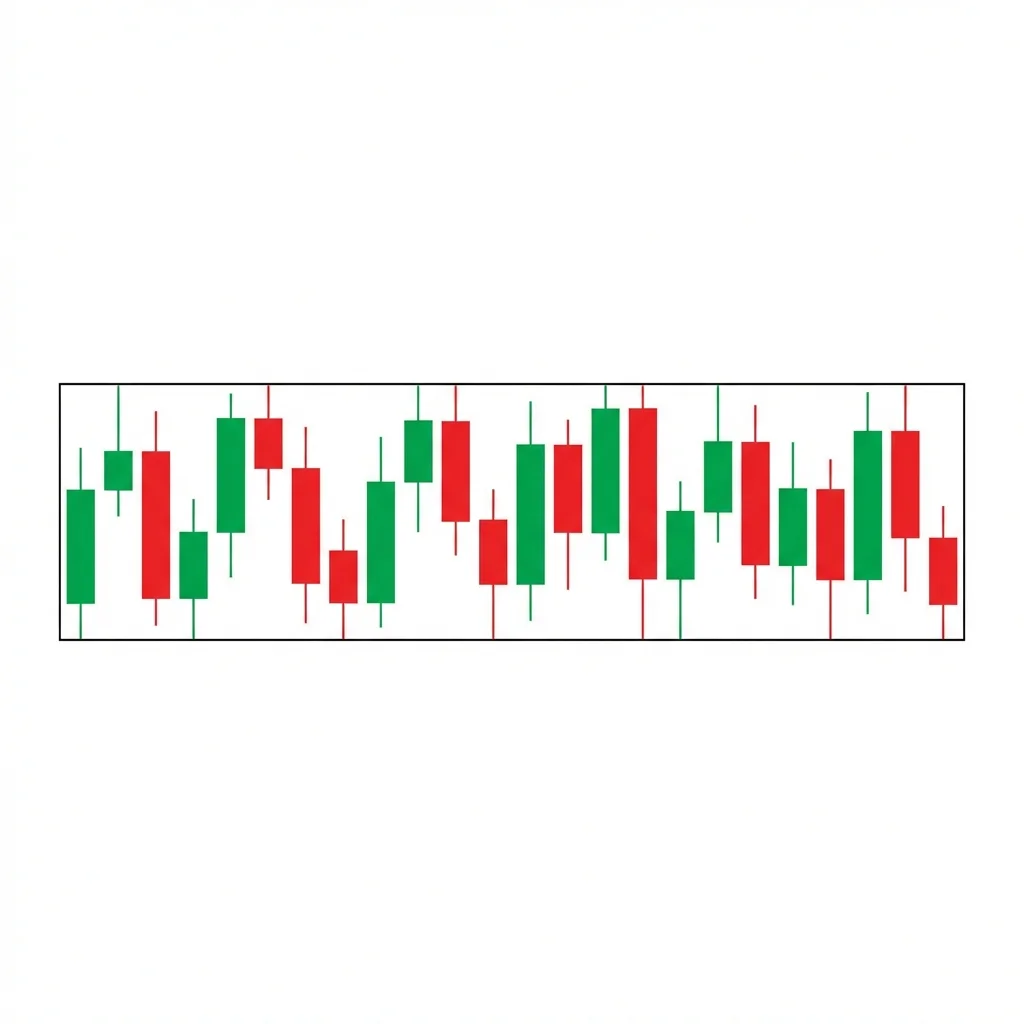
Rectangle
Also known as: Trading Range, Box Pattern, Consolidation Range, Horizontal Channel
The Rectangle is a chart formation where price consolidates between parallel horizontal support and resistance levels, creating a box-like pattern that can break in either direction.
The Rectangle pattern forms when price becomes trapped between clearly defined horizontal support and resistance levels, bouncing back and forth within this range. The pattern reflects a period of equilibrium where buyers consistently defend support and sellers consistently defend resistance. The rectangle can form as a continuation pattern (where the breakout resumes the prior trend) or as a reversal pattern (where the breakout opposes the prior trend). The longer the rectangle persists and the more times it tests its boundaries, the more significant the eventual breakout tends to be. The height of the rectangle provides a measured move target for the breakout direction.
History & Etymology
The Rectangle pattern is one of the oldest recognized chart formations in Western technical analysis, described by Richard Schabacker in the 1930s and later detailed by Edwards and Magee in their 1948 classic 'Technical Analysis of Stock Trends'. It is one of the foundation patterns of chart pattern analysis.
Named for its visual appearance on a chart — price action bounded by parallel horizontal lines creates a rectangular shape.
How It Forms
Formation Steps
- 1Price oscillates between a horizontal resistance level (top) and a horizontal support level (bottom)
- 2At least two touches of resistance and two touches of support
- 3The boundaries are roughly parallel horizontal lines
Prerequisites
- Clear horizontal resistance level with multiple rejections
- Clear horizontal support level with multiple bounces
- Price action confined within the range for an extended period
Confirmation Signals
- Decisive close above resistance (bullish breakout) or below support (bearish breakout)
- Volume surge on the breakout candle
- Retest of the broken level that holds
Invalidation Signals
- False breakout that immediately reverses back into the range
- No volume on the breakout attempt
- Price continues to oscillate within the range
Candle Breakdown
Range-Bound Candles
Multiple candles oscillating between horizontal support and resistance, creating the body of the rectangle
Each bounce off support and rejection at resistance reinforces the range boundaries. Over time, participants become conditioned to expect the range to hold.
Psychology
The Rectangle reflects a prolonged battle between evenly matched buyers and sellers. The support level represents where buyers perceive value, and the resistance level represents where sellers see overvaluation. This dynamic creates a feedback loop until an external catalyst or gradual exhaustion of one side triggers the breakout.
Buyer Perspective
Buyers accumulate at support, viewing the lower bound as a value zone. Each successful defense of support reinforces their conviction. They become complacent within the range but will aggressively buy a bullish breakout.
Seller Perspective
Sellers distribute at resistance, viewing the upper bound as an overvaluation zone. Each rejection at resistance reinforces their conviction. They are prepared to sell aggressively on a bearish breakdown.
Smart Money Action
Institutional traders accumulate or distribute throughout the rectangle, using the range-bound conditions to fill large orders without moving the market. The breakout direction often reveals whether they were accumulating (bullish) or distributing (bearish).
Retail Trader Trap
Retail traders often fade the range boundaries (buy support, sell resistance) and get trapped when the eventual breakout occurs. Others chase false breakouts from the range edges.
Emotional Cycle
Trading Strategy
Aggressive Entry
Trade within the range — buy at support, sell at resistance — until a breakout occurs.
Conservative Entry
Wait for a decisive close outside the rectangle with above-average volume, then enter in the breakout direction.
Measured move: the height of the rectangle projected from the breakout point.
1.5x the rectangle height projected from the breakout.
2x the rectangle height or the next major support/resistance level.
Best Conditions
- Timeframe: daily
- Timeframe: 4h
- Timeframe: weekly
- after trending moves that consolidate
- during accumulation/distribution
- before major events
- Asset: stocks
- Asset: forex
- Asset: indices
- Asset: ETFs
Avoid When
- Timeframe: 1m
- Timeframe: 5m
- extremely low volatility with no catalyst
- declining interest in the security
Confluence Factors
- Rectangle boundaries align with major support/resistance levels
- Volume pattern confirms accumulation or distribution
- The prior trend direction supports the breakout direction (continuation)
- Bollinger Bands are squeezing during the rectangle
- RSI shows divergence at one of the boundaries
Scale In Strategy
Trade the range with small positions. Add to the breakout position once confirmation occurs.
Scale Out Strategy
Take one-third at the measured move, one-third at 1.5x, and trail the remainder.
Risk Management
Volume Analysis
Volume Confirmation
Volume should decline throughout the rectangle formation and surge on the breakout. This is the most important confirmation.
Volume Profile
Heavy volume at both boundaries during the rectangle; declining volume in the middle. Breakout volume should exceed any volume within the range.
Volume Divergence
If volume consistently picks up at one boundary (e.g., support), it suggests accumulation and favors that side for breakout.
Technical Confluence
Support Resistance
The rectangle IS a support/resistance pattern. The boundaries become key levels for years after the pattern resolves.
Fibonacci Levels
Fibonacci retracement levels within the rectangle help identify internal structure and breakout bias.
Moving Averages
Moving averages flatten during the rectangle and begin to slope on breakout, confirming direction.
Rsi Confirmation
RSI oscillating between 40 and 60 during the rectangle. A break above 60 or below 40 signals breakout direction.
Macd Confirmation
MACD flattening near zero during the rectangle. Expansion on breakout confirms the directional move.
Bollinger Bands
Bollinger Band squeeze during the rectangle with expansion on breakout is the ideal confirmation.
Vwap
VWAP flattens during the rectangle. The breakout candle's relationship to VWAP provides intraday direction.
Ichimoku Cloud
The Kumo cloud flattens during the rectangle. Breakout above or below the cloud confirms the trend change.
Elliott Wave
Rectangles often form as Wave 4 corrections (continuation) or Wave B of a corrective pattern.
Wyckoff Phase
Rectangles map directly to Wyckoff accumulation (bullish breakout) or distribution (bearish breakout) schematics.
Market Profile
The rectangle creates a well-defined value area. Breakout from value signals value migration.
Order Flow
Monitor cumulative delta during the rectangle. Consistent buy delta favors upside; sell delta favors downside.
Open Interest
Rising open interest during the rectangle suggests new positions being established for the breakout.
Multi-Timeframe Analysis
Higher Timeframe Alignment
A daily rectangle at a weekly support/resistance zone creates a high-probability breakout setup.
Lower Timeframe Entry
After identifying a daily rectangle breakout, use the 1-hour chart for precise entry timing on the breakout or retest.
Timeframe Confluence
Rectangles visible on both daily and weekly charts produce the most significant breakouts.
Top-Down Approach
Monthly trend provides macro bias. Weekly/daily rectangle identifies the consolidation. 4-hour chart provides the breakout entry.
Statistics
Historical Examples
Apple Rectangle Accumulation
successAAPL formed a 3-month rectangle between $125 and $150. The bullish breakout above $150 with strong volume led to a rally above $190.
Lesson: Long-duration rectangles in quality stocks often signal institutional accumulation before major moves.
Bitcoin Rectangle Before Halving
successBTC formed a 6-month rectangle between $25,000 and $31,000. The eventual breakout above $31,000 initiated the 2024 bull run.
Lesson: Weekly rectangles in crypto can persist for months but produce enormous moves when they resolve.
EUR/USD Rectangle Breakdown
successEUR/USD traded in a rectangle between 1.0350 and 1.0600. The breakdown below 1.0350 led to a decline toward parity at 1.0000.
Lesson: Rectangle breakdowns in the direction of the prevailing trend (bearish EUR/USD) are especially powerful.
Variations
Bullish Rectangle
Rectangle that breaks to the upside, often after a prior uptrend (continuation).
Bearish Rectangle
Rectangle that breaks to the downside, often after a prior downtrend (continuation).
Confusion Matrix
Patterns commonly confused with Rectangle and how to distinguish them.
Neutral Symmetrical Triangle
6000% similarCheck if the boundaries converge. Parallel = Rectangle. Converging = Triangle.
Key Differences
- Rectangle has parallel horizontal boundaries
- Symmetrical Triangle has converging boundaries
The Squeeze Breakout occurs when volatility compresses to extreme levels (tight Bollinger Bands or low ATR) before an explosive directional move, representing the market's transition from consolidation to trending.
The Symmetrical Triangle is a chart formation where converging trendlines of roughly equal slope create a coiling pattern, indicating a period of equilibrium that will resolve with an explosive breakout in either direction.
The Tight Coil is a multi-candle pattern where each successive candle has a smaller range than the last, creating a coiled-spring effect that typically precedes an explosive directional breakout.
The Volatility Contraction Pattern (VCP) shows progressively smaller price swings as ATR declines, signaling that the market is absorbing supply and preparing for a significant directional breakout.
The Broadening Top (Megaphone) is a chart formation characterized by expanding price swings that create higher highs and lower lows, reflecting increasing volatility and instability at market tops before a bearish breakdown.
The Descending Channel is a chart formation where price trends lower within two parallel downward-sloping trendlines, making consistent lower highs and lower lows in an orderly bearish progression.
Pro Tips & Common Mistakes
Pro Tips
- The longer the rectangle persists and the more boundary tests it has, the more powerful the eventual breakout
- Volume declining within the rectangle and surging on breakout is the single most important confirmation
- The measured move target (rectangle height projected from breakout) is achieved roughly 65% of the time
- Trade within the range while waiting for the breakout — buy support, sell resistance with tight stops
- False breakouts are common — require a close outside the range, not just an intraday breach
Common Mistakes
- Entering on a breakout without waiting for a close outside the range (false breakout trap)
- Ignoring volume on the breakout — low-volume breakouts frequently fail
- Not considering the prior trend direction for breakout bias
- Placing stops at the exact boundary rather than inside the range
- Getting complacent within the range and missing the breakout signal
Advanced Techniques
- Use Wyckoff analysis to classify the rectangle as accumulation or distribution for breakout prediction
- Monitor options open interest at the boundary levels for clues about institutional positioning
- Apply volume profile to identify the Point of Control within the rectangle — breakout from this level is most significant
- Use the rectangle's boundaries as permanent support/resistance levels on your chart
Institutional Perspective
The Rectangle is an institutional trader's favorite environment. The clear boundaries allow large position building without tipping their hand. The breakout direction reveals the institution's intent — accumulation leads to upside breaks, distribution leads to downside breaks. Watch for dark pool prints near the boundaries.
Fun Facts
- The Rectangle pattern was one of the first chart patterns formally described in Western technical analysis, appearing in Schabacker's 1932 text.
- According to Thomas Bulkowski's pattern statistics, the Rectangle has a measured move success rate of 65%, making it one of the most reliable chart formations.
- Some of the largest market moves in history began with Rectangle breakouts, including several S&P 500 multi-year base breakouts.
Frequently Asked Questions
A Rectangle is a chart pattern where price bounces between parallel horizontal support and resistance levels, creating a box-like consolidation zone that eventually breaks in one direction.
Measure the height of the rectangle (resistance minus support) and project it from the breakout point in the breakout direction. This gives the measured move target.
Yes. Buy at support and sell at resistance with tight stops. This range-trading approach works well while the rectangle persists, but always be prepared for the eventual breakout.