
Overview
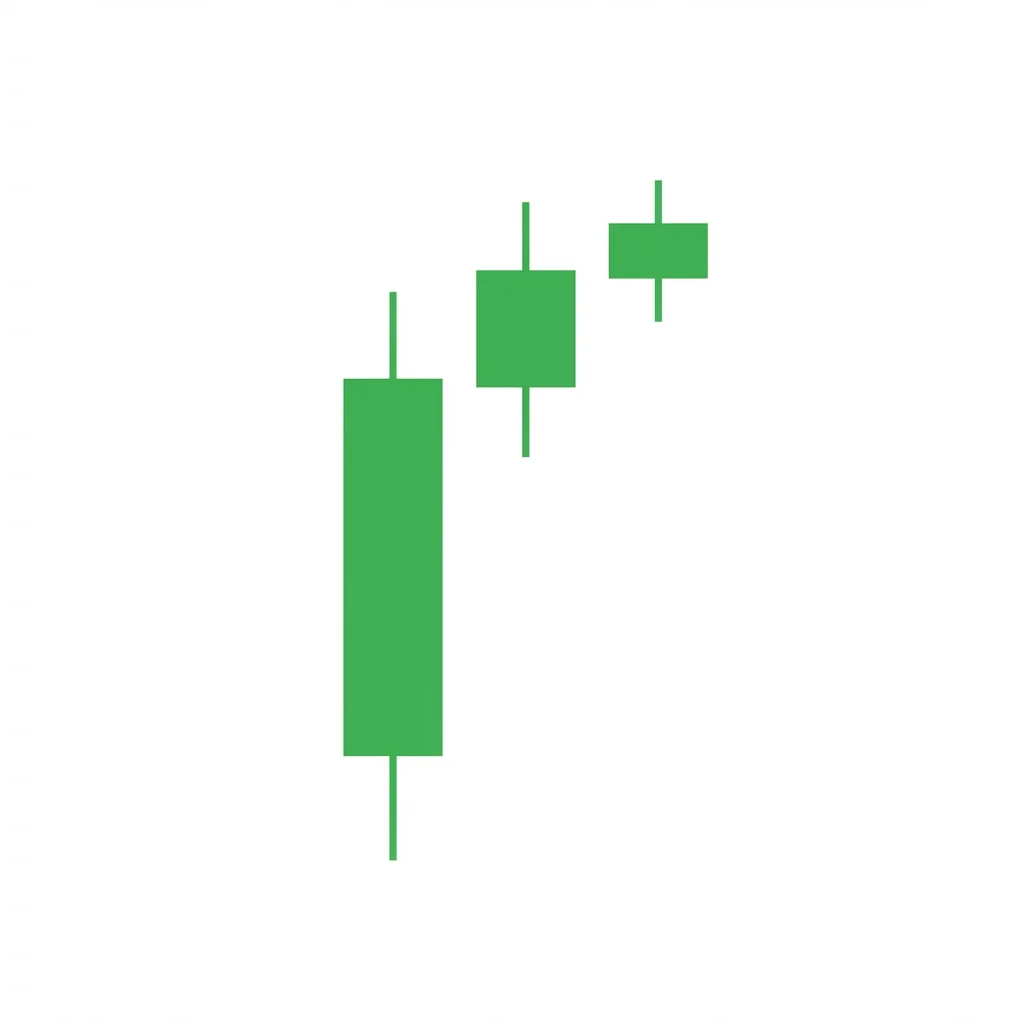
Bearish Deliberation
Akasansen Shianboshi
Also known as: Deliberation Pattern, Stalled Pattern, Stalling Pattern
The Deliberation pattern shows two strong bullish candles followed by a small-bodied third candle, indicating that the uptrend is 'deliberating' — the bulls have stalled and are uncertain about pushing higher.
The Deliberation pattern (also called the Stalled Pattern) is a three-candle bearish reversal signal that appears during an uptrend. The first two candles are strong bullish candles demonstrating continued buying pressure. However, the third candle is markedly different — a small-bodied candle (spinning top, doji, or very small bullish candle) that may gap up slightly from the second candle's close. The dramatic shift from two strong candles to one weak candle tells a story: the bulls are running out of steam. The pattern's name captures this psychology perfectly — the market is 'deliberating' about whether to continue higher. Unlike the Advance Block (where deterioration is gradual across all three candles), the Deliberation pattern shows strength in the first two candles before abruptly stalling on the third.
History & Etymology
The Deliberation pattern comes from traditional Japanese candlestick analysis. It is closely related to the Advance Block but represents a more sudden loss of momentum. Japanese traders saw the pattern as a sign that the market's 'ki' (energy) had been exhausted, with the small third candle representing the moment of hesitation before a potential reversal.
The name 'deliberation' refers to the market's hesitation on the third candle. After two decisive bullish sessions, the market pauses to 'deliberate' whether to continue. This indecision, coming after strong momentum, is bearish because it suggests the trend has run out of conviction.
How It Forms
Formation Steps
- 1First candle: long bullish candle continuing the uptrend
- 2Second candle: long bullish candle opening within the first candle's body with a similar strong close
- 3Third candle: small-bodied candle (spinning top, doji, or small bullish candle) that opens at or near the second candle's close — may gap up slightly
Prerequisites
- Established uptrend
- The first two candles must be strong (long bodies)
- The third candle must be noticeably smaller than the first two
- The third candle opens near or gaps above the second candle's close
Confirmation Signals
- Bearish candle following the pattern
- Break below the third candle's low
- Volume declining across the three candles
- Bearish follow-through selling
Invalidation Signals
- Strong bullish candle continuing higher after the third candle
- Volume increasing on the third candle
- The third candle has a large body similar to the first two
Candle Breakdown
First Strong Bullish
A long bullish candle with a large body, continuing the uptrend with conviction.
Strong buying continues. No sign of weakness yet.
Second Strong Bullish
Another long bullish candle, opening within the first candle's body and closing higher. Similar strength to the first.
Bulls push higher again. The second consecutive strong candle reinforces bullish sentiment. But this may be the final push.
Deliberation Candle
A small-bodied candle — spinning top, small bullish candle, or doji — that opens near the second candle's close. It may gap up slightly.
Suddenly, all momentum vanishes. The small body after two large ones is jarring. The market hesitates. Smart money has finished distributing, and there are no remaining buyers to push the price higher.
Psychology
The Deliberation captures a sudden loss of energy in a rally. Two strong candles create confidence, but the third candle's small body reveals that the buying power has been exhausted. The abruptness of the stall makes it a warning that the trend may not survive.
Buyer Perspective
Buyers were confident through the first two candles. The third candle's lack of progress creates uncertainty — why did the rally suddenly stall? Those holding long positions begin to question their thesis.
Seller Perspective
Sellers note the sudden loss of momentum and prepare to act. The small third candle suggests buyers are exhausted, creating an opportunity for sellers to take control.
Smart Money Action
Smart money uses the first two strong candles to complete their distribution. The small third candle appears because there are no more institutional buyers — only retail remnants.
Retail Trader Trap
Retail traders see the two strong candles and enter long, expecting continuation. The third candle's stall initially seems like a minor pause, but the subsequent decline catches them off guard.
Emotional Cycle
Trading Strategy
Aggressive Entry
Short at the close of the third candle, especially if it is a doji or spinning top.
Conservative Entry
Wait for a bearish candle that closes below the third candle's low.
The open of the first candle.
The 50% retracement of the entire three-candle advance.
The previous swing low.
Best Conditions
- Timeframe: daily
- Timeframe: weekly
- Timeframe: 4h
- mature uptrend
- near resistance
- overbought conditions
- Asset: stocks
- Asset: indices
- Asset: forex
Avoid When
- Timeframe: 1m
- Timeframe: 5m
- Timeframe: 15m
- early breakout phase
- strong momentum
Confluence Factors
- Volume declining across all three candles
- RSI divergence or overbought
- Pattern at a resistance level
- The third candle is a doji (stronger signal)
- Higher timeframe shows resistance
Scale In Strategy
Enter 30% at third candle close, add 70% on bearish confirmation.
Scale Out Strategy
Take 50% at first support, trail the rest.
Risk Management
Volume Analysis
Volume Confirmation
Declining volume across the three candles, especially a notable drop on the third, strengthens the pattern.
Volume Profile
High, high, low — the volume should mirror the candle size pattern.
Volume Divergence
Declining volume with rising price across the three candles is the key divergence.
Technical Confluence
Support Resistance
Most significant when the third candle stalls at a known resistance level.
Fibonacci Levels
Pattern at Fibonacci extensions adds confluence.
Moving Averages
When price is extended above the 20 EMA and the third candle stalls, expect mean reversion.
Rsi Confirmation
RSI above 70 declining on the third candle confirms the stalling.
Macd Confirmation
MACD histogram declining while the third candle stalls adds bearish evidence.
Bollinger Bands
Third candle touching or piercing the upper Bollinger Band before stalling is significant.
Vwap
Above VWAP with a stalling third candle suggests overextension.
Ichimoku Cloud
Above the cloud with the third candle stalling near a Senkou Span level adds resistance context.
Elliott Wave
The Deliberation often marks the terminal thrust of a fifth wave.
Wyckoff Phase
Aligns with the end of the Buying Climax phase where momentum exhausts.
Market Profile
The third candle's low volume creates thin structure at the top — a poor high.
Order Flow
Watch for the delta turning neutral or negative on the third candle despite the slightly higher price.
Open Interest
Flat or declining OI on the third candle shows the rally is losing participation.
Multi-Timeframe Analysis
Higher Timeframe Alignment
A daily Deliberation at weekly resistance is a strong warning signal.
Lower Timeframe Entry
After the daily pattern, use 4H for entry if the breakdown begins.
Timeframe Confluence
Weekly Deliberation patterns are rare but very significant for multi-week reversals.
Top-Down Approach
Weekly: resistance zone. Daily: Deliberation forms. 4H: confirmation entry.
Statistics
Historical Examples
Amazon (AMZN) Deliberation at $188
successAMZN showed two strong bullish candles followed by a tiny spinning top on low volume near $188 resistance. The stock declined 7% over the following three weeks.
Lesson: The sudden loss of momentum after two strong candles at resistance was a clear warning that the rally was exhausted.
Variations
Deliberation with Doji
The third candle is a doji, adding stronger indecision signals.
Gapped Deliberation
The third candle gaps up from the second before stalling.
Confusion Matrix
Patterns commonly confused with Bearish Deliberation and how to distinguish them.
Bearish Advance Block
7500% similarCheck the second candle. If it is still strong (similar to the first), it is Deliberation. If the second candle shows deterioration (smaller body, longer shadows), it is an Advance Block.
Key Differences
- Advance Block shows gradual deterioration across all three candles
- Deliberation has two strong candles followed by sudden weakness on the third
- In Advance Block, the second candle already shows weakness
Bearish Evening Star
6000% similarIf there are gaps and a strong bearish third candle, it may be an Evening Star. If the third candle simply stalls without gaps, it is Deliberation.
Key Differences
- Evening Star has a gap up to the small third candle and a gap down to the bearish candle
- Deliberation is two bullish candles then a small candle — no specific gap or third bearish candle required
- Evening Star is a stronger, more defined pattern
The Bearish Advance Block shows three consecutive bullish candles with progressively smaller bodies and longer upper shadows, signaling that buying momentum is weakening and a reversal or consolidation is likely.
The Bearish Doji Star is a two-candle reversal pattern featuring a strong bullish candle followed by a doji that gaps above it, signaling that buying momentum has stalled and indecision has replaced conviction at the top of an uptrend.
The shooting star is a single-candle bearish reversal pattern with a small body near the low and a long upper shadow. It shows that buyers pushed price significantly higher during the session but sellers drove it back down, signaling a potential top.
The Bearish Abandoned Baby is one of the rarest and most reliable top reversal patterns in candlestick analysis. It features a doji that is completely isolated by gaps on both sides, signaling an abrupt and dramatic shift from buying to selling pressure.
The Downside Tasuki Gap is a bearish continuation pattern in a downtrend where a gap-down is partially but not completely filled by a bullish candle, suggesting that the downtrend will continue as the gap acts as resistance.
The Evening Doji Star is a top-tier three-candle bearish reversal pattern. The doji in the star position represents the pivot point between bullish confidence (first candle) and bearish dominance (third candle), making it one of the most reliable reversal signals in candlestick analysis.
Pro Tips & Common Mistakes
Pro Tips
- The more dramatic the size contrast between the first two candles and the third, the stronger the signal.
- The Deliberation is more of a warning than a definitive sell signal. Use it to tighten stops and reduce long exposure.
- If the third candle is a doji, the pattern transitions toward an Evening Doji Star setup, which is more powerful.
- Volume analysis is essential — the third candle should have notably lower volume than the first two.
Common Mistakes
- Confusing Deliberation with a minor pause before continuation — always wait for bearish confirmation.
- Mixing up Deliberation and Advance Block — check whether deterioration starts on the second or third candle.
- Shorting aggressively on the pattern alone without additional confluence.
- Ignoring the pattern because all three candles are technically bullish.
Advanced Techniques
- Use the Deliberation to adjust options positions — sell covered calls against long positions when the third candle stalls.
- Monitor the intraday chart of the third candle. If it opened strong but faded, the pattern is more reliable.
- Combine with order flow to see if the third candle's low volume reflects genuine exhaustion or just a low-activity session.
Institutional Perspective
Institutions view the Deliberation as a signal that their distribution is nearly complete. The two strong candles provided exit liquidity, and the small third candle confirms demand has been absorbed.
Fun Facts
- The Japanese name 'Akasansen Shianboshi' translates roughly to 'three red lines deliberating star,' referring to the market pausing to think about its next move.
- The Deliberation pattern appears more frequently in markets dominated by institutional trading, where sudden liquidity withdrawal creates the characteristic small third candle.
Frequently Asked Questions
In the Advance Block, deterioration is gradual — the second candle already shows weakness (smaller body, longer shadows). In Deliberation, the first two candles are both strong, and the weakness appears suddenly only on the third candle.
It is primarily a warning signal. Use it to tighten stops on long positions and watch for bearish confirmation. Do not aggressively short based on the Deliberation alone without additional confluence.