
Overview
Bearish Kicker
Keri Ashi
Also known as: Bearish Kicking Pattern, Gap Kicker Down
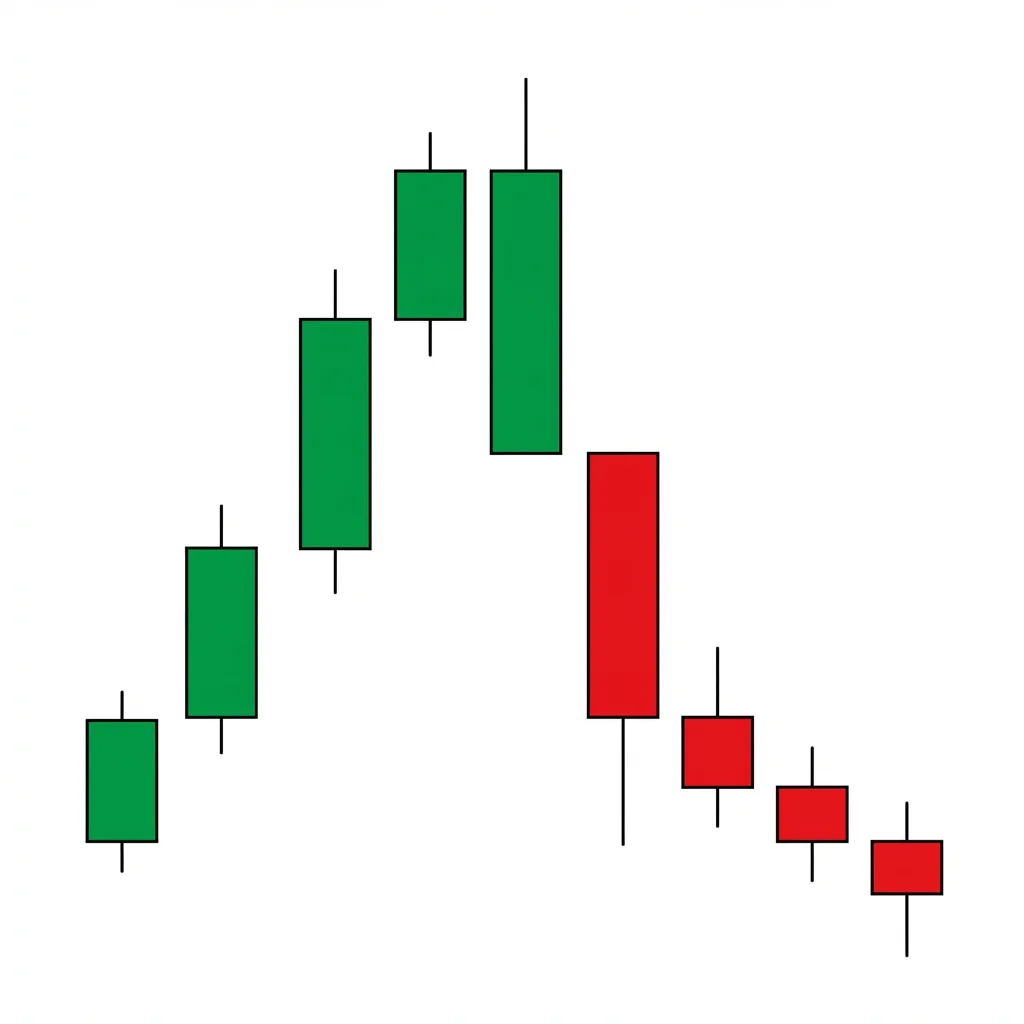
The bearish kicker is one of the most powerful two-candle reversal patterns. A bullish candle is followed by a bearish candle that gaps down to open at or below the first candle's open, signaling an immediate and complete sentiment reversal.
The bearish kicker is considered by many candlestick practitioners to be the single most powerful reversal signal. It occurs when a bullish candle is immediately followed by a bearish candle that gaps down dramatically — the second candle opens at or below the first candle's open, not just its close. This means the entire first candle's gains are instantly erased and more. The pattern represents a total and sudden shift in sentiment, typically driven by a major catalyst (earnings surprise, macro event, regulatory action). The kicker's power comes from the completeness of the reversal — every buyer from the first candle is immediately trapped.
History & Etymology
The kicker pattern is documented in Japanese candlestick literature as one of the most decisive reversal signals. It was emphasized by Steve Nison as a pattern that should be traded with high conviction due to its extremely high reliability rate.
The name 'kicker' comes from the dramatic, sudden nature of the reversal — the market is 'kicked' in the opposite direction. The Japanese term 'keri ashi' involves a similar kicking metaphor.
How It Forms
Formation Steps
- 1First candle: a bullish candle (preferably marubozu-like) in an uptrend
- 2Second candle: a bearish candle that opens at or below the first candle's open (gap down from the close)
- 3The second candle gaps in the opposite direction and closes near its low
- 4The gap between the close of the first candle and the open of the second is significant
Prerequisites
- A bullish candle as the first candle
- A significant gap down to open the second candle at or below the first candle's open
Confirmation Signals
- The gap remains unfilled
- Volume is high on the second candle
- Follow-through selling on subsequent sessions
Invalidation Signals
- The gap fills completely on the second candle
- Price rallies above the first candle's close
- Low volume on the second candle
Candle Breakdown
Bullish Candle
A strong bullish candle, ideally with minimal shadows (marubozu-like), showing confident buying.
Strong buying conviction. Bulls are confident and in full control.
Bearish Kicker Candle
A strong bearish candle that gaps down to open at or below the first candle's open, and closes near its low.
Complete sentiment reversal. Every gain from the first candle is erased plus more. Total bull capitulation.
Psychology
The kicker represents the most violent form of sentiment reversal. Between two sessions, the market goes from confident buying to aggressive selling with a gap that erases all prior gains. This is often caused by a fundamental catalyst that completely changes the thesis.
Buyer Perspective
Buyers from the first candle wake up to an overnight catastrophe. The gap below their entry means instant, significant losses with no chance to exit near their entry price. Capitulation is immediate.
Seller Perspective
Sellers are given the ultimate gift — a catalyst that validates their thesis with a gap that traps all prior buyers. They enter aggressively, knowing the gap creates a natural resistance level.
Smart Money Action
Institutions often have advance information of the catalyst (earnings pre-announcement, regulatory leak). They position before the gap, and the retail capitulation on the kicker provides exit liquidity for remaining longs.
Retail Trader Trap
Retail traders holding long positions from the first candle are maximally trapped — the gap ensures they cannot exit at a reasonable price. Their stops below the first candle are gapped through.
Emotional Cycle
Trading Strategy
Aggressive Entry
Short on the open of the second candle if the gap is clearly at or below the first candle's open.
Conservative Entry
Short after the first 15-30 minutes confirm the gap will not fill.
First candle's body length projected below the second candle's open.
Next major support level.
2x the combined range of both candles.
Best Conditions
- Timeframe: daily
- Timeframe: weekly
- catalyst-driven reversal
- earnings surprise
- regulatory event
- Asset: stocks
- Asset: indices
- Asset: crypto
Avoid When
- Timeframe: 1m
- Timeframe: 5m
- Timeframe: 15m
- gradual trend change
- low volatility
Confluence Factors
- Strong fundamental catalyst for the gap
- Volume is 2x+ average
- Pattern occurs at a resistance level
- Broader market is also weak
- Sector showing similar weakness
Scale In Strategy
Enter full position on the kicker — this is a high-conviction trade. No need to scale in.
Scale Out Strategy
Take 33% at TP1, 33% at TP2, trail remaining.
Risk Management
Volume Analysis
Volume Confirmation
Volume on the kicker candle must be significantly above average. Ideally 2x or more.
Volume Profile
The gap area should show zero volume (no trading), confirming a true price vacuum.
Volume Divergence
Low volume on the kicker candle significantly weakens the signal — wait for confirmation.
Technical Confluence
Support Resistance
The gap area becomes extremely strong resistance. The first candle's close is the key resistance level.
Fibonacci Levels
The kicker often ignores Fibonacci levels — the catalyst drives price beyond technical levels.
Moving Averages
The kicker often breaks below multiple moving averages simultaneously.
Rsi Confirmation
RSI crashes from above 50 to below 30 on the kicker — confirming extreme selling.
Macd Confirmation
MACD shows a dramatic bearish crossover on the kicker session.
Bollinger Bands
Price crashing from the upper band to the lower band on a single kicker candle.
Vwap
Price opening far below VWAP on the kicker day confirms institutional selling.
Ichimoku Cloud
Kicker breaking below the Kumo cloud in a single candle is extremely bearish.
Elliott Wave
Kickers often mark the start of Wave C or a new impulsive decline (Wave 1 down).
Wyckoff Phase
The kicker represents the sign of weakness (SOW) that follows distribution. It is the most dramatic form of the breakdown.
Market Profile
The kicker creates a gap that becomes a reference point in the profile. The market is unlikely to revisit the gap area.
Order Flow
Extreme negative delta on the kicker candle. Aggressive selling overwhelms all levels.
Open Interest
Massive put open interest increase on the kicker day. Call open interest collapses.
Multi-Timeframe Analysis
Higher Timeframe Alignment
A kicker on the weekly chart is an extraordinary event — trade with maximum conviction.
Lower Timeframe Entry
The 5-minute chart at the open will show the gap forming — enter as soon as the gap is confirmed not filling.
Timeframe Confluence
A kicker visible on both the daily and 4H charts is definitive.
Top-Down Approach
Weekly resistance → Daily kicker pattern → Enter short at the open.
Statistics
Historical Examples
Facebook/Meta Kicker 2022
successMETA gapped down 26% after earnings, opening below the prior day's open and forming a textbook bearish kicker. The stock continued declining another 50% in the following months.
Lesson: Earnings-driven kickers in large-cap stocks can initiate multi-month downtrends.
Luna/UST Kicker 2022
successLuna formed a bearish kicker as the UST depeg began, gapping down massively and continuing to near zero.
Lesson: Catalyst-driven kickers in crypto can be terminal — the pattern signaled the complete collapse.
Variations
Perfect Kicker
Both candles are marubozu (no shadows) with the gap below the first candle's open.
Modified Kicker
The gap opens near but not quite at the first candle's open, with small shadows.
Confusion Matrix
Patterns commonly confused with Bearish Kicker and how to distinguish them.
Bearish Engulfing
60% similarCheck for the gap: if the second candle gaps down to or below the first candle's OPEN (not close), it is a kicker. If the second candle opens at the first's close and wraps around it, it is an engulfing.
Key Differences
- Kicker has a gap; engulfing does not require a gap
- Kicker's second candle opens at/below the first candle's OPEN
- Engulfing's second candle opens above the first candle's close
Bearish Dark Cloud Cover
40% similarThe opening location is completely different: dark cloud cover opens high and falls into the body. Kicker opens low (below the prior open) and falls further.
Key Differences
- Dark cloud cover opens ABOVE the first candle's close; kicker opens BELOW the first candle's open
- Dark cloud cover penetrates into the first body; kicker gaps below entirely
- Kicker is significantly more powerful
The Dark Cloud Cover is a two-candle bearish reversal pattern where a bearish candle opens above the prior bullish candle's high and closes below its midpoint, signaling that the bullish 'sky' is being covered by a bearish 'dark cloud.'
The Bearish Engulfing is one of the most powerful and commonly traded two-candle reversal patterns. A large bearish candle completely engulfs the prior bullish candle, demonstrating a decisive shift from buying to selling dominance.
A falling window is a Japanese candlestick term for a gap down in price where the high of the current candle is below the low of the previous candle, signaling strong bearish continuation momentum.
The bearish key reversal is a powerful single-bar reversal pattern where price makes a new high then reverses to close below the prior bar's low on high volume, signaling a decisive shift from buying to selling control.
The bearish marubozu is a single candle with no shadows — price opened at the high and closed at the low, showing complete seller domination throughout the entire session with no buying resistance.
The Bullish Kicker is one of the strongest two-candle reversal patterns. A bearish candle is followed by a bullish candle that gaps up to open at or above the prior candle's open, signaling an immediate and powerful shift in sentiment.
Pro Tips & Common Mistakes
Pro Tips
- The kicker is the highest-conviction reversal pattern — trade it with full size and confidence when the catalyst supports it.
- Marubozu-like candles (minimal shadows) on both candles create the 'perfect kicker' — the most reliable variant.
- The gap must open at or below the first candle's OPEN, not just its close — this is what makes it a kicker vs an engulfing.
- Never try to fade a kicker pattern — trading against it has an 80%+ failure rate.
Common Mistakes
- Confusing a regular gap with a kicker — the gap must go below the first candle's OPEN.
- Trying to buy the dip after a kicker — the pattern has the highest continuation rate of any two-candle pattern.
- Not verifying the catalyst — kickers without a clear catalyst are less reliable.
- Setting stops too tight within the gap — the gap area is the natural stop level.
Advanced Techniques
- Use pre-market data to identify kickers before the regular session opens — this allows earlier positioning.
- Combine with options flow analysis: massive put buying or call selling on the kicker day confirms the institutional thesis.
- Monitor credit default swap spreads for the company — widening CDS confirms fundamental deterioration.
- Use dark pool data: large institutional sells at the open confirm the kicker's validity.
Institutional Perspective
The kicker represents a fundamental regime change. Institutions with advance knowledge (earnings calls, regulatory filings) position aggressively. The pattern's 80% win rate reflects the fact that the catalyst is usually fundamental and lasting.
Fun Facts
- Steve Nison called the kicker 'the most powerful reversal signal' in his book 'Japanese Candlestick Charting Techniques.'
- The bearish kicker has the highest win rate of any two-candle pattern documented in candlestick literature.
- Perfect kickers (both candles as marubozu) are so rare that a trader may only see a few in a year across all markets.
Frequently Asked Questions
A bearish kicker is a two-candle reversal pattern where a bullish candle is followed by a bearish candle that gaps down to open at or below the first candle's OPEN (not close). It is considered the most powerful reversal signal in candlestick analysis.
The kicker requires a gap below the first candle's open, which only happens with a significant catalyst. This fundamental backing (earnings miss, regulatory issue, etc.) provides lasting directional pressure, resulting in approximately 80% win rates.
A kicker gaps below the first candle's OPEN. An engulfing pattern opens at or near the first candle's CLOSE. The kicker's gap is much larger, erasing the entire first candle's range immediately.