
Overview
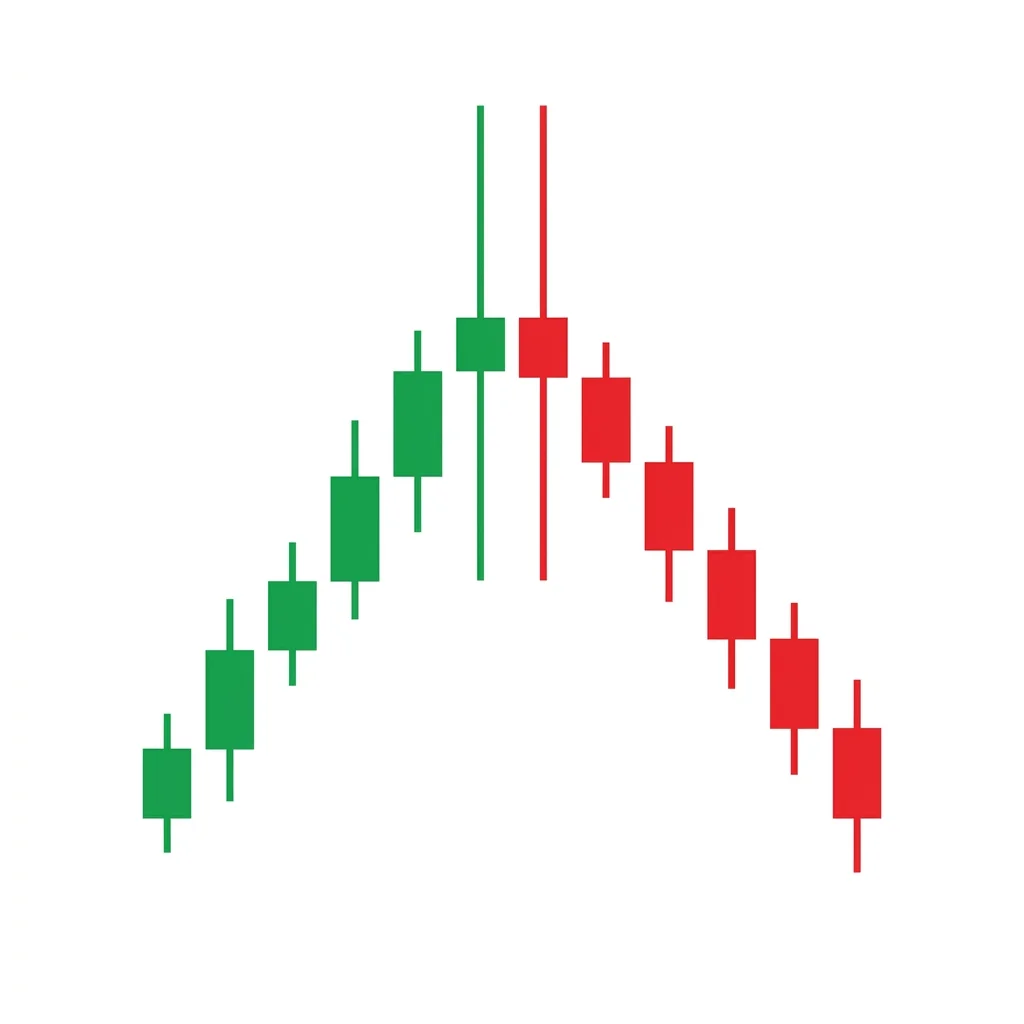
Bearish Pipe Top
Also known as: Pipe Formation Top, Twin Tower Top, Parallel High Bars
The bearish pipe top consists of two adjacent candles with long upper shadows reaching similar highs, showing that sellers twice defended a price level. This double rejection signals strong overhead resistance and an impending reversal.
The bearish pipe top is a relatively uncommon reversal pattern identified by Thomas Bulkowski. It features two adjacent bars or candles, each with notably long upper shadows that reach approximately the same high. The bodies of both candles rest in the lower portion of their respective ranges. The formation resembles two pipes standing side by side, hence the name. The significance of this pattern lies in the double rejection at the same price level—sellers defend a resistance zone twice in consecutive sessions, demonstrating conviction. When price subsequently breaks below the bodies of the pipe candles, it confirms that the uptrend is losing steam and a reversal is underway.
History & Etymology
The pipe top was formally documented by Thomas Bulkowski in his 'Encyclopedia of Chart Patterns.' While similar concepts existed in Japanese candlestick analysis (such as tweezers), Bulkowski's pipe formation focuses specifically on the long-shadow characteristic and statistical performance of this two-bar reversal pattern.
Named 'pipe' because the two long upper shadows resemble a pair of pipes standing upright. 'Top' indicates it forms at the peak of an uptrend, signaling a bearish reversal.
How It Forms
Formation Steps
- 1First candle has a long upper shadow reaching a high point
- 2Second candle also has a long upper shadow reaching approximately the same high
- 3Both candles have their bodies in the lower portion of their range
- 4The twin upper shadows create a 'pipe' formation at the top
Prerequisites
- Established uptrend leading into the pattern
- Price approaching a potential resistance zone
Confirmation Signals
- Third candle closes below the bodies of both pipe candles
- Volume increases on the rejection candles
- RSI showing bearish divergence
Invalidation Signals
- Price closes above the highs of the pipe formation
- Strong bullish follow-through breaking above the rejection zone
- Volume surges on a breakout above the highs
Candle Breakdown
First Pipe Candle
A candle with a long upper shadow that probes a high price level before sellers push it back down. The body closes in the lower half of the range.
Buyers push price to a new high but sellers aggressively reject the advance, creating the long upper shadow.
Second Pipe Candle
Another candle with a long upper shadow reaching approximately the same high as the first, confirming the resistance level. Body closes near the low.
Buyers attempt the same high again but are rejected a second time, confirming that sellers are firmly in control at that level.
Psychology
The pipe top reveals a contested price level where sellers consistently overwhelm buyers. Two consecutive failed attempts to hold above a price zone signals that the uptrend is exhausting.
Buyer Perspective
Buyers attempt to push through a resistance level twice but fail both times, leading to frustration and eventual capitulation as they stop trying to break higher.
Seller Perspective
Sellers successfully defend a price zone twice, gaining confidence that the level will hold. They begin to enter short positions more aggressively after the double rejection.
Smart Money Action
Institutional sellers place resting sell orders at the resistance level, creating the long upper shadows. The double test confirms their commitment to defending the zone.
Retail Trader Trap
Retail breakout traders buy both pushes toward the high, getting trapped twice before capitulating on the breakdown.
Emotional Cycle
Trading Strategy
Aggressive Entry
Enter short on the close of the second pipe candle, anticipating breakdown.
Conservative Entry
Wait for a candle to close below the lowest body of the two pipe candles before entering short.
Equal to the height of the pipe shadows projected downward
Next major support level below
2x the pipe height for extended moves
Best Conditions
- Timeframe: 1D
- Timeframe: 1W
- Timeframe: 4h
- After extended rallies
- Near historical resistance levels
- Overbought markets
- Asset: Stocks
- Asset: Indices
- Asset: Commodities
Avoid When
- Timeframe: 1m
- Timeframe: 5m
- Strong trending markets with momentum
- Low-volatility environments
Confluence Factors
- Pipe highs align with historical resistance
- RSI bearish divergence at the top
- Fibonacci extension level at the pipe highs
- 200 SMA/EMA near the rejection level
- Volume spike on the rejection wicks
Scale In Strategy
Add to the short position if price retests the pipe bodies from below and fails.
Scale Out Strategy
Take 50% at the first support level and trail the rest.
Risk Management
Volume Analysis
Volume Confirmation
Higher-than-average volume on either or both pipe candles strengthens the signal, showing real selling activity at the highs.
Volume Profile
Volume clustered at the top of the candle ranges suggests active selling at the rejection level.
Volume Divergence
If the second pipe candle has lower volume than the first, it may indicate weakening sell conviction.
Technical Confluence
Support Resistance
The pipe top is most powerful when the twin highs align with a pre-existing horizontal resistance level.
Fibonacci Levels
Pipe tops at 127.2% or 161.8% Fibonacci extension levels have enhanced significance.
Moving Averages
If the pipe formation's highs coincide with the 200 SMA, the resistance is doubly confirmed.
Rsi Confirmation
RSI above 70 with lower highs on the RSI while price makes equal highs creates powerful bearish divergence.
Macd Confirmation
MACD histogram decreasing while price tests the same high twice confirms waning momentum.
Bollinger Bands
Pipe candle wicks penetrating the upper Bollinger Band and falling back suggest overextension.
Vwap
Pipe formation above VWAP indicates price rejection at premium levels.
Ichimoku Cloud
Pipe tops above the Kumo cloud with Chikou span crossing below signal a potential trend change.
Elliott Wave
Pipe tops frequently mark the end of Wave 5 or Wave C in Elliott Wave theory.
Wyckoff Phase
May appear during the UTAD phase of Wyckoff distribution.
Market Profile
The pipe highs often correspond to the upper extreme of a developing value area.
Order Flow
Large resting sell orders at the pipe level are visible in the order book, creating the consistent rejections.
Open Interest
Monitor open interest changes for additional confirmation of institutional participation in the move.
Multi-Timeframe Analysis
Higher Timeframe Alignment
A daily pipe top at a weekly resistance level is a high-conviction setup.
Lower Timeframe Entry
Use the 1H chart to find a precise entry as the second pipe candle's wick forms, entering short during the intraday reversal.
Timeframe Confluence
When pipe tops appear simultaneously on the 4H and daily charts at the same price level, the signal is very strong.
Top-Down Approach
Identify weekly resistance, look for daily pipe top formations at that level, and enter on the 4H timeframe.
Statistics
Historical Examples
Gold Pipe Top at $2,075
successGold formed a weekly pipe top at the all-time high of $2,075 with two consecutive weekly candles showing long upper shadows. Price declined to $1,680 over the following months.
Lesson: Pipe tops at all-time highs in commodities can signal multi-month corrections.
Amazon Pipe Top Before Correction
successAmazon formed a pipe top with two daily candles showing long upper wicks at $3,770. The stock dropped 15% over the following two months.
Lesson: Pipe tops in large-cap tech stocks near all-time highs can precede significant corrections.
Variations
Triple Pipe Top
Three consecutive candles with long upper shadows at the same level.
Wide Pipe Top
Pipe top where the two candles are separated by one or two small candles.
Confusion Matrix
Patterns commonly confused with Bearish Pipe Top and how to distinguish them.
Bearish Tweezer Top
8500% similarIf both candles have notably long upper shadows (at least twice the body length) reaching the same level, it is a pipe top. If the match is primarily in the body highs, it is a tweezer top.
Key Differences
- Tweezer tops focus on matching highs (bodies or wicks); pipe tops specifically require long upper shadows
- Pipe tops emphasize the shadow length as the key feature
- Tweezer tops can have short shadows if the bodies match at the top
Bearish Double Top
6000% similarPipe tops are two consecutive candles. Double tops involve two peaks separated by a pullback, typically over weeks or months.
Key Differences
- Double tops form over many candles with a valley between peaks; pipe tops are two adjacent candles
- Double tops are chart formations; pipe tops are candlestick patterns
- Time scale is completely different
The Double Top is an M-shaped reversal pattern where price tests a resistance level twice and fails, creating two peaks at similar levels. The breakdown below the neckline (trough between peaks) confirms the reversal with a measured move target equal to the pattern height.
The Bearish Engulfing is one of the most powerful and commonly traded two-candle reversal patterns. A large bearish candle completely engulfs the prior bullish candle, demonstrating a decisive shift from buying to selling dominance.
The shooting star is a single-candle bearish reversal pattern with a small body near the low and a long upper shadow. It shows that buyers pushed price significantly higher during the session but sellers drove it back down, signaling a potential top.
The tweezer top is a two-candle bearish reversal pattern where two consecutive candles reach the same high price and are rejected. The matching highs demonstrate a precise resistance level where sellers consistently overwhelm buyers.
The Pipe Bottom is a two-candle bullish reversal pattern featuring two adjacent candles with long lower shadows at similar levels, resembling parallel pipes. The double rejection of lower prices creates a powerful support floor signaling a potential bottom.
The Confirmed Shooting Star adds a bearish confirmation candle to the classic shooting star, eliminating the ambiguity of the standalone pattern and creating a higher-probability reversal signal at the top of uptrends.
Pro Tips & Common Mistakes
Pro Tips
- The more similar the two highs are, the stronger the resistance confirmation.
- Pipe tops are most effective on daily and weekly charts—they lose significance on intraday timeframes.
- Look for the upper shadows to be at least twice the body length for a valid pipe formation.
- Combine with RSI divergence for the highest probability signals.
- If a third candle also shows rejection at the same level, the pattern becomes even more significant.
Common Mistakes
- Confusing pipe tops with regular tweezer tops that lack the characteristic long shadows
- Trading the pattern in the middle of a trend rather than at significant resistance
- Not waiting for confirmation below the pipe bodies
- Setting stop losses too tight—always use the pipe highs as the stop level
- Ignoring the overall trend context
Advanced Techniques
- Use volume profile to confirm that the pipe high corresponds to a high-volume node where selling is concentrated.
- Combine with options open interest data to see if there are large call walls at the pipe level.
- On lower timeframes, the pipe top often reveals a double top or M-pattern within each shadow.
- Use the midpoint between the pipe highs and the bodies as a key decision level for managing trades.
Institutional Perspective
Institutional traders may place large sell limit orders at specific price levels, which create the rejection wicks seen in pipe formations. The consistency of the rejection level across two sessions suggests a deliberate defense of that price zone.
Fun Facts
- The pipe top was formally documented by Thomas Bulkowski, who found it performs better in bear markets than bull markets.
- Pipe tops are sometimes visible on tick charts of individual order book events, showing the exact moment institutional sell orders are hit.
- In commodities trading, pipe tops at contract expiration levels can signal delivery-related selling pressure.
Frequently Asked Questions
A bearish pipe top consists of two adjacent candles with long upper shadows reaching approximately the same high, with bodies in the lower portion of their ranges. The double rejection signals strong overhead resistance and a potential reversal.
A pipe top specifically requires long upper shadows on both candles, whereas a tweezer top focuses on matching highs which can come from bodies or short wicks. The pipe top emphasizes the rejection quality of the long shadows.