
Overview
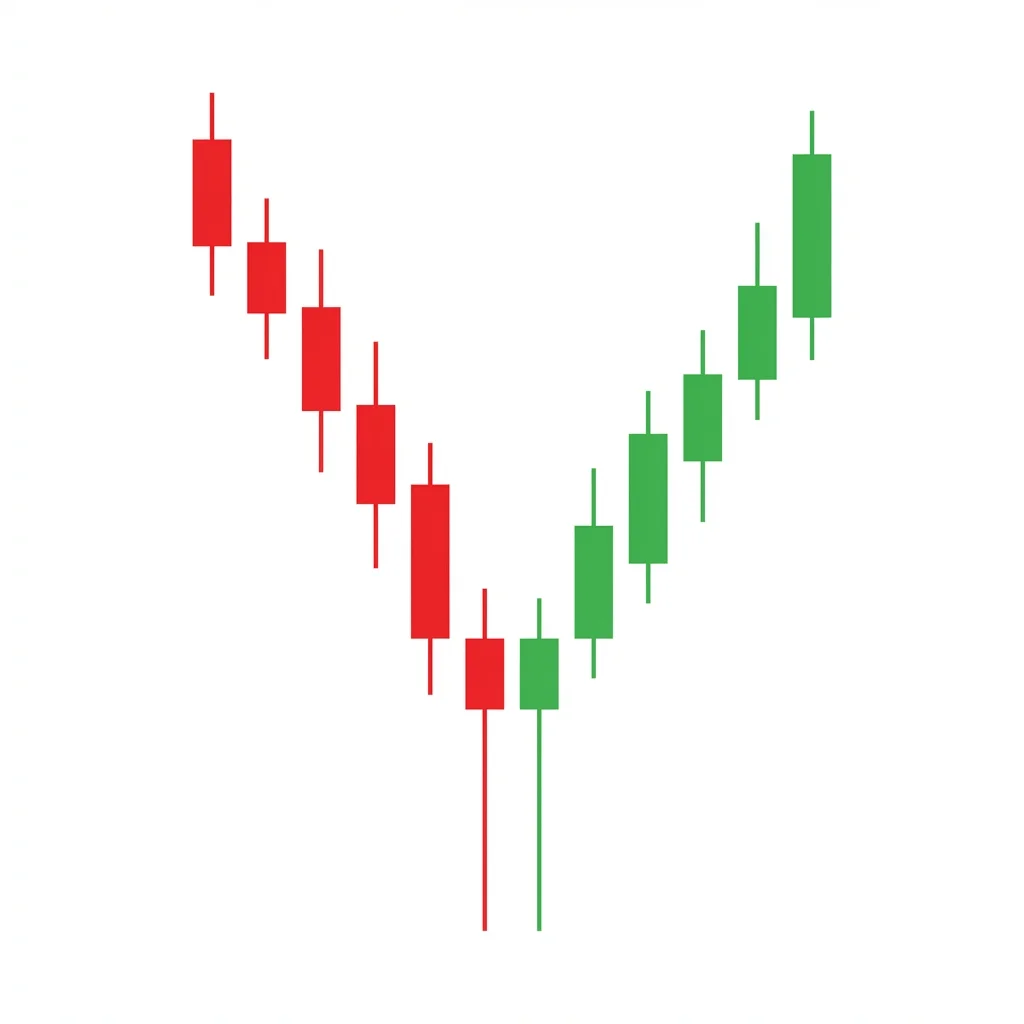
Bullish Pipe Bottom
Also known as: Pipe Formation, Pipe Reversal, Twin Long Shadow Bottom
The Pipe Bottom is a two-candle bullish reversal pattern featuring two adjacent candles with long lower shadows at similar levels, resembling parallel pipes. The double rejection of lower prices creates a powerful support floor signaling a potential bottom.
The Pipe Bottom is a lesser-known but reliable reversal pattern identified by Thomas Bulkowski in his research on chart patterns. It consists of two adjacent candles — typically one bearish and one bullish — both with notably long lower shadows that extend to approximately the same price level. The visual of two long parallel shadows pointing downward resembles pipes, giving the pattern its name. The significance lies in the double rejection: on two separate sessions, sellers pushed price to the same low area and were rejected by aggressive buying both times. This double test of support creates a reliable floor from which a reversal can launch. Bulkowski's research found the Pipe Bottom to be one of the more reliable two-candle reversal patterns.
History & Etymology
The Pipe Bottom was identified and named by Thomas Bulkowski through his extensive statistical analysis of chart patterns. It appears in his 'Encyclopedia of Chart Patterns' and was specifically highlighted for its above-average reliability as a bottom reversal signal.
Named for the visual appearance: the two long lower shadows look like parallel pipes extending downward from the candle bodies. The pattern was coined by Thomas Bulkowski.
How It Forms
Formation Steps
- 1First candle: a candle with a long lower shadow (typically bearish) at the bottom of a downtrend
- 2Second candle: a candle with a similarly long lower shadow at approximately the same level (typically bullish)
- 3Both candles' long shadows create the 'pipe' visual extending below the bodies
Prerequisites
- Prior downtrend
- Two adjacent candles with notably long lower shadows
- The shadows should reach approximately the same low level
- The bodies should be relatively small compared to the shadows
Confirmation Signals
- Third candle closes above the second candle's high
- Volume increases on the second candle or confirmation candle
- The matching shadow lows confirm a strong support floor
Invalidation Signals
- Price breaks below the shadow lows
- Third candle is bearish and closes at new lows
- No bullish follow-through
Candle Breakdown
First Pipe
A candle (usually bearish) with a long lower shadow showing buying rejection of lower prices
Sellers push price sharply lower but encounter strong buying demand that pushes price back up. The first test of support.
Second Pipe
A candle (usually bullish) with a similarly long lower shadow reaching the same approximate level
Sellers try again to push below the same level and are rejected again. The double rejection confirms strong demand and a reliable support floor.
Psychology
The Pipe Bottom represents a double test of buying demand at the same price level across two sessions. When institutional buyers defend the same level twice, it establishes a high-confidence support floor.
Buyer Perspective
Buyers who defended the level on the first candle are validated when price returns and is again rejected. Their confidence in the support level is now very high.
Seller Perspective
Sellers who failed to break through on two attempts lose conviction. The double failure signals that the supply at lower prices is exhausted.
Smart Money Action
Large institutional limit buy orders at a specific price create the parallel shadows. The orders are large enough to absorb selling on two separate sessions.
Retail Trader Trap
Retail bears who tried to sell below the first shadow's low are stopped out when the second test confirms the support.
Emotional Cycle
Trading Strategy
Aggressive Entry
Enter at the close of the second pipe candle (especially if it closes bullish).
Conservative Entry
Wait for a third candle to close above the second candle's high.
Previous swing high or 1:1 R:R.
2:1 R:R.
Measured move equal to the distance from the shadow lows to the body highs.
Best Conditions
- Timeframe: daily
- Timeframe: weekly
- Timeframe: 4h
- at support levels
- oversold conditions
- after extended decline
- Asset: stocks
- Asset: forex
- Asset: indices
- Asset: commodities
Avoid When
- Timeframe: 1m
- Timeframe: 5m
- free-falling markets
- no support structure
- extremely low liquidity
Confluence Factors
- Shadow lows at a known support level
- RSI oversold
- Moving average at the shadow level
- Fibonacci retracement alignment
- Volume confirms buying at the lows
Scale In Strategy
Enter on the second candle, add on the confirmation candle.
Scale Out Strategy
Scale out at each profit target.
Risk Management
Volume Analysis
Volume Confirmation
High volume on both candles (especially the shadows) confirms genuine buying at the support level.
Volume Profile
Volume concentrated at the shadow lows shows institutional defense.
Volume Divergence
Low volume on the shadows reduces the signal's significance.
Technical Confluence
Support Resistance
The shadow lows mark the exact support level — confirmed by two tests.
Fibonacci Levels
Pipe bottom at a Fibonacci retracement adds major confluence.
Moving Averages
The shadows touching the 200-day MA create a powerful setup.
Rsi Confirmation
RSI oversold during both candles, with bullish divergence on the second.
Macd Confirmation
MACD histogram flattening or bullish crossover on the second candle.
Bollinger Bands
Both shadows piercing the lower band show oversold conditions.
Vwap
Shadows below VWAP with bodies above confirm institutional defense.
Ichimoku Cloud
Pipe bottom at cloud support.
Elliott Wave
Can mark the end of corrective waves.
Wyckoff Phase
The double test maps to the test phase in accumulation.
Market Profile
Shadows at the Value Area Low confirm institutional support.
Order Flow
Buy absorption visible at the shadow lows on both candles.
Open Interest
Stable OI confirms the level is being defended, not just stop-hunted.
Multi-Timeframe Analysis
Higher Timeframe Alignment
A daily pipe bottom at weekly support is a strong setup.
Lower Timeframe Entry
After the daily pipe bottom, use 4H for the confirmation entry.
Timeframe Confluence
The shadow low being significant on multiple timeframes strengthens the support.
Top-Down Approach
Identify weekly support, spot daily pipe bottom, enter on 4H confirmation.
Statistics
Historical Examples
Gold Pipe Bottom at $1,620
successGold formed a pipe bottom at the $1,620 support level. Both candles had long lower shadows reaching $1,614 before recovering. Gold rallied $100 from this double test.
Lesson: Pipe bottoms in commodities at major support levels are particularly reliable.
S&P 500 Pipe Bottom
successThe S&P 500 formed a weekly pipe bottom at the October 2022 lows. Two consecutive weeks with long lower shadows confirmed the bottom before a major rally.
Lesson: Weekly pipe bottoms can mark significant market turning points.
Variations
Triple Pipe
Three consecutive candles with long lower shadows at the same level.
Pipe Bottom with Doji
One or both candles are dojis with long lower shadows.
Confusion Matrix
Patterns commonly confused with Bullish Pipe Bottom and how to distinguish them.
Bullish Tweezer Bottom
8500% similarPipe bottom emphasizes the LENGTH of the shadows (both must be notably long). Tweezer bottom focuses on the matching LOW level. There is significant overlap.
Key Differences
- Tweezer bottom focuses on matching session lows
- Pipe bottom focuses on long parallel lower shadows
Bullish Hammer
6500% similarIf it's one candle, it's a hammer. If two adjacent candles have matching long shadows, it's a pipe bottom.
Key Differences
- Hammer is a single candle
- Pipe bottom is two candles with matching long shadows
The bearish pipe top consists of two adjacent candles with long upper shadows reaching similar highs, showing that sellers twice defended a price level. This double rejection signals strong overhead resistance and an impending reversal.
The Double Bottom is one of the most recognized reversal patterns, forming a W-shape where price tests a support level twice and bounces, signaling that sellers cannot push through and buyers are gaining control.
The Bullish Engulfing is one of the most popular and reliable two-candle reversal patterns. A large bullish candle completely engulfs the prior bearish candle body, signaling a decisive shift from selling to buying control.
The Matching Low is a two-candle bullish reversal pattern where two consecutive bearish candles close at the same price, indicating a support level that sellers cannot breach.
The Morning Star is a three-candle bullish reversal pattern consisting of a large bearish candle, a small star candle showing indecision, and a large bullish candle confirming the reversal. It is one of the most widely recognized and reliable bottom reversal signals.
The Confirmed Shooting Star adds a bearish confirmation candle to the classic shooting star, eliminating the ambiguity of the standalone pattern and creating a higher-probability reversal signal at the top of uptrends.
Pro Tips & Common Mistakes
Pro Tips
- Both shadows must be notably long — short shadows don't qualify as pipes
- The shadow lows should be at approximately the same level (within 1-2%)
- Ideally, the first candle is bearish and the second is bullish, showing a sentiment shift
- Volume at the shadow lows (intraday volume profile) confirms genuine buying
- The pipe bottom is essentially a two-candle double bottom — the concept is the same
Common Mistakes
- Accepting candles with short shadows as a pipe bottom — the shadows must be notably long
- Not verifying that the shadow lows are at approximately the same level
- Entering before confirmation when the pattern is not at an established support level
- Placing stops above the shadows instead of below them
- Confusing with random long-shadow candles that are not at the same price level
Advanced Techniques
- Map the shadow lows to the order book to verify institutional limit orders at that level
- Combine with volume-at-price to confirm that heavy trading occurred at the shadow level
- Use the pipe bottom as a component of a larger bottoming formation (like an inverse H&S)
- Track pipe bottom levels as key support for future pullback entries
Institutional Perspective
The pipe bottom reveals the exact price where institutional limit buy orders are resting. The fact that the market probed this level twice and was rejected both times shows the orders are large and persistent. This information is valuable for understanding where institutional demand exists.
Fun Facts
- Thomas Bulkowski's research found the Pipe Bottom to have a 62% success rate, making it above average for two-candle patterns.
- The visual resemblance to parallel pipes extending downward makes this one of the most intuitively named chart patterns.
- The Pipe Bottom is essentially a statistical validation of the common trader observation that 'support confirmed by multiple tests is more reliable.'
Frequently Asked Questions
A two-candle reversal pattern where both candles have notably long lower shadows reaching approximately the same level, like parallel pipes. The double rejection of lower prices confirms strong support.
They are similar, but the Pipe Bottom emphasizes the LENGTH of the shadows (both must be notably long), while the Tweezer Bottom emphasizes the matching LOW level. Pipe Bottom candles typically have more prominent shadows relative to their bodies.
Thomas Bulkowski identified and named the Pipe Bottom pattern through his statistical analysis of chart patterns, documented in his 'Encyclopedia of Chart Patterns.'