
Overview
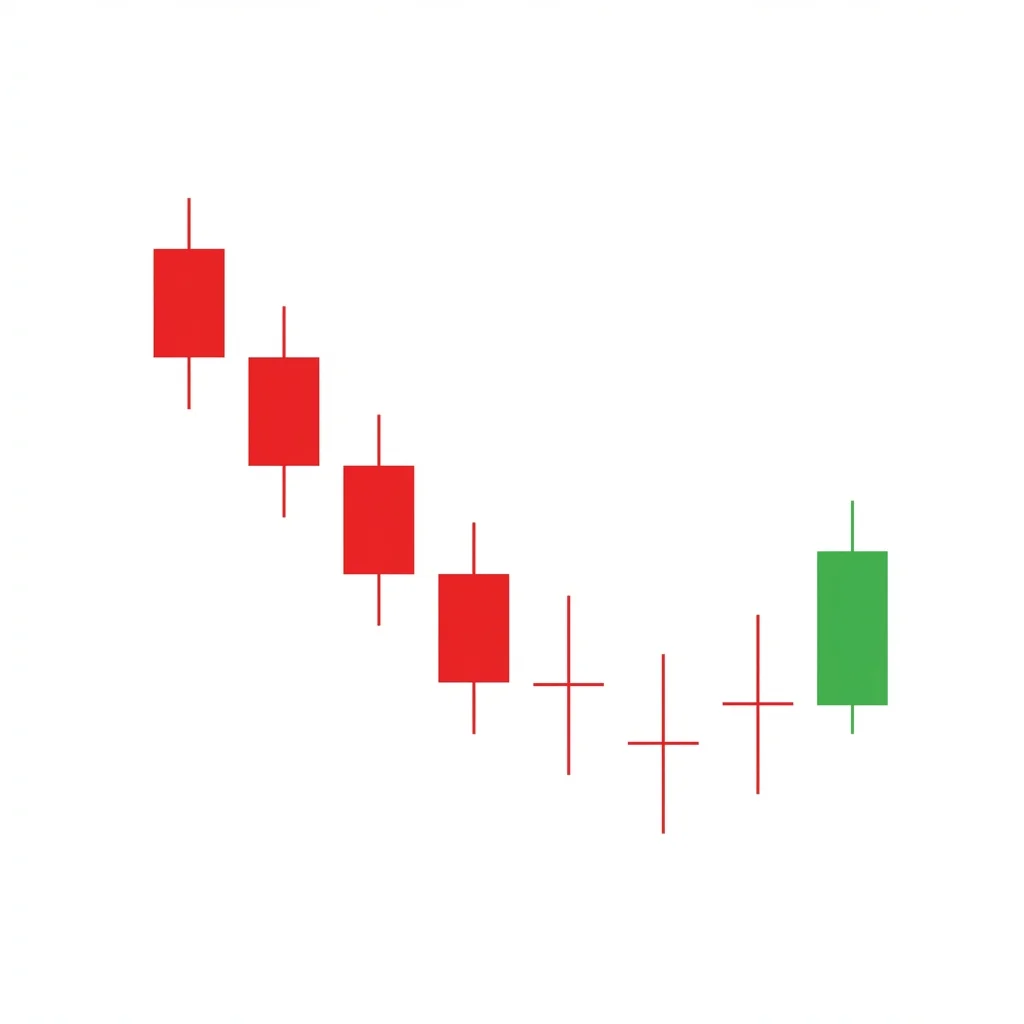
Bullish Tri-Star
Sansei (三星)
Also known as: Triple Doji Star, Three Star Doji
The Bullish Tri-Star is an extremely rare reversal pattern consisting of three consecutive doji candles with the middle one gapping below the others. It signals maximum indecision and a potential major trend reversal.
The Tri-Star is one of the rarest and most significant reversal patterns. Three consecutive dojis show three sessions of perfect balance between buyers and sellers — the market has reached a state of complete indecision. The middle doji gapping below the first and the third gapping back up creates a star formation that signals a major turning point. When this pattern appears at a market bottom after a downtrend, it suggests that selling has completely exhausted itself and a reversal is imminent. Due to its rarity, the Tri-Star is considered highly significant when it does appear.
History & Etymology
The Tri-Star is documented in traditional Japanese candlestick analysis as one of the most powerful reversal signals. Its extreme rarity means that historical documentation focuses more on the theoretical significance than empirical frequency.
Named for the three star-like doji candles. In Japanese candlestick terminology, a doji is called a star when it gaps from the prior candle. Three consecutive stars form the Tri-Star pattern.
How It Forms
Formation Steps
- 1First candle: a doji in a downtrend
- 2Second candle: a doji that gaps below the first doji
- 3Third candle: a doji that gaps above the second doji, back toward the first doji's level
Prerequisites
- Established downtrend
- All three candles are dojis (open and close at the same or nearly the same price)
- The second doji gaps below the first
- The third doji gaps above the second
Confirmation Signals
- Fourth candle is bullish and closes above the first doji's high
- Volume increases on the confirmation candle
- The gap above the second doji holds
Invalidation Signals
- Price continues lower after the third doji
- No follow-through buying
- Volume remains heavy on the downside
Candle Breakdown
First Star (Doji)
A doji candle in the downtrend showing the first sign of indecision
After sustained selling, the first doji shows that bears can no longer push price lower with conviction. Equilibrium emerges.
Second Star (Doji)
A doji that gaps below the first, showing a final push lower that fails to follow through
The gap down on a doji is the market's last attempt to go lower. The inability to close lower than the open confirms complete exhaustion.
Third Star (Doji)
A doji that gaps above the second, showing the beginning of a reversal
The gap up on a third doji shows the market is shifting. Three consecutive sessions of indecision resolve with the upward gap, hinting at a bullish resolution.
Psychology
Three consecutive dojis represent three sessions of perfect equilibrium — a rare event that signals a major inflection point. The gaps create a star formation that marks the transition from bearish to bullish control.
Buyer Perspective
Buyers see three sessions of failed selling as the ultimate sign of exhaustion. The upward gap on the third doji encourages them to enter.
Seller Perspective
Sellers cannot make progress despite the gap down on the second doji. Three sessions of indecision are demoralizing.
Smart Money Action
Institutions recognize the extreme indecision as a sign that all selling pressure is absorbed. They begin positioning before the confirmation candle.
Retail Trader Trap
Retail traders may interpret the three small candles as a pause before continuation lower, missing the reversal signal.
Emotional Cycle
Trading Strategy
Aggressive Entry
Enter long at the close of the third doji.
Conservative Entry
Wait for a bullish fourth candle closing above the first doji's high.
The prior swing low before the downtrend accelerated.
50% retracement of the entire decline.
Previous swing high.
Best Conditions
- Timeframe: daily
- Timeframe: weekly
- at major support
- after extended downtrend
- extreme oversold conditions
- Asset: stocks
- Asset: forex
- Asset: crypto
Avoid When
- Timeframe: 1m
- Timeframe: 5m
- Timeframe: 15m
- mid-range with no trend
- low volatility consolidation
Confluence Factors
- At major support
- Oversold RSI
- Pattern rarity adds significance
- Fibonacci alignment
- Sentiment extremes
Scale In Strategy
Enter on pattern completion, add on confirmation.
Scale Out Strategy
Take half at first target, trail the rest.
Risk Management
Volume Analysis
Volume Confirmation
Volume should be low across all three dojis and expand on the confirmation candle.
Volume Profile
Low volume on the dojis (indecision) followed by high volume on confirmation.
Volume Divergence
High volume on the dojis would reduce the significance of the pattern.
Technical Confluence
Support Resistance
The second doji's low creates a significant support reference.
Fibonacci Levels
Pattern at a Fibonacci retracement adds major significance.
Moving Averages
Near the 200-day MA adds institutional importance.
Rsi Confirmation
RSI at extreme oversold levels with three dojis is very powerful.
Macd Confirmation
MACD bottoming with histogram approaching zero confirms the indecision.
Bollinger Bands
Pattern at the lower Bollinger Band suggests extreme conditions.
Vwap
Pattern near VWAP adds reference.
Ichimoku Cloud
Below the cloud with three dojis marks exhaustion.
Elliott Wave
May mark the end of Wave 5 or complex corrections.
Wyckoff Phase
Can appear during the spring or selling climax phase.
Market Profile
Pattern at a major profile level adds significance.
Order Flow
Near-zero delta on all three candles confirms complete indecision.
Open Interest
Declining OI across the pattern suggests liquidation is complete.
Multi-Timeframe Analysis
Higher Timeframe Alignment
Weekly or monthly Tri-Stars are major reversal signals.
Lower Timeframe Entry
Use the 4-hour chart to time entry within the daily Tri-Star formation.
Timeframe Confluence
Weekly support, daily Tri-Star, 4-hour bullish confirmation.
Top-Down Approach
Higher TF support, daily Tri-Star, lower TF entry timing.
Statistics
Historical Examples
Market Bottom Tri-Star
successSPY formed three consecutive doji-like candles at the December 2018 bottom near $234. The Tri-Star preceded a powerful rally into 2019.
Lesson: Tri-Star patterns at major market bottoms can mark the exact turning point.
Gold Tri-Star
successGold formed a weekly Tri-Star near $1,160 at its 2018 bottom. The pattern preceded a multi-year rally to $2,000+.
Lesson: Weekly Tri-Stars are extremely significant and can mark major multi-year turning points.
Failed in Sideways Market
failureINTC showed three doji-like candles but in a sideways range without a clear downtrend. The pattern did not produce a meaningful reversal.
Lesson: The Tri-Star requires a preceding downtrend to be valid. Dojis in a range are just indecision, not reversal signals.
Variations
Approximate Tri-Star
The three candles are near-dojis with very small bodies rather than exact dojis.
Confusion Matrix
Patterns commonly confused with Bullish Tri-Star and how to distinguish them.
Bullish Morning Doji Star
6500% similarCount the dojis. One middle doji = Morning Doji Star. Three consecutive dojis with gaps = Tri-Star.
Key Differences
- Morning Doji Star has only one doji (the middle candle) with bearish and bullish candles flanking it
- Tri-Star has three consecutive dojis with specific gap requirements
The bearish tri-star is an extremely rare and powerful reversal pattern consisting of three consecutive doji candles, with the middle doji gapping higher. Three sessions of complete indecision at the top of an uptrend signal that buying momentum has evaporated.
The Bullish Doji Star is a two-candle pattern where a doji gaps below a bearish candle, signaling that selling momentum has stalled and a potential reversal is forming.
The Morning Doji Star is a three-candle bullish reversal pattern where a bearish candle, a gapped-down doji, and a strong bullish candle combine to signal a decisive bottom — more powerful than the standard Morning Star due to the doji's complete indecision signal.
The Morning Star is a three-candle bullish reversal pattern consisting of a large bearish candle, a small star candle showing indecision, and a large bullish candle confirming the reversal. It is one of the most widely recognized and reliable bottom reversal signals.
Three Stars in the South is a rare bullish reversal pattern of three progressively smaller bearish candles, each with shorter lower shadows and higher lows, signaling that selling pressure is systematically diminishing.
The Bearish Abandoned Baby is one of the rarest and most reliable top reversal patterns in candlestick analysis. It features a doji that is completely isolated by gaps on both sides, signaling an abrupt and dramatic shift from buying to selling pressure.
Pro Tips & Common Mistakes
Pro Tips
- This is one of the rarest patterns — its appearance at a market bottom should be taken very seriously
- All three candles must be genuine dojis (open and close at nearly the same price)
- The gap structure is essential: the second doji gaps below, the third gaps back up
- The rarity of the pattern itself is part of the signal — markets rarely show three consecutive sessions of perfect indecision at a bottom
- Always combine with other oversold indicators for highest probability
Common Mistakes
- Accepting candles that are not true dojis (significant bodies)
- Not requiring the gap structure between the dojis
- Trading the pattern without a preceding downtrend
- Entering without confirmation from a fourth bullish candle
- Not recognizing the pattern's extreme rarity and significance
Advanced Techniques
- The Tri-Star at a Fibonacci 78.6% retracement is one of the highest probability setups in all of technical analysis
- Combine with options strategies: the low volatility implied by three dojis makes options relatively cheap
- Use the pattern as a portfolio-level signal: a Tri-Star on a major index suggests a broad market turning point
- Track the pattern in multiple timeframes — a weekly Tri-Star is far more significant than a daily one
Institutional Perspective
The three consecutive dojis represent a market in complete equilibrium — a state that is inherently unstable and must resolve in one direction. When this occurs at a bottom with exhausted selling, institutions view it as a signal that the accumulation phase is nearly complete.
Fun Facts
- The Tri-Star may be the single rarest formally defined candlestick pattern, with some databases showing fewer than 10 valid occurrences per year across all major stock markets.
- In Japanese culture, three stars in alignment was considered an extremely auspicious celestial event — the pattern carries this significance.
- Some traders go their entire career without seeing a textbook Tri-Star in real-time.
Frequently Asked Questions
Three consecutive doji candles at a market bottom, with the middle doji gapping below the others. It signals maximum indecision and a potential major reversal.
Extremely rare — one of the rarest patterns in candlestick analysis. The requirement for three consecutive dojis with specific gap structure makes it appear in less than 0.1% of chart formations.