
Overview
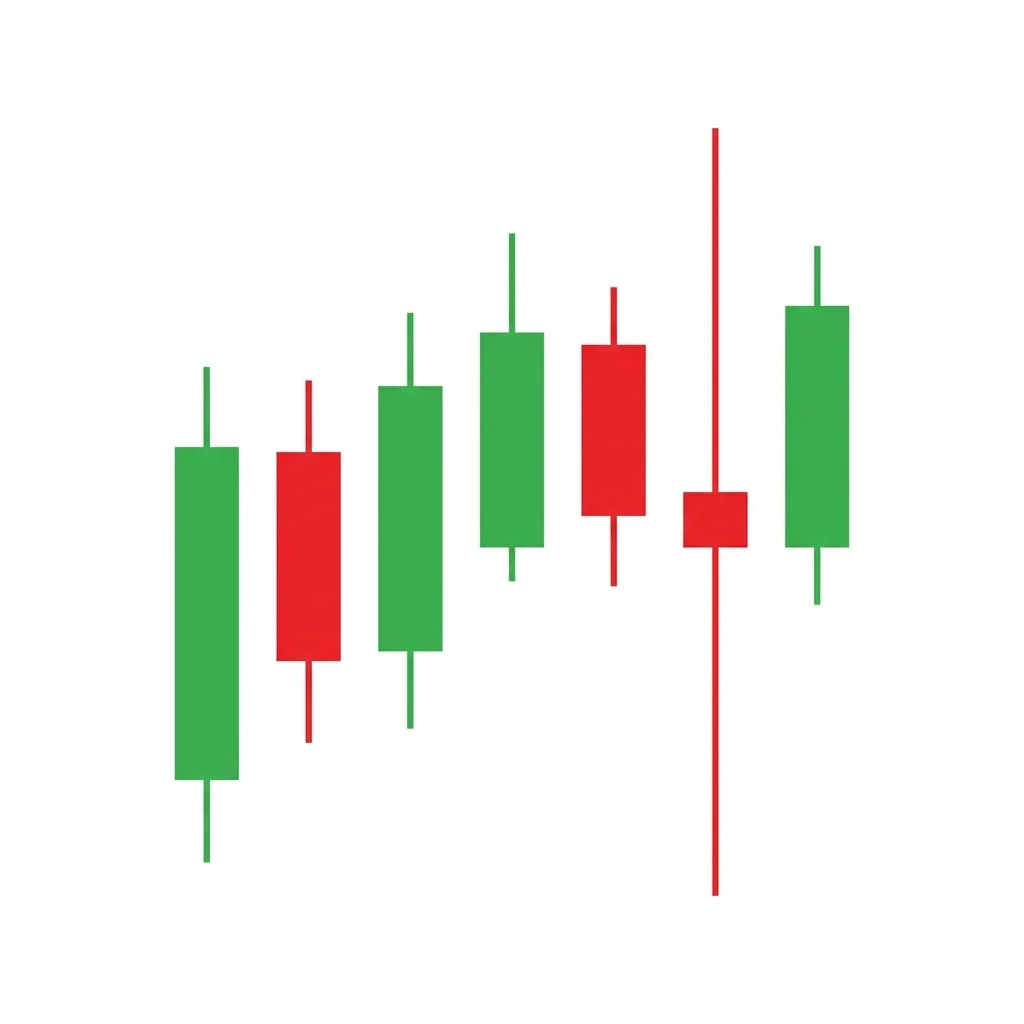
High Wave
Takuri (たくり)
Also known as: High Wave Candle, Long Shadow Candle, Extreme Indecision Candle
The High Wave candle features a small body with extremely long upper and lower shadows, signaling intense intraday volatility and extreme indecision that often precedes a significant directional move.
The High Wave candle is characterized by its small real body flanked by exceptionally long shadows in both directions. Unlike a standard spinning top with moderate shadows, the High Wave's shadows are disproportionately long, indicating that price swung wildly during the session but ultimately closed near the open. This extreme volatility without resolution creates one of the strongest indecision signals in candlestick analysis. The pattern suggests that both buyers and sellers made aggressive attempts to control the market but neither succeeded. When appearing after a trend, the High Wave is a powerful warning that momentum is exhausting and a significant move is likely imminent.
History & Etymology
The High Wave candle concept originates from Japanese rice trading and is related to the 'takuri' line. Modern technical analysts distinguish it from the spinning top by the exceptional length of its shadows, recognizing it as a more extreme form of indecision.
The name 'High Wave' refers to the extreme price oscillation during the session, resembling the crest and trough of a high ocean wave. The Japanese term 'takuri' relates to the idea of feeling out or testing both sides of the market.
How It Forms
Formation Steps
- 1Single candle with a small real body (can be bullish or bearish)
- 2Very long upper shadow extending well above the body
- 3Very long lower shadow extending well below the body
Prerequisites
- Upper and lower shadows must be significantly longer than the real body
- Shadows should be among the longest of recent candles
- Can appear in any trend context
Confirmation Signals
- Decisive directional candle on the following session
- Volume increase on the confirmation candle
- Break above the high-wave high or below the high-wave low
Invalidation Signals
- Another indecision candle follows with no resolution
- Price stays within the high-wave range for multiple sessions
- Volume continues declining
Candle Breakdown
High Wave Candle
A small-bodied candle with extremely long shadows in both directions, showing violent intraday price swings that resolved near the open
The session experienced extreme emotional swings. Bulls and bears each had their moment of control, but the session ended with neither side claiming victory. The wild price action reflects panic and aggression from both camps.
Psychology
The High Wave candle represents the most extreme form of intraday indecision. Both buyers and sellers pushed prices to extreme levels during the session, creating massive volatility, but the closing price near the open shows the market was unable to commit to either direction.
Buyer Perspective
Buyers pushed price to significant highs during the session, showing strong demand exists. However, they could not maintain the rally, suggesting resistance at higher levels or profit-taking pressure.
Seller Perspective
Sellers drove price to significant lows during the session, demonstrating heavy selling pressure. However, they could not keep price depressed, indicating demand at lower levels.
Smart Money Action
Smart money uses the extreme volatility of the High Wave to execute large orders in both directions — selling into the highs and buying into the lows — essentially providing liquidity to emotional retail participants.
Retail Trader Trap
Retail traders are whipsawed repeatedly during the session, buying the highs and selling the lows. The emotional toll leads many to exit positions entirely, creating the liquidity institutions exploit.
Emotional Cycle
Trading Strategy
Aggressive Entry
Enter in the expected direction at the close of the high wave, using the opposite shadow extreme as the stop.
Conservative Entry
Wait for a decisive close beyond the high-wave high or low on the next candle before entering.
1:1 risk-reward (note: the wide range makes this a significant absolute move).
Next major support or resistance level.
Measured move equal to the full high-wave range.
Best Conditions
- Timeframe: daily
- Timeframe: 4h
- Timeframe: weekly
- after extended trends
- at major support/resistance
- during high-volatility events
- Asset: stocks
- Asset: forex
- Asset: crypto
- Asset: commodities
Avoid When
- Timeframe: 1m
- Timeframe: 5m
- Timeframe: 15m
- choppy markets with frequent high waves
- during news-driven random volatility
Confluence Factors
- High wave forms at a major support or resistance level
- RSI divergence at the pattern location
- Bollinger Band extreme touch by the shadow
- Key Fibonacci level alignment
- Volume spike accompanying the pattern
Scale In Strategy
Enter a small position at the high wave close, add on confirmation candle if it breaks in the expected direction.
Scale Out Strategy
Exit half at 1:1 R:R, trail the remainder with a wide stop.
Risk Management
Volume Analysis
Volume Confirmation
High volume on the high wave itself confirms genuine participation. Even higher volume on the breakout candle validates the direction.
Volume Profile
Heavy volume at both shadow extremes indicates aggressive participation. If volume concentrated at one extreme, that direction has the edge.
Volume Divergence
Declining volume during the trend leading to a high volume High Wave candle is a powerful exhaustion signal.
Technical Confluence
Support Resistance
High wave candles at major support/resistance create the most significant indecision signals. The shadow extremes mark new support/resistance levels.
Fibonacci Levels
If the shadows test both the 38.2% and 61.8% retracement levels, the market is actively testing the Fibonacci framework.
Moving Averages
A high wave candle at a major moving average confluence suggests the market is violently testing trend definition levels.
Rsi Confirmation
RSI whipsaw during the High Wave session typically settles near 50, confirming the indecision. Divergence increases reversal probability.
Macd Confirmation
MACD histogram flip during the session reflects the tug-of-war. A subsequent histogram expansion confirms the breakout direction.
Bollinger Bands
High wave shadows often touch or exceed both Bollinger Bands, creating a classic volatility expansion signal.
Vwap
Price crossing VWAP multiple times during the session reflects the indecision. The final VWAP position relative to close suggests directional bias.
Ichimoku Cloud
High wave candles spanning the Kumo cloud from top to bottom indicate a major battle at the cloud boundary.
Elliott Wave
High Wave candles frequently mark the terminal candle of Wave 5, reflecting the climactic battle before a reversal.
Wyckoff Phase
May represent the Selling Climax or Buying Climax in Wyckoff, where extreme volume and range signal a potential turn.
Market Profile
The High Wave session creates a wide profile with a single distribution, indicating rejection of both extremes.
Order Flow
Massive delta swings during the session, with the cumulative delta near zero, confirm the bilateral aggression.
Open Interest
Significant open interest changes during a High Wave session suggest major position restructuring.
Multi-Timeframe Analysis
Higher Timeframe Alignment
A daily High Wave at a weekly support/resistance level is a significant event that often leads to a multi-day move.
Lower Timeframe Entry
After a daily High Wave, use the 1-hour chart to identify the breakout direction as the range resolves.
Timeframe Confluence
High Wave appearing on multiple timeframes simultaneously signals extreme market uncertainty and an imminent large move.
Top-Down Approach
Weekly trend provides directional bias. Daily High Wave identifies the inflection point. 4-hour chart provides the entry after the range breaks.
Statistics
Historical Examples
S&P 500 High Wave Before Correction
successSPX printed a high wave candle near all-time highs with a 90-point intraday range. The following sessions saw a significant decline.
Lesson: High wave candles at trend extremes with high volume are among the most reliable exhaustion signals.
Gold High Wave at Resistance
successGold printed a massive high wave candle at $2,080 resistance with a $50 intraday range. Price reversed and declined to $1,980 over the next two weeks.
Lesson: High wave candles at well-established resistance often resolve to the downside as buyers exhaust themselves.
Tesla High Wave Mid-Range
failureTSLA formed a high wave candle in the middle of its trading range. Price continued to chop sideways for another two weeks with no clear direction.
Lesson: High wave candles in the middle of ranges often lead to more indecision rather than directional breakouts.
Variations
Bullish High Wave
A High Wave where the close is slightly above the open, giving a marginal bullish bias.
Bearish High Wave
A High Wave where the close is slightly below the open, giving a marginal bearish bias.
Confusion Matrix
Patterns commonly confused with High Wave and how to distinguish them.
Neutral Spinning Top
7500% similarCompare shadow lengths to the average of recent candles. If shadows are more than 2x the average range, it is a High Wave.
Key Differences
- Spinning Top has moderate shadow lengths
- High Wave has exceptionally long shadows relative to the body and recent candles
Neutral Long Legged Doji
8000% similarCheck for a real body. If open and close are identical, it is a Long-Legged Doji. If there is a small body, it is a High Wave.
Key Differences
- Long-Legged Doji has no real body (doji)
- High Wave has a small but visible real body
The Doji is the quintessential indecision candle where opening and closing prices are virtually identical, reflecting a perfect tug-of-war between buyers and sellers.
The Long-Legged Doji features extremely long shadows in both directions with the open and close near the center, representing the most extreme form of single-candle indecision and a potent warning of momentum exhaustion.
The Rickshaw Man is a specialized long-legged doji where the open and close are positioned exactly at the midpoint of the candle's range, representing the purest expression of market indecision with perfectly balanced shadows.
The Spinning Top is one of the most common candlestick patterns, featuring a small real body with shadows on both sides, indicating mild to moderate indecision where neither buyers nor sellers gained meaningful ground.
The Bearish Belt Hold is a single bearish candle that opens at its high and closes near its low with a long body, indicating that sellers dominated from the opening bell and controlled price action throughout the session.
The Bearish Closing Marubozu is a single bearish candle with no lower shadow — the close is at the exact low of the session. This indicates that sellers controlled the session and maintained pressure through the very last trade, a sign of strong bearish conviction.
Pro Tips & Common Mistakes
Pro Tips
- The High Wave is most significant at trend extremes and major technical levels — mid-range appearances are often noise
- Use the shadow extremes as the breakout range: a close above the high or below the low triggers the trade
- Reduce position size to account for the wider stop loss required by the extreme range
- High volume on the High Wave itself increases its significance as a potential turning point
- Look for the High Wave after 3+ consecutive trend candles for the strongest exhaustion signal
Common Mistakes
- Using the full High Wave range as a stop loss without adjusting position size, leading to oversized risk
- Trading every High Wave without considering its location within the broader price structure
- Entering before the next candle confirms the direction of the breakout
- Confusing news-driven volatile candles with genuine indecision High Wave patterns
- Ignoring that High Wave candles in choppy markets are noise, not signals
Advanced Techniques
- Use the High Wave shadow extremes as future support and resistance levels for trade planning
- Combine with volume-at-price analysis to determine which shadow extreme attracted more institutional interest
- Trade the breakout-retest: wait for a break of the High Wave range, then enter on the pullback to the breakout level
- Use the High Wave as a volatility expansion alert for options strategies
Institutional Perspective
Institutions use High Wave sessions to sweep both sides of the order book, triggering stops above and below. This creates liquidity for large position entries. The true directional move begins after the High Wave when the institution has completed its accumulation or distribution.
Fun Facts
- The High Wave candle produces the widest intraday range of any indecision pattern, often exceeding the range of several prior candles combined.
- In Japanese charting, the High Wave was considered an omen of market chaos, and traders were advised to stand aside until clarity returned.
- High Wave candles on the weekly chart are among the rarest and most significant single-candle patterns in technical analysis.
Frequently Asked Questions
A High Wave candle has a small real body with very long upper and lower shadows, indicating extreme intraday volatility where both buyers and sellers pushed price aggressively but neither maintained control.
Both have small bodies, but the High Wave has disproportionately long shadows that are significantly larger than the average candle range. A Spinning Top has moderate shadows.
At the end of extended trends and at major support/resistance levels. High Wave candles mid-range or in choppy markets are usually noise.