
Overview
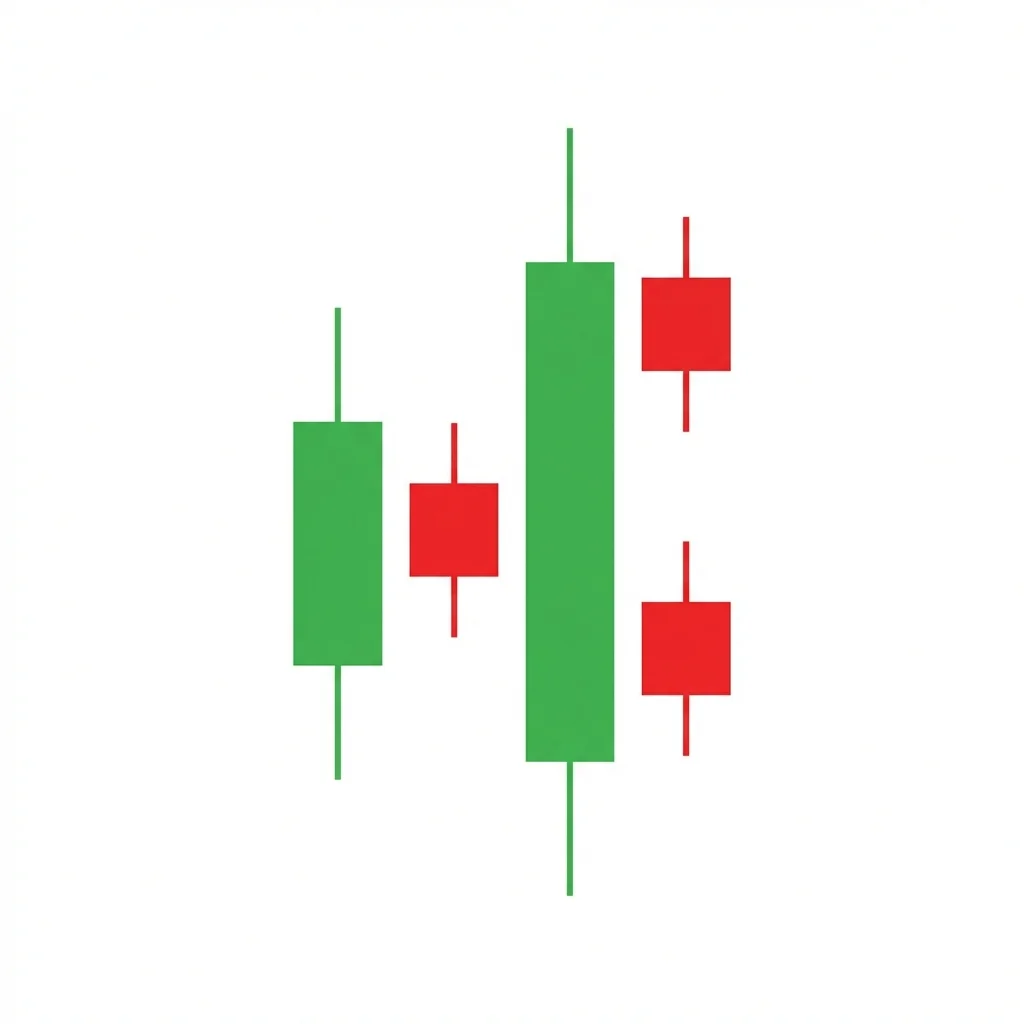
Inside-Outside-Inside
Also known as: IOI Pattern, Sandwich Pattern, Compression-Expansion-Compression
The Inside-Outside-Inside (IOI) is a three-candle pattern where an inside bar is followed by an outside bar and then another inside bar, creating a compression-expansion-compression sequence that often precedes a significant breakout.
The IOI pattern represents one of the most sophisticated compression setups in price action trading. The first inside bar shows initial consolidation, the outside bar then expands the range dramatically (testing both sides of the market), and the third candle contracts again within the outside bar's range. This creates a rhythmic breathing pattern — compression, expansion, compression — that coils the market for a powerful directional move. The outside bar effectively establishes a new range by sweeping liquidity on both sides, while the final inside bar confirms that the market has absorbed this information and is ready to commit to a direction.
History & Etymology
The IOI pattern was popularized by price action trading communities in the 2010s. It draws from both Japanese candlestick analysis (harami and engulfing concepts) and Western bar chart analysis (inside/outside day patterns). The pattern gained recognition as traders identified the rhythmic nature of market compression and expansion.
Named descriptively for its three components: Inside bar, Outside bar, Inside bar — hence 'Inside-Outside-Inside' or 'IOI'.
How It Forms
Formation Steps
- 1First candle: establishes the initial range
- 2Second candle (outside bar): range exceeds the first candle's range on both sides
- 3Third candle (inside bar): range fits entirely within the second candle's range
Prerequisites
- Second candle must engulf the first candle's full range (outside bar)
- Third candle's range must fit within the second candle's range (inside bar)
- The sequence creates a clear compression-expansion-compression rhythm
Confirmation Signals
- Fourth candle breaks beyond the outside bar's high or low with volume
- Break in the direction of the prevailing trend
- Volume surge on the breakout candle
Invalidation Signals
- Price continues to chop within the outside bar range
- Multiple failed breakout attempts from the outside bar range
- Volume remains low with no resolution
Candle Breakdown
First Inside Bar
The initial candle that establishes the base range, often appearing as a consolidation within the prior trend
The market is digesting recent price action. Activity contracts as participants await new information.
Outside Bar
A large candle that exceeds the first candle's range on both sides, testing liquidity above and below
The market explodes with activity, testing both directional extremes. Both bull and bear stops are triggered, creating a liquidity sweep.
Second Inside Bar
A candle that contracts within the outside bar's range, showing the market has absorbed the volatility and is ready to commit
After the chaos of the outside bar, the market calms. Participants have been shaken out, and the remaining committed traders prepare for the next move.
Psychology
The IOI pattern reflects a market that breathes in (compression), breathes out (expansion), and breathes in again (compression). The outside bar acts as a volatility flush, clearing weak hands on both sides. The final inside bar shows that after this flush, the market has found equilibrium and is ready for a decisive move.
Buyer Perspective
Buyers who survived the outside bar's downside test are emboldened. The inside bar after the flush provides a low-risk entry opportunity with the stop placed at the outside bar's low.
Seller Perspective
Sellers who survived the outside bar's upside test see the compression as an opportunity. The inside bar offers defined risk with the stop at the outside bar's high.
Smart Money Action
Institutional traders engineer the outside bar to trigger stops on both sides, creating liquidity. They then use the second inside bar's quiet session to finalize their positioning before triggering the breakout.
Retail Trader Trap
Retail traders get whipsawed during the outside bar — those who sold the lows get stopped out on the high, and those who bought the highs get stopped on the low. Many exit entirely, missing the actual move.
Emotional Cycle
Trading Strategy
Aggressive Entry
Enter on a break of the second inside bar's range in the anticipated direction.
Conservative Entry
Wait for a close beyond the outside bar's high or low before entering.
Measured move equal to the outside bar's range projected from the breakout.
Next major support or resistance level.
2x the outside bar range as a measured move.
Best Conditions
- Timeframe: daily
- Timeframe: 4h
- trending markets with pullbacks
- at major decision levels
- before breakout moves
- Asset: forex
- Asset: stocks
- Asset: indices
Avoid When
- Timeframe: 1m
- Timeframe: 5m
- Timeframe: 15m
- choppy ranging markets
- low volatility environments
- holiday trading
Confluence Factors
- IOI forms at a key support or resistance level
- The outside bar sweeps a clearly defined liquidity zone
- The prevailing trend supports the breakout direction
- Moving average confluence at the pattern location
- RSI divergence present at the pattern
Scale In Strategy
Enter on the second inside bar breakout with a small position, add on the outside bar range breakout confirmation.
Scale Out Strategy
Exit one-third at each take profit level.
Risk Management
Volume Analysis
Volume Confirmation
Volume should spike on the outside bar, decline on the second inside bar, and surge again on the breakout.
Volume Profile
The ideal volume sequence is: low, high, low, HIGH — matching the compression-expansion-compression-breakout rhythm.
Volume Divergence
If the outside bar has low volume, the pattern is less reliable as the liquidity sweep may not have been thorough.
Technical Confluence
Support Resistance
IOI at support/resistance with the outside bar sweeping beyond the level and recovering is an extremely strong setup.
Fibonacci Levels
IOI forming at a 61.8% retracement with the outside bar testing and rejecting it creates a high-probability entry.
Moving Averages
IOI at a major moving average where the outside bar briefly violates the MA and recovers signals a false breakdown/breakout.
Rsi Confirmation
RSI whipsaw during the outside bar followed by stabilization during the second inside bar confirms the pattern.
Macd Confirmation
MACD signal line crossing during the outside bar with compression during the inside bar validates the setup.
Bollinger Bands
The outside bar touching both Bollinger Bands followed by Band contraction on the inside bar is a powerful combination.
Vwap
The outside bar sweeping above and below VWAP with the inside bar settling near VWAP confirms the equilibrium.
Ichimoku Cloud
IOI at the Kumo cloud boundary with the outside bar piercing the cloud and the inside bar closing outside creates direction.
Elliott Wave
IOI frequently forms at the junction of Wave 4 and Wave 5 initiation points.
Wyckoff Phase
The outside bar can represent a Spring or Upthrust, with the second inside bar being the Test before markup/markdown.
Market Profile
The outside bar creates a wide profile. The inside bar's narrow range shows value acceptance before migration.
Order Flow
The outside bar shows massive bilateral flow. The inside bar shows balanced, diminished flow. The breakout shows directional flow.
Open Interest
Open interest changes during the outside bar (shakeout) followed by rebuilding during the inside bar confirm the pattern.
Multi-Timeframe Analysis
Higher Timeframe Alignment
A daily IOI at a weekly support/resistance level is a rare and extremely high-probability setup.
Lower Timeframe Entry
After identifying a daily IOI, use the 1-hour chart to enter on the first break of the second inside bar range.
Timeframe Confluence
An IOI on the daily and a corresponding pattern on the 4-hour chart create multi-timeframe alignment.
Top-Down Approach
Weekly trend determines bias. Daily IOI provides the setup. 4-hour chart provides the precise entry timing.
Statistics
Historical Examples
GBP/USD IOI at Key Support
successGBP/USD formed a textbook IOI at 1.1800 support. The outside bar swept below support and recovered. The breakout above the outside bar high yielded a 300-pip rally.
Lesson: IOI patterns at key levels with the outside bar sweeping liquidity produce powerful reversal moves.
Nvidia IOI Before Earnings
successNVDA formed an IOI pattern before its May 2023 earnings. The breakout above the outside bar high preceded the massive AI-driven rally.
Lesson: IOI patterns before major catalysts can position traders for life-changing moves.
Bitcoin IOI False Signal
failureBTC formed an IOI near $29,000. The bearish breakout triggered but quickly reversed above the outside bar high, trapping shorts.
Lesson: IOI false breakouts require quick stop execution. Always respect the outside bar range as the invalidation level.
Variations
Bullish IOI
An IOI where the second inside bar closes in the upper half of the outside bar's range, suggesting bullish bias.
Bearish IOI
An IOI where the second inside bar closes in the lower half of the outside bar's range, suggesting bearish bias.
Confusion Matrix
Patterns commonly confused with Inside-Outside-Inside and how to distinguish them.
Neutral Inside Bar
5500% similarCount the candles. If there is an outside bar between two inside bars, it is an IOI. A simple inside bar is just two candles.
Key Differences
- Inside Bar is a two-candle pattern; IOI is three candles
- IOI includes the outside bar liquidity sweep component
- IOI is generally more reliable due to the added complexity
The Inside Bar is a two-candle pattern where the second candle's entire range is contained within the first candle, signaling a contraction in volatility and a pending breakout in either direction.
The Squeeze Breakout occurs when volatility compresses to extreme levels (tight Bollinger Bands or low ATR) before an explosive directional move, representing the market's transition from consolidation to trending.
The Tight Coil is a multi-candle pattern where each successive candle has a smaller range than the last, creating a coiled-spring effect that typically precedes an explosive directional breakout.
The Volatility Contraction Pattern (VCP) shows progressively smaller price swings as ATR declines, signaling that the market is absorbing supply and preparing for a significant directional breakout.
The Bearish Abandoned Baby is one of the rarest and most reliable top reversal patterns in candlestick analysis. It features a doji that is completely isolated by gaps on both sides, signaling an abrupt and dramatic shift from buying to selling pressure.
The Bearish Advance Block shows three consecutive bullish candles with progressively smaller bodies and longer upper shadows, signaling that buying momentum is weakening and a reversal or consolidation is likely.
Pro Tips & Common Mistakes
Pro Tips
- The outside bar is the key candle — it sweeps liquidity on both sides and sets the breakout range
- Trade the IOI breakout in the direction of the prevailing trend for highest probability
- The second inside bar's close position provides a directional clue — a close near the upper half favors upside
- Volume sequence should follow the pattern: quiet, loud, quiet, LOUD for optimal setups
- Use the tight stop (second inside bar boundary) for aggressive risk-reward ratios of 3:1 or better
Common Mistakes
- Entering during the outside bar when volatility is highest and stops are being swept
- Failing to recognize that the outside bar is a liquidity event, not a directional signal
- Using stops that are too tight within the second inside bar range
- Ignoring the trend context when choosing breakout direction
- Missing the pattern because the outside bar looks like a reversal rather than part of a three-candle structure
Advanced Techniques
- Use the outside bar's high and low as the key liquidity levels — these become significant support/resistance after breakout
- Monitor order flow during the outside bar to determine which side absorbed more aggressive orders
- Combine with the 'fakey' concept: if the initial breakout fails, trade the reversal through the opposite side
- Layer the IOI with Bollinger Band squeeze for the highest conviction breakout setups
Institutional Perspective
The IOI is a textbook institutional play. The outside bar is often engineered to sweep retail stops on both sides, creating the liquidity needed for large institutional orders. The second inside bar represents the final accumulation phase before the markup. Watch for unusual options activity during IOI formation.
Fun Facts
- The IOI pattern is sometimes called the 'institutional shakeout' pattern because the outside bar is believed to trigger stops on both sides before the real move begins.
- Professional trader Linda Raschke referenced compression-expansion-compression dynamics as one of the most reliable setups in her trading career.
- The IOI pattern appears roughly once every 20-30 daily candles in major forex pairs, making it uncommon enough to be significant but frequent enough to be tradable.
Frequently Asked Questions
The IOI is a three-candle pattern: an inside bar, followed by an outside bar that exceeds the first candle's range, followed by another inside bar within the outside bar's range. It signals compression-expansion-compression before a breakout.
The outside bar sweeps liquidity on both sides, clearing weak positions. The second inside bar shows the market has absorbed this volatility. The resulting breakout tends to be cleaner because the liquidity has already been harvested.
Trade in the direction of the prevailing trend for the highest probability. The close position of the second inside bar can also provide a directional clue.